"Turning the Direction of View": The May-Ayim-Ufer
"The Empire writes back" – this title of a central classic of postcolonial thinking succinctly sums up what the May-Ayim-Ufer in Berlin Kreuzberg stands for today, namely a monument against racism as a result of German and European imperialism and colonialism. The embankment symbolises the boomerang-like movement of postcolonial remembrance: while this place was named after Otto von der Groeben, a German colonial pioneer, was named after Otto von der Groeben , a German colonial pioneer, a good hundred years later the ghosts of the former colonial peripheries pushed into the formerly colonial metropolises such as Berlin to commemorate the injustices suffered. Since the official renaming by the Friedrichshain-Kreuzberg district council in 2010, the quay has commemorated the Black German author and feminist May Ayim, who made her experiences of racism and exclusion in Germany the driving force behind her writing and activism. Development NGOs and interest groups of Africans and Afro-Germans such as AfricAvenir, the Initiative Schwarze Menschen in Deutschland, the Werkstatt der Kulturen and the Berlin Development Policy Council as well as the Alliance 90/The Greens initiated this project and, with the votes of the SPD and the Left Party, made it the first successful, albeit still controversially discussed, postcolonial street renaming in reunified Germany.
From the very beginning, street renaming has played a central role in Germany's reappraisal of its long-suppressed colonial past. [2] In the meantime, several streets in Berlin and other German cities have been renamed or are about to do so. The dispute and debate about it have not stopped. Nevertheless, May-Ayim-Ufer is now a place of remembrance for the reappraisal of Germany's colonial history. At the same time, this street is of great importance for the power of words, literature and commitment against a centuries-long process of dehumanization, which is what the colonial chapter in German and European history stands for.
Otto von der Groeben and German Colonialism
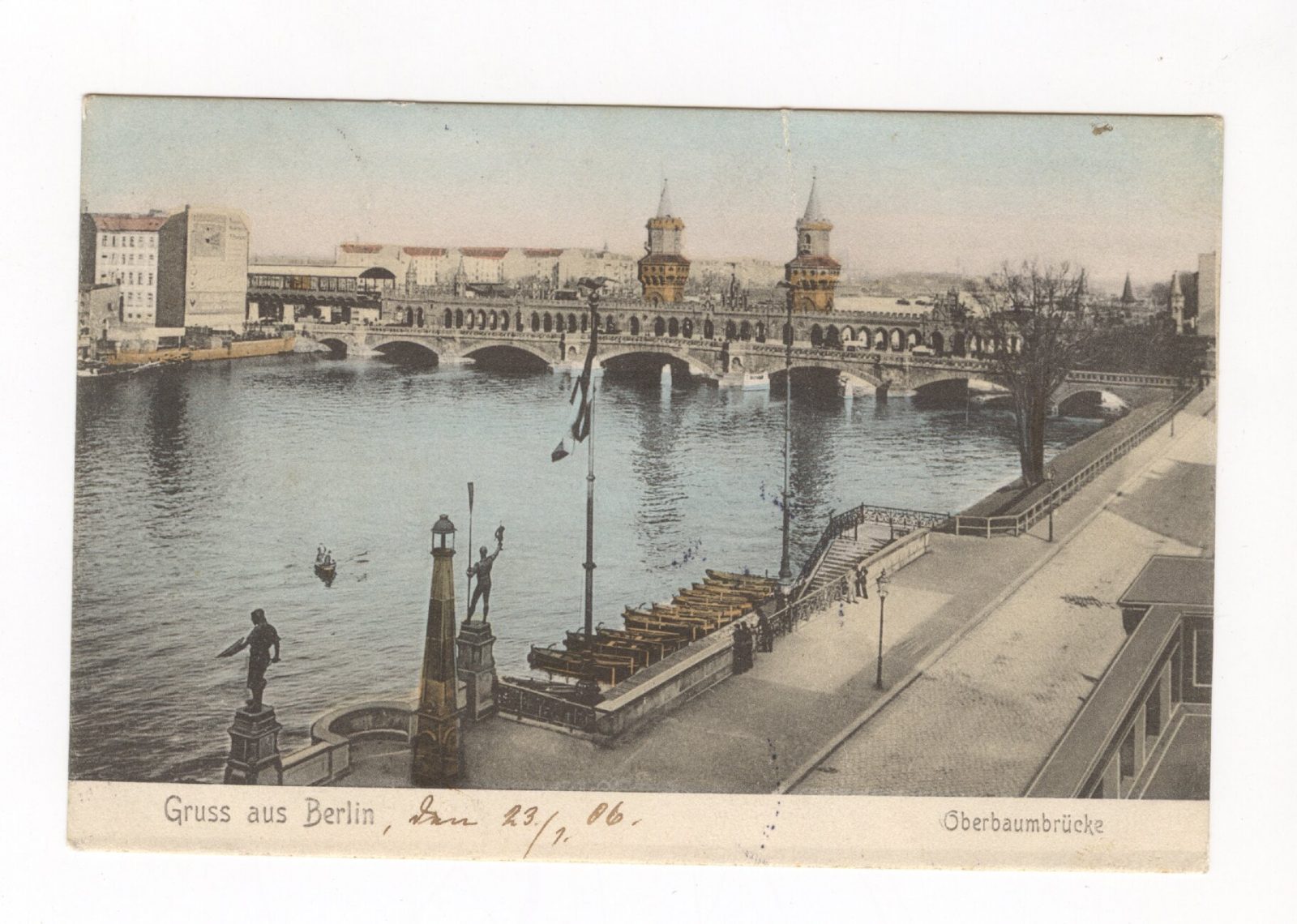
It all began with a nearby wooden bridge that connected Friedrichshain and Kreuzberg over the Spree, was used for customs purposes and to which today's Oberbaum Bridge owes its name. In 1895, ten years after the division of the African continent among the European powers at the Berlin Conference, Kaiser Wilhelm II personally named the street "Gröbenufer" after Otto Friedrich von der Groeben (1656–1728). In doing so, he snatched this place from its twilight state and at the same time signalled the revival of the expansionist, overseas side of Brandenburg's history. The enormous push for industrialisation and modernisation in the German Empire had awakened the desire to continue this tradition and, similar to other European powers, to gain access to resources and markets in its own colonies.
In 1682, Groeben had led the expedition to the African Guinea coast on behalf of Elector Friedrich Wilhelm von Brandenburg (1620–1688) to establish a trading base for Brandenburg-Prussia. Like many Europeans at the time, the Brandenburgers were striving for economic expansion by participating in the emerging overseas trade, whereby they were mainly interested in acquiring gold, ivory, pepper and slaves. During his stay in the Netherlands, Elector Frederick William of Brandenburg had been able to observe the advantages of trade overseas. His uncle and role model, James II, Duke of Courland (1610–1681), also "owned" a colony at the mouth of the Gambia.
Otto von der Groeben, born in 1656 in Napraten in Warmia, the son of a Brandenburg officer, brought good conditions for the Elector's planned expedition, as he had already undertaken numerous journeys in Italy, Malta, Egypt, Palestine, Cyprus, Spain, France and England from the age of 17. Under his leadership, two frigates named Moriaen and Churprinz von Brandenburg sailed from Glückstadt on the Elbe to the west coast of Africa in 1682. There, near today's Princess Town, Otto von der Groeben commanded the construction of the Groß-Friedrichsburg station, thus laying the foundation for the first "German" colony in today's Ghana, which lasted until 1717, for a lively barter trade and for Brandenburg-Prussia's entry into the transatlantic slave trade: handguns, ammunition, simple iron products and also ruby glass were exchanged for ivory, gold and enslaved people. On the two frigates under his command, enslaved people were to be deported to Europe and as far as America. [3] When he returned in the summer of 1683 with the Moriaen, the Elector honored him as the founder of the first Brandenburg colony and rewarded him with the candidacy of the Amtshauptmannschaft over Marienwerder and Riesenburg.
Even though the trade in Groß Friedrichsburg ultimately proved not to be as profitable as hoped, the initial development of the trade in precious metals, other raw materials and enslaved people was initially positive from a Brandenburg point of view. As early as 1686, Elector Friedrich Wilhelm was able to satisfy his economic partners with a severance payment and take over the management of the Brandenburg-African Company alone. In order to allow the slave trade from Africa to flourish, the Brandenburgers arranged for a settlement in the Caribbean: in 1685, the Electoral Brandenburg naval director general Benjamin Raule (1634–1707) reached an agreement with representatives of the Danish West India Company on the leasing of part of the Caribbean island of St. Thomas to Brandenburg. With such advances, Elector Friedrich Wilhelm was not only involved in the transatlantic slave trade, but also became one of "the spiritual fathers of German colonial policy from 1884/85 to 1918/19". [5]
The Gröbenufer and the Trade and Colonial Exhibition in the German Empire
The colonial ambitions of the German Empire were expressed not only by the naming of the Uferstraße, but also by the trade and colonial exhibition that took place in the immediate vicinity from 1 May to 15 October 1896 in Berlin Treptow, which in turn was connected to the Gröbenufer. As part of the planning for the exhibition, two piers had been created here – from the double quay, interested persons could travel directly by ship to the colonial exhibition, passing the neo-Gothic, "German-looking Oberbaumbrücke" and then symbolically entering international waters. Parts of the complex (it was badly damaged in the Second World War) have been restored and accessible after restoration between 2009 and 2011 – the former waiting halls for boat traffic are now a restaurant.
Like hardly any other event, world exhibitions at the end of the 19th century represented the epitome of absolute modernity and expressed the claims to power of European states. The first world exhibition took place in 1851 in London's Hyde Park under the title "Great Exhibition of the Works of Industry of All Nations". France also organised an "Exposition Universelle" in Paris in 1867, and the USA in 1876 in Philadelphia the "International Exhibition of Arts, Manufactures and Products of the Soil and Mine". Driven by a belief in progress and nationalistic competitiveness, they served the presentation of inventions, technical and industrial products, the exchange of knowledge and national staging.
Since the founding of the German Empire, German industrialists, bankers and businessmen in particular have claimed to hold an international exhibition on German soil, preferably in Berlin, following the example of other great powers. In 1880, for example, the polemic "A World Exhibition in Berlin" stated: "It is Germany's turn to receive the peoples. […] Berlin, the youngest of the imperial capitals, must hold the international Cercle. […] Berlin will dispel old prejudices that exist against the former Wendish fishing village, it will even shake off the remnants of its petty-bourgeois past and learn to feel like a cosmopolitan city." [6]
At the Berlin Trade and Colonial Exhibition – one of the few "people's shows" that was supported by the state – about 300 entrepreneurs presented themselves who profited considerably from the German colonies, some of them, such as Bahlsen or Deutsche Bank, still exist today. The exhibition did not leave behind a 600-metre-long spectacular crystal palace made of glass and iron as in London, a rotunda as in Vienna, no Champs de Mars with the Eiffel Tower as a place of remembrance, but a comparatively modest new construction of the Oberbaum Bridge. This took place between 1894 and 1896 according to the designs of the architect Otto Stahn and the company Siemens & Halske, the predecessor of today's Siemens Group. As was typical of historicism, the neo-Gothic bridge style reinterpreted national history and at the same time revived it: the two striking and almost identical towers flanking the central arch of the bridge were intended to remind us of its past as a water customs office. While one of them is round and carries the Berlin bear on top, the other is octagonal and displays the Brandenburg eagle. Below the two floors of the bridge is a cloister for pedestrians, which was modeled on medieval monastery corridors. Tram lines ran on the new Oberbaum Bridge, and excursion boats sailed next to the bridge to the trade and colonial exhibition in 1896.
As the title suggests, part of the exhibition consisted of the so-called 260×380-metre "German Colonial Exhibition". After the German Empire had become a young colonial power in 1894 with the occupation of Togo, Cameroon, German-East Africa and German-South West Africa and other areas in Asia, it wanted to stage itself as such through a colonial spectacle.
Until the First World War and the spread of film, colonial exhibitions and so-called people's shows were among the most popular mass and entertainment phenomena: between 1875 and 1930, for example, about 400 people's shows took place in Germany. [7] The infrastructure of early globalization made this possible, and the colonial-racist structures made it easier to organize people's shows. Performances such as those at the Berlin World's Fair, but also at fairs and amusement parks, ensured their dissemination. [8] So-called "native villages" were erected at the carp pond in the eastern part of Treptow Park, "inhabited" by hundreds of Africans from the German colonies: Duala from Cameroon, Ewe from Togo, Herero and Nama from present-day Namibia, Maasai from East Africa, as well as Muslim East Africans who were referred to as Arabs,[9] people from Burundi, Rwanda and Papua New Guinea. They had all been recruited as performers from the German colonies in Africa and Oceania and shipped to Germany. [10] The anthropologist Felix von Luschan not only photographed them, but also took the anthropological skull measurements customary at the time and secured the right to autopsy the dead. [11] Their names can be found on the lists in the catalogue of the colonial exhibition next to stolen art and artifacts: they were called Petrus Jod, Hazina, Yondra, Friedrich Maharero or Salim Bin Faraja. As the permanent exhibition "zurückgeschaut I looking back" on the history of colonialism, racism and resistance at the Museum Treptow since 2017 shows,[12] many of them were wealthy, well-educated and came from influential families. Some had come to Germany to learn about Germany and to establish diplomatic relations, such as the 22-year-old Friedrich Maharero, son of the Herero chief Samuel Maharero, who had arrived accompanied two other Chief sons and an interpreter. During his stay, he received an audience with Kaiser Wilhelm II together with Ferdinand Demondja, Petrus Witbooi and the interpreter Kamatoto.[13] Nevertheless, after the exertions and despite illness due to the weeks-long, arduous ship journey, they had to dress in "exotic" costumes and let themselves be stared at by the fascinated eyes of onlookers from morning to night for over half a year. Their task was mainly to act out the European idea of a supposedly authentic and backward Africa.
The exhibition organizers specified exactly what kind of spectacle was expected of the "cultureless savages": For example, lunch had to be prepared at 12 noon in one village, and a dance had to be performed at 6 p.m. in another. After work, they went to cramped barracks, where they were housed without any privacy. [14] As a hygienic preventive measure, a doctor visited them once a week, who examined them mainly for contagious diseases. For this purpose, they were taken to a room, similar to the military, and subjected to a public joint examination. However, this procedure, which was perceived as unworthy, was soon discontinued after protests. [15] Other performers also refused to appear in supposedly typical African costumes, as they were used to appearing in shirts and tailcoats at home. The Cameroonian Kwelle Ndumbe even chose a quiet but original form of protest: sitting with opera glasses, he stared back at the people who streamed into the exhibition to gawk at the people from the colonies. [16] In total, over 7.4 million people visited the exhibition within the almost seven months. [17] Significant for the imperial way of thinking at the time was that the colonial exhibition was not part of the actual main exhibition, but spatially separated by a street. Nevertheless, it was one of the exhibition sections that attracted the most interest.
Even though the Berlin Trade and Colonial Exhibition could not compete with those in London and Paris in terms of international resonance, and the cosmopolitan feelings remained trapped in the provincial,[18] it was of great importance in the local and national context. It helped to catch up with technical developments, to overcome Berlin's inferiority complexes, and to assert the city's status as the Prussian and imperial capital. It also offered a "demonstration of the foreign"[19], introduced the "native village" and the largest group of colonial "compatriots" who suddenly found their way to Germany at that time.
Although they served primarily as exotica of entertainment, such ethnographic exhibitions, which became fashionable at the time, contributed significantly to an inhuman and negative image of Africa that was regarded as backward. The contrast between the modern exhibition halls with the latest technical inventions and the simple "native huts" with their archaic forms of craftsmanship was striking. It underlined the image of "primitive Africa" and the "other" and thus contributed to consolidating it in the collective memory.
The exhibitions also prove that the comparatively short German colonial period does not represent an insignificant chapter of German history in which only a few were involved, but also reached the "broad masses". The latter were supposed to convince themselves of the superiority of their "own" culture and the meaningfulness of Germany as a colonial power and the "missionariness" of the "savages" and amuse themselves in the process. [20] Initiatives like these made it impossible for Black Germans like May Ayim to feel at home in Germany and lead a normal life for decades.
The street renaming in 2010
With the symbolic act of renaming the Gröben- to May-Ayim-Ufer, the local politicians of Friedrichshain-Kreuzberg aimed to bring about a paradigm shift in dealing with colonialism and racism in Berlin and in Germany. In doing so, the initiators expressed that they did not consider figures such as Otto von der Groeben to be exemplary due to his role in Brandenburg-Prussia's entry into the slave trade – which was also considered a figurehead of German colonialism in the German Empire. Rather, the street was intended to commemorate the poet, educator, activist and feminist May Ayim, who still suffered from the consequences of colonialism and the racism associated with it in the 20th century. She provided many approaches for a critical examination of both phenomena in Germany and advanced to become a pioneer of the Afro-German women's movement and the Afro-German movement.
May Ayim, whose real name is Sylvia Brigitte Gertrud Opitz, was born on May 3, 1960 in Hamburg as the daughter of the German Ursula Andler and the Ghanaian Emmanuel Ayim and committed suicide in Berlin Kreuzberg at the age of 36. Shortly after her birth, she was sent to an infant home, where she spent the first 18 months of her life. The Opitz foster family adopted her shortly afterwards and raised her in Münster together with her biological children. At the University of Regensburg, where Ayim began studying psychology and education, she began to deal with the history of Africans and blacks in Germany and to become politically active. Her diploma thesis "Afro-Germans. Their cultural and social history against the background of social changes" is the result of this work.
It was above all in the multicultural environment of Berlin, where she moved in 1984, that this side of Ayim unfolded. Here she felt more at home; here she had the opportunity to maintain contact with Afro-Germans and other national and international figures of the feminist-anti-racist movement and to get involved. In 1986, her diploma thesis was published as a chapter in the anthology "Farbe bekennen – Afro-Deutsche Frauen auf den Spuren ihrer Geschichte" (Showing Colors – Afro-German Women on the Trail of Their History). This volume, edited by her with Katharina Oguntoye (*1959) and Dagmar Schultz (*1941), is considered the cornerstone of the Afro-German movement in Germany. Ayim was also a founding member of the Initiative Schwarze Deutsche und Schwarze in Deutschland (ISD), the West German form of today's Initiative Schwarze Menschen in Deutschland, which, together with other civil society initiatives, contributed significantly to street renaming such as this one and to the reappraisal of the colonial history of Berlin and Germany. In Berlin, May Ayim also wrote the thesis "Ethnocentrism and Sexism in Speech Therapy" in 1990 as part of her speech therapy training. This documents her deep interest in the topics of racism in everyday life and the connection between racism and language.
The renaming of the street from Gröbenufer to May-Ayim-Ufer retained the colonial reference, but the change of perspective means that it is assessed quite differently. For example, Bündnis 90/Die Grünen wanted to "promote the examination of German colonial history and its effects in today's world". Furthermore, as Elvira Pilcher, cultural policy spokeswoman for the Bündnis 90/Die Grünen parliamentary group in the Friedrichshain-Kreuzberg district council, explained at the renaming ceremony, spaces of remembrance should be created with which people with transnational biographies could also identify. [21]
The debate about the renaming of the street
The fact that this symbolic postcolonial gesture was not yet uncontroversial in Berlin in 2010 is shown by the fierce controversy that preceded it in the Friedrichshain-Kreuzberg district council and followed it in the media. The first problem on the way to renaming that had to be overcome was the doubts expressed as to whether the Gröbenufer had actually been named after Otto Friedrich von der Groeben. After this question had been clarified, the real polemic was sparked by the question of whether Otto von der Groeben was the appropriate person to make an example of colonialism and racism. According to the historian Götz Aly, Otto von der Groeben was "only" a "mercenary, adventurer and explorer" who, in the service of Brandenburg, co-founded the "mini-colony" or "colony" of Groß Friedrichsburg in present-day Ghana,[22] which had already been sold to the Dutch by Frederick William I in 1717. In June 2009, the historian Ulrich van der Heyden also expressed outrage at this choice in his article "Gröblicher Rufmord an von der Gröben" (Gross character assassination of von der Gröben). [23] There was nothing wrong with renaming streets, van der Heyden argued, but he was of the opinion that the wrong street had been chosen, because Otto von der Groeben had not profited from the slave trade: In his opinion, Otto von der Groeben had created "no material conditions for the inhumane transatlantic slave trade". [24] However, the historian Christian Kopp rejected this assessment of Otto von der Groeben as euphemistic in his specially prepared study "Otto Friedrich von der Gröben and the Brandenburg-Prussian Slave Trade". Although Otto von der Groeben was not a slave trader in the classical sense, "for good money" and a handful of young Black servants, he sailed to the Gold Coast with two ships sent out for the slave trade in order to found a trading colony there, which was also to serve the slave trade." [25] According to Kopp, it is not plausible that Otto von der Groeben was not aware of the purpose of the fortress he had founded himself. [26] According to the Elector's order of 17 May 1682, the frigate Churprinz, the larger ship, was to bring 500 slaves from West Africa to Berbices (Guyana), and the ship Moriaen was to transport 100 slaves to St. Thomas (Virgin Islands), sell 60 slaves and return to Hamburg with the rest. [27]
Götz Aly's objection that history is not a "self-service shop for current use" also caused a stir in the renaming debate: "The street names of a city document ways of thinking, horizons of experience, errors and illusory certainties of the respective era. That is why they are instructive." [28] For this reason, they should be retained, according to Aly. The aforementioned historian Christian Kopp, who acted as an expert, the English scholar Susanne Arndt and the Green politician Elvira Pilcher replied that, following this logic, street names that recalled the National Socialist past should not have been touched. [29] The slavery of that time could not be legitimized by the spirit of the times, Kopp continued, because even then there had been protests by German and Dutch settlers against the enslavement and trade in human beings. [30]
It is striking in this public debate that hardly any space was given to the reflection on colonialism and racism in German society desired by the initiators, that May Ayim's work was hardly discussed, and that her biobibliography was mentioned only very briefly, and sometimes even disparagingly. [31] Instead, there was a focus on the above-mentioned questions, which above all expressed a national perspective.
To complicate the situation, the fact that the Gröbenufer not only stands for a place of remembrance of colonialism and racism, but also for a dark chapter of German and European history, more precisely for the tragic fates of people during the Cold War and the division of Berlin, proved to be even more complicated. This is because the sector border ran exactly along the Gröbenufer during the Cold War, with the Spree belonging to East Berlin. In the 1960s and 1970s, the children Cengaver Katranci (9 years old), Siegfried Kroboth (5), Giuseppe Savocca (6) and Çetin Mert (5) fell into the Spree at this point and drowned, as GDR border guards had forbidden any Western intervention and did nothing themselves to save them. West Berliners, for their part, did not dare to come to the children's aid anyway. In addition, several people died at this point while trying to escape across the river to the west.
During the Cold War, the nearby Oberbaum Bridge was also alienated from its original purpose: instead of acting as a connection, it mutated into the dreaded border between East and West: First, the GDR authorities closed the bridge to cars and trams, and in 1955 also to motorcycles and bicycles. While pedestrians could still move back and forth across the bridge, after the Wall was built on August 13, 1961, this also came to an end, except when ransomed political prisoners were allowed to leave the GDR. The Cold War thus transformed the bridge into a fortified and heavily controlled wall. The fact that many older West Berliners associated the Gröbenufer primarily with these dramatic events and feared losing this place of remembrance may also have contributed to the fierce renaming debate. Therefore, the renaming was only agreed to on the condition that the people who died there must also be commemorated. Today, memorial stones attached to the shore commemorate them.
Otto von der Groeben and May Ayim: United by Colonial History
Even though Otto von der Groeben and May Ayim were very different people, separated by 300 years, it is precisely this history and its legacy for the present that unites both personalities. Their biographies make it clear that colonialism was not an "exotic" adventure or just a "colorful" chapter of German history, but a violent and exploitative system in many ways that lasted for over 500 years, affected almost 85 percent of the earth's surface and whose consequences can still be observed in today's economic and social inequalities. Germany participated in European colonialism directly or indirectly almost from the beginning.
The legacy of colonialism also includes the racism present in German society and general prejudices against "others". The relatively small number of Black people in Germany and the at least superficial similarity between German and other European forms of racism against people with non-white skin color indicate that these are long-standing prejudices that have solidified in German and European consciousness and have been passed on from generation to generation. Colonialism is one – if not the – central factor in this. While racism is hardly perceptible to the European white majority society, it is a traumatizing experience for those affected.
Hardly any life and work bears better witness to this experience in Germany than May Ayim's. Even three centuries after Otto von der Groeben's expedition to Ghana, when European racism and the associated "racial hierarchization" put Black people almost on a par with animals, thus justifying their exploitation, May Ayim experienced the impossibility of leading a normal life in Germany in the second half of the 20th century because she was the daughter of a Black medical student from Ghana. Her career is a prime example of the inability of German society to regard a Black woman as German and as part of social normality. May Ayim, fulfilled the "integration requirements" repeatedly formulated by the majority society and its representatives: She bore a German name, was born in Germany and was socialized in a German family as well as in German educational institutions. Nevertheless, she was seen as "non-German" because of her skin color. Her existence as a permanent projection screen for third parties was so strong that it became impossible for her to fully identify with the Germans and Germany. The pain that arose from this was expressed above all in her experience of the "Wende", which she called "Sch-unity"[32]. She experienced this historical caesura as a nightmare: "When the Wall fell, I was temporarily afraid of being beaten to death. Not much fear or not much fear, but more than usual." [33] On the one hand, because it made her aware of the racist violence in Germany, and on the other hand, because it also showed her that German identity was not based on the principle of territoriality and socialization, but above all on the principle of descent. Although "East Germans" lived in a completely different system for almost half a century, after the fall of the Berlin Wall they were seen as more "German" than May Ayim and "different-looking" people who had been socialized in West Germany: "Just like other Black Germans and immigrants, I knew that even a German passport was not an invitation to the East-West celebrations [on November 9, 1989]. We sensed that the imminent inner-German unification would be accompanied by an increasing demarcation from the outside world – an outside that would not include us. Our participation in the festival was not in demand." [34]
As a result of her painful experiences, May Ayim sought an extraterritorial, spiritual "home" in association with other people who had experienced or thought similarly. Above all, the Black US women's movement, especially Audre Lorde (1934–1992), poet and role model of the US "Black Women's Movement", had an inspiring effect on her and fuelled her activism.
The triangular constellation expressed in May Ayim's search for identity between the continents of Europe – Africa – America also reflects the legacy of colonialism and the inhumane Atlantic triangular trade in Germany in the 20th century. The May-Ayim-Ufer, which runs from Pfuelstraße in the northwest to Oberbaumstraße in south-east Berlin and forms the bank of the Spree, is a reminder of this legacy.

Clara Ervedosa
- LOCATION
- Groebenufer
- TODAY
- May-Ayim-Ufer
Citing the article
Clara Ervedosa: "Turning the Direction of View": The May-Ayim-Ufer. In: Kolonialismus begegnen. Decentralized Perspectives on Berlin's City History. URL: https://kolonialismus-begegnen.de/geschichten/die-blickrichtung-drehen-das-may-ayim-ufer/ (03.03.2025).
Literature & Sources
[1] Article "Gröben, Otto Friedrich v. d." by Friedrich Ratzel in: Allgemeine Deutsche Biographie, published by the Historical Commission at the Bavarian Academy of Sciences and Humanities, Volume 9 (1879), pp. 706–707, Digital full-text edition in Wikisource, URL: https://de.wikisource.org/w/index.php?title=ADB:Groeben,_Otto_Friedrich_von_der&oldid=-)
[2] Mainly since reunification, civil society groups, especially Black communities and People of Color , have drawn public attention to the topic with their knowledge and commitment. Various publications and initiatives such as "Berlin Postkolonial", the alliance "Decolonize Berlin" or the research centre "Hamburg's (post-)colonial heritage" have made a significant contribution to the reappraisal of German colonial history.
[3] Kopp, Christian, 'Mission Moriae' – Otto Friedrich von der Gröben und der brandenburgisch-preußische Sklavenhandel", (2009), p. 6. Available online at: : http://www.afrika-hamburg.de/PDF/kopp_groeben.pdf [last access: 30.03.2013].
[4] Van der Heyden, Ulrich, "Slave Fortresses on the Coast of Ghana as Places of Remembrance. The Example of Großfriedrichsburg – a Monument of German-African Relations" in: Speitkamp, Winfried (ed.), Communication Spaces – Memory Spaces. Contributions to the Transcultural Encounter in Africa, Munich 2005, pp. 101–120, here p. 105.
[5] Ibid., p. 104.
[6] Quoted. according to Geppert, Alexander C.T., "Weltstadt für einen Sommer: Die Berliner Gewerbeausstellung 1896 im europäischen Kontext", in: Mitteilungen des Vereins für die Geschichte Berlins, Vol. 103, Issue 1 (2007), pp. 434-448, here p. 434.
[7] Dreesbach, Anne, "Gezähmte Wilde". Die Zurschaustellung 'exotischer' Menschen in Deutschland 1870-1940, Frankfurt a. Main 2005, p. 3. On the same phenomenon in other European countries such as Austria, see Schwarz, Werner Michael, Anthropologische Spektakel. Zur Schaustellung "exotischer" Menschen. Vienna 1870-1910 / Vienna 2001.
[8] Herfert, Caroline, ""Geh'n wir mal zu Hagenbeck...". Das Hamburger Traditionsunternehmen als Schau-Fenster in die koloniale Welt", in: Zimmerer, Jürgen / Todzi, Kim (eds.), Hamburg: Tor zur kolonialen Welt: Erinnerungort der (post)kolonialen Globalisierung, Göttingen 2021 (in press).
[9] Van der Heyden, Ulrich "Die Kolonial- und die Transvaal-Ausstellung 1896/97", in: id. / Zeller, Joachim (eds.), Kolonialmetropole Berlin, Berlin 2002, pp. 135-141, here p. 136.
[10] Kurt, Seyda, "Colonial People's Shows, 'It was and is the racist view of non-white people'", In: ze.tt, 29.09.2019.
[11] Ibid.
[12] Since 2021, a revised version of "zurückgeschaut | looking back – The First German Colonial Exhibition of 1896 in Berlin-Treptow" has been on display in the permanent exhibition of the Museum Treptow.
[13] Graf von Schweinitz (ed.), Deutschland und seine Kolonien im Jahre 1896, Amtlicher Bericht über die erste deutsche Kolonial-Ausstellung, Berlin 1897, p. 221.
[14] Kurt, Koloniale Völkerschau, 'It was and is the racist view of non-white people.
[15] See: "Deutsches Historisches Museum: "Treptow – Die Deutsche Colonial-Ausstellung von 1896 im Treptower Park"", in: Afrika in Berlin – Ein Spaziergang des DHM, available online at: www.dhm.de [last access: 13.08.2022]
[16] Kurt, Koloniale Völkerschau, 'It was and is the racist view of non-white people.
[17] Geppert, Weltstadt für einen Sommer: Die Berliner Gewerbeausstellung 1896 im europäischen Kontext, p. 439.
[18] Ibid., p. 446.
[19] Van der Heyden, The Colonial and the Transvaal Exhibition 1896/97, p. 135.
[20] Cf. ibid.; Dreesbach, Gezähmte Wilde". The display of 'exotic' people in Germany 1870-1940; Herfert, "Geh'n wir mal zu Hagenbeck...". The traditional Hamburg company as a shop window into the colonial world.
[21] Cf. Pilcher, Elvira, Rede zur Umbenennung des Gröbenufers, 27.02.2010 Available online at: www.frieke.de/bvv_fraktion/themen_und_ags/ayim_ufer/4111537.html [last access: 25.03.2013].
[22] Aly, Götz, "Straßenschänder in Kreuzberg", in: Berliner Zeitung, 02.02.2010. Available online at: http://www.berliner-zeitung.de/archiv/von-goetz-aly–historiker-strassenschaender-in-kreuzberg,10810590,10696192.html [last access: 27.06.2013].
[23] Van der Heyden, Ulricht, "Gröblicher Rufmord an von der Gröben. How a street renaming in Berlin took place politically, but not historically correct", in: Neues Deutschland, 13.06.2009.
[24] Ibid.
[25] Kopp, 'Mission Moriae' – Otto Friedrich von der Gröben und der brandenburgisch-preußische Sklavenhandel, p. 8.
[26] Ibid.
[27] "Kurfürstlicher Auftrag für die Kapitäne Voß und Blonck, 17 May 1682", in: Jones: Brandenburg Sources for West African History, p. 217. On page 3 of his study, Kopp quotes from this source.
[28] Aly, street desecrator in Kreuzberg.
[29] Cf. Kopp, 'Mission Moriae' – Otto Friedrich von der Gröben and the Brandenburg-Prussian Slave Trade, p. 9; Pilcher, Speech on the Renaming of the Gröbenufer ; Arndt, Susan, Götz Aly's Reaction to the May Ayim Ufer. Available online at: http://www.edition-assemblage.de/tag/may-ayim/ [last access: 04.02.2010].
[30] Kopp, 'Mission Moriae' – Otto Friedrich von der Gröben and the Brandenburg-Prussian slave trade, p. 9; Pilcher, Speech on the renaming of the Gröbenufer, p. 9.
[31] E.g. Aly, street desecrator in Kreuzberg.
[32] The poem "grenzenlos und unverschämt" (borderless and outrageous) bears the subtitle "A poem against German Sch-unity". Ayim, May, "grenzenlos und unverschämt" in: dies.: blues in schwarz weiss. geGedichte, 4th edition, Berlin 2005, p. 61.
[33] Ayim, May, "The Year 1990. Homeland and Unity from an Afro-German Perspective", in: dies.: Grenzenlos und unverschämt, Berlin 2005, pp. 88-103, here p. 89.
[34] Ibid., p. 90.
Tags