The protest of Chinese students against the film The Mistress of the World
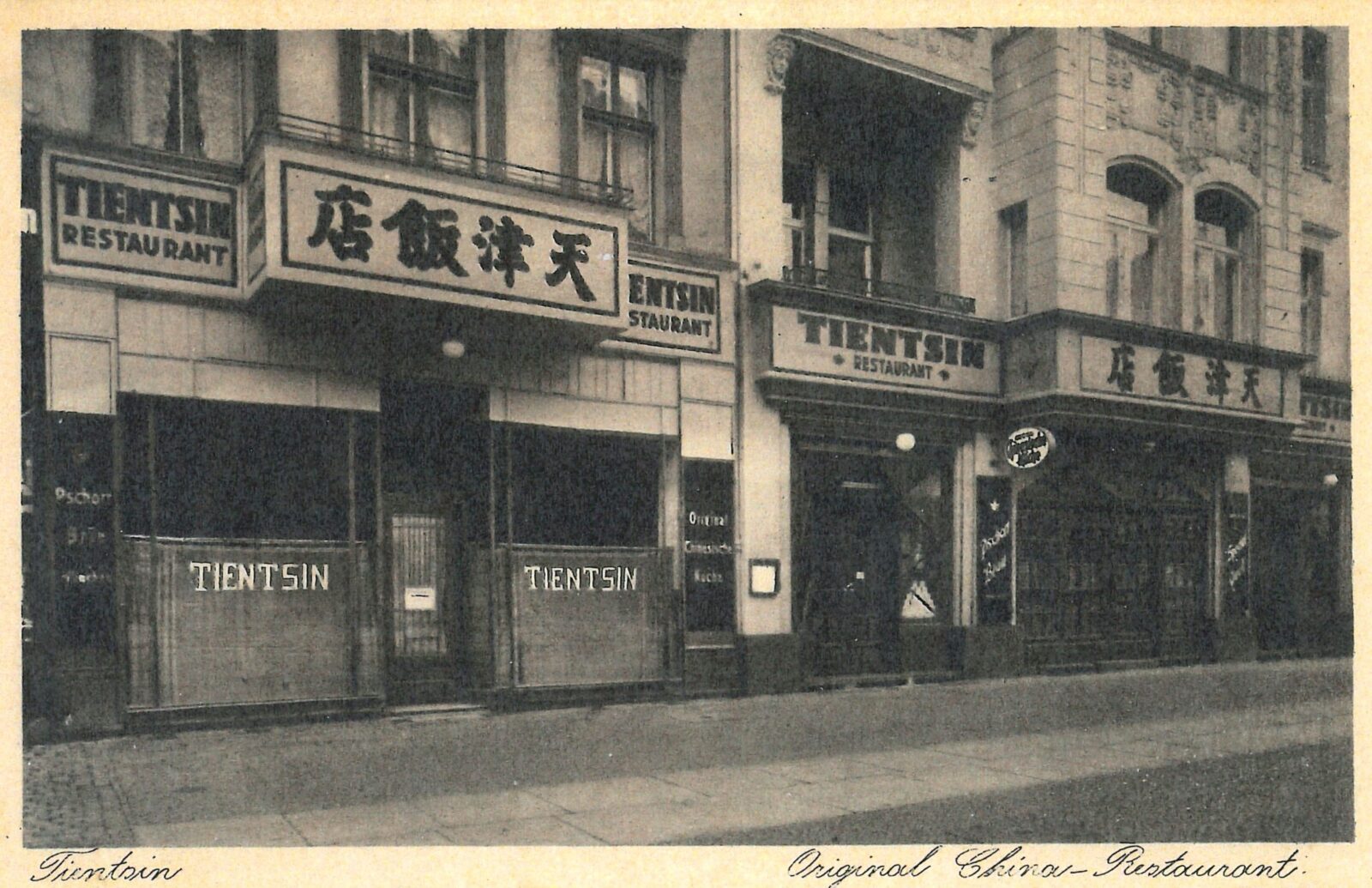
From 1923, the Tientsin was located at Kantstraße 130b/131 on the corner of Leibnizstraße – probably the first Asian restaurant in Berlin. It was run by Wen Tsaitien, a former chef at the Chinese legation. Several large-format windows stretched across the entire front of the building to the busy intersection. Apart from the Chinese characters on one side, the Tientsin "with its white-covered tables and the tailcoated German waiters did not differ from a good German restaurant." [1] It suited the international crowd that frequented Charlottenburg and quickly developed into a meeting place for all Asians in Berlin: In addition to Chinese, Japanese, Mongolians and Indians also visited the restaurant, often accompanied by European ladies.
The Berlin of the Weimar Republic offered a special environment for migrants and political activists from the colonial world. After the defeat in the First World War, Germany had to give up all its colonies in the course of the provisions of the Treaty of Versailles, including Kiautschou (Jiaozhou) with the city of Tsingtau (Qingdao) in northeastern China. This area was transferred to Japanese administration – to the disappointment of Germany and China.
China itself had experienced far-reaching political upheavals in the years before: the fall of the Qing Empire as the last dynasty was followed in 1912 by the proclamation of the republic under the leadership of Sun Yatsen. In the course of the reform movement, tens of thousands of predominantly male Chinese left their homeland to study in Western countries and contribute to the modernization of their country with the knowledge they had acquired there. They financed their education with state support or scholarships from their respective home provinces. Some also came from wealthy families who supported them generously. To this day, a degree from a foreign university is considered "23 carats" and a prerequisite for a successful career in China. [2] Despite their different origins, the students were united by the hope of a sovereign China free of foreign influence. However, they disagreed on the question of how to achieve this goal.
Chinese Students in Berlin
The first Chinese students had already come to the imperial capital at the end of the 19th century. At the Friedrich-Wilhelms-Universität (now Humboldt University of Berlin), they initially studied mainly humanities subjects such as German literature, philosophy and theology. At the same time, young Chinese were enrolled at the Technical University of Berlin who were oriented towards the natural sciences or wanted to train in mechanical engineering, engineering and military sciences. [3] In 1902, twenty of them founded the Club of Chinese Students in Germany. [4] This was officially registered with the district court in 1926 as the Association of Chinese Students in Germany. In a spacious old building at Kantstraße 118, the association had rented several rooms on the courtyard side. In addition to a small library, there was also enough space for public events, student meetings and leisure activities, such as table tennis. According to the statutes, "discussions of political questions were strictly forbidden within the club rooms as well as at events outside." [5] But this did not impress the nationally conscious young men much.
After the founding of the Republic of China under provisional President Sun Yatsen in 1912, the political differences between conservative and left-wing revolutionary supporters within the National Party (Kuomintang) came to a head. With the founding of the Chinese Communist Party (CCP) in 1921 and the death of Sun Yat-sen in 1925, there were also increasing clashes among Chinese students in Berlin. In August 1925, supporters of the Kuomintang and activists of the CCP, who worked closely with the Communist Party of Germany, engaged in a fierce brawl over the premises of the Association of Chinese Students, which both groups claimed for themselves. After the "left" students had split into a main association of Chinese students, there were several violent clashes. [6]
In the imperial capital, the Chinese students were welcome guests, who were supposed to convey a positive image of the German Reich in their homeland as "modernization agents". [7] The press described them as "horn-rimmed spectacle types, with finely combed back hair", who shaped the Berlin cityscape in Charlottenburg with their elegant appearance. [8] Most of them lived in Kantstraße and the surrounding area. The sons of wealthy parents could afford to live in the upper-middle-class apartments as subtenants. Some were also guests of a widowed landlady, who of course had only good things to say about the "perfect manners" and the pleasant behavior of her tenants. At least that's how the press saw it. She even suspected that "the sound of the name Kant exerted its attraction. There is not a long way from the word Kant to Canton." [9] Even though many students came from southern China and even from the province of Canton (now Guangdong), it was mainly practical reasons that spoke in favor of choosing the residential area: Kantstraße was located near the Technical University of Berlin, the School of Politics founded in 1920, and the Chinese Legation at Kurfürstendamm 218. The Chinese Empire had acquired the narrow building with the small outdoor staircase leading to the boulevard from a private owner in 1902 for 350,000 Reichsmarks. [10] The new residence with its four floors was originally built as a residential building with many rooms. However, these were not large enough for representative receptions, as the later envoy W.W. Yen complained. He lamented that Kurfürstendamm had once been an elegant residential street in Charlottenburg, "but in 1913 it [the residential street] was only a crowded main thoroughfare, filled with cafés and shops." [11] However, urban life was one of the reasons for the young Chinese to live here.
Protests against the film The Mistress of the World
At joint meetings with friends, in the student association or in a Chinese restaurant, the prospective academics passionately discussed the political situation in their homeland. The educated and cosmopolitan intellectuals saw themselves as representatives of a modern China and defended themselves against clichés and prejudices that associated their country with the "yellow peril" and the German colonization of Kiautshou. However, their protests against lectures by the national-conservative Academic Colonial League in 1926 or the visit of the Japan-friendly General Hsü to Berlin in the same year hardly reached the German public. [12]
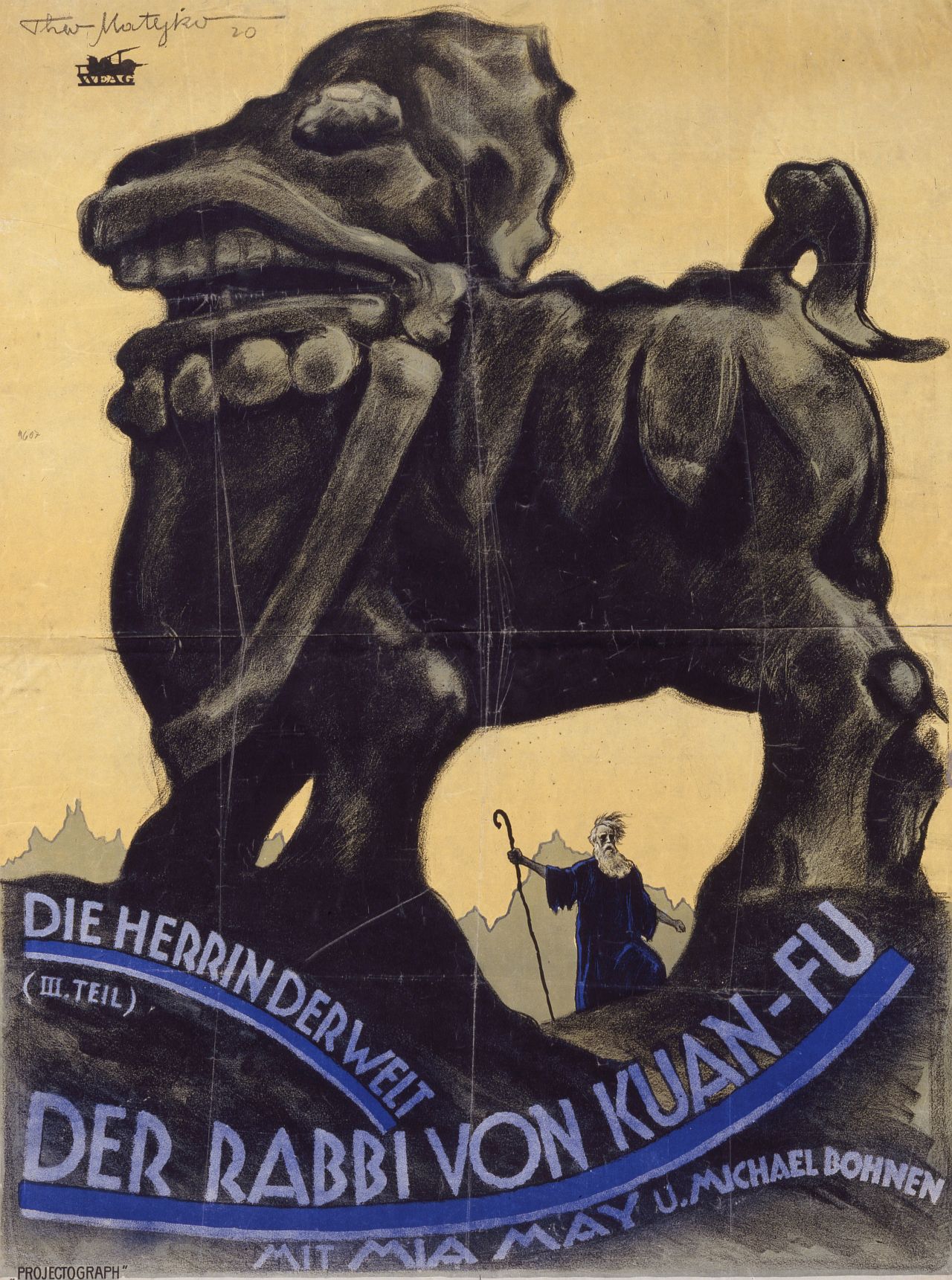
The situation was different in the disputes over the film series The Mistress of the World, the first three parts of which were partly set in China. After viewing the films in January 1920, there had been heated discussions among the Chinese students. Members of the student association and Chinese journalists turned to the public with their criticism, describing the production as a relic of colonial thinking and stereotypical prejudices of the previous century. [13] The spokesman was a 21-year-old student named Hu Shuhua. Hu was close to the Kuomintang and had studied metallurgy at the Technical University in Berlin. After graduating in 1920, he had stayed in Germany and worked for a year at the Krupp company in Essen, among other places. [14]
Why did the protests come about? With the loss of the German colonies, the local film industry relied on the success of exciting adventure and sensational films. In the film studios of Universum-Film Aktiengesellschaft (Ufa), monumental productions were created that were oriented towards the entertainment wishes of the audience and conjured up exotic fantasy worlds. [15] The Polish film historian Jerzy Toeplitz wrote about the reasons for this trend: "The dreams of colonial expansion and attempts to realize it had come to an end! It was worthwhile to remember the dreams in film." [16] One of these productions was the eight-part film series The Mistress of the World.
For producer Joe May, there was a lot at stake. The film was not only to be a box office success, but also to promote the limited admission of German productions abroad – especially in the USA – after the First World War. Already during the planning phase, May had described the project as a "propaganda film for the German cinema industry" and boastfully announced: "You don't have to be a prophet to be able to say that it [the film] will conquer the foreign market, including that of the hitherto hostile foreign countries [...]." [17] To this end, he had acquired a huge site in Woltersdorf near Erkner for his May-Film GmbH. There he tried to "reconstruct most of the world in the vicinity of Berlin." [18] On the terrain with its hills, orchards and bushes, May had an African and Asian fantasy world created in a very short time. The Chinese scenery included pagodas, round bridges and streets including a grocer's shop. [19] Costumes and props were supplied by the Charlottenburg company Verch & Flothow. Leopold Verch had already made a name for himself as a distributor of costumes, uniforms, jewellery and weapons for theatre productions. In June 1919, filming began on the first three parts of the film: The Yellow Man's Girlfriend, The Story of Maud Gregaards and The Rabbi of Kuan-Fu. The screenplay was based on a novel by the Austrian journalist Karl Figdor.
China on the silver screen
The first part of the series, The Girlfriend of the Yellow Man, tells the story of the young Danish woman Maud Gregaards. It serves the entire spectrum of colonial ideas of China as a foreign and dangerous culture. The plot arises from the contrasts between the white main protagonist, her Chinese boyfriend and the mass of faceless Chinese. Due to a newspaper advertisement, Maud, played by Mia May, the producer's wife, wants to take a job as a kindergarten teacher in the Chinese port city of Canton (now Guangzhou). On the crossing, she meets the Chinese physician Dr. Kien-Lung, who has a doctorate from a European university. With his Western clothing and cultivated behavior, he stands out from his compatriots, who are portrayed in the film as uneducated. On arrival in China, Maud discovers that she has been deceived. Instead of working as a kindergarten teacher, she ends up in a brothel, where she is humiliated and raped. With the help of Kien-Lung, who is himself tortured by the brothel owner, the Danish consul succeeds in freeing her. In his house, she finds protection from all the Chinese, who are portrayed as "particularly cruel, unscrupulous and sadistic". [20] The character of the Europeanized Chinese Kien-Lung also remains ambivalent in the other parts of the film series. In the end, Maud does not accept him as an equal partner at the end of the first part by rejecting his marriage proposal. [21]
The students' criticism was particularly directed at Henry Sze – a Chinese fellow student who had taken on the role of Dr. Kien-Lung. At the time of filming, he was actually still a student, later he completed his diploma as an engineer and appeared in a few more films. He lived at Düsseldorfer Straße 48 in Wilmersdorf and was listed in a 1921/22 handbook for actors, directors and writers as "Chinese, exotic character roles". [22] While Sze appeared quite Europeanized in his outward appearance and appearance in the role of the white woman's sympathetic friend, hundreds of Chinese extras formed the nameless mass of pigtailed Chinese. In the eyes of his compatriots, he had thus given up his Chinese identity and betrayed his own people. [23]
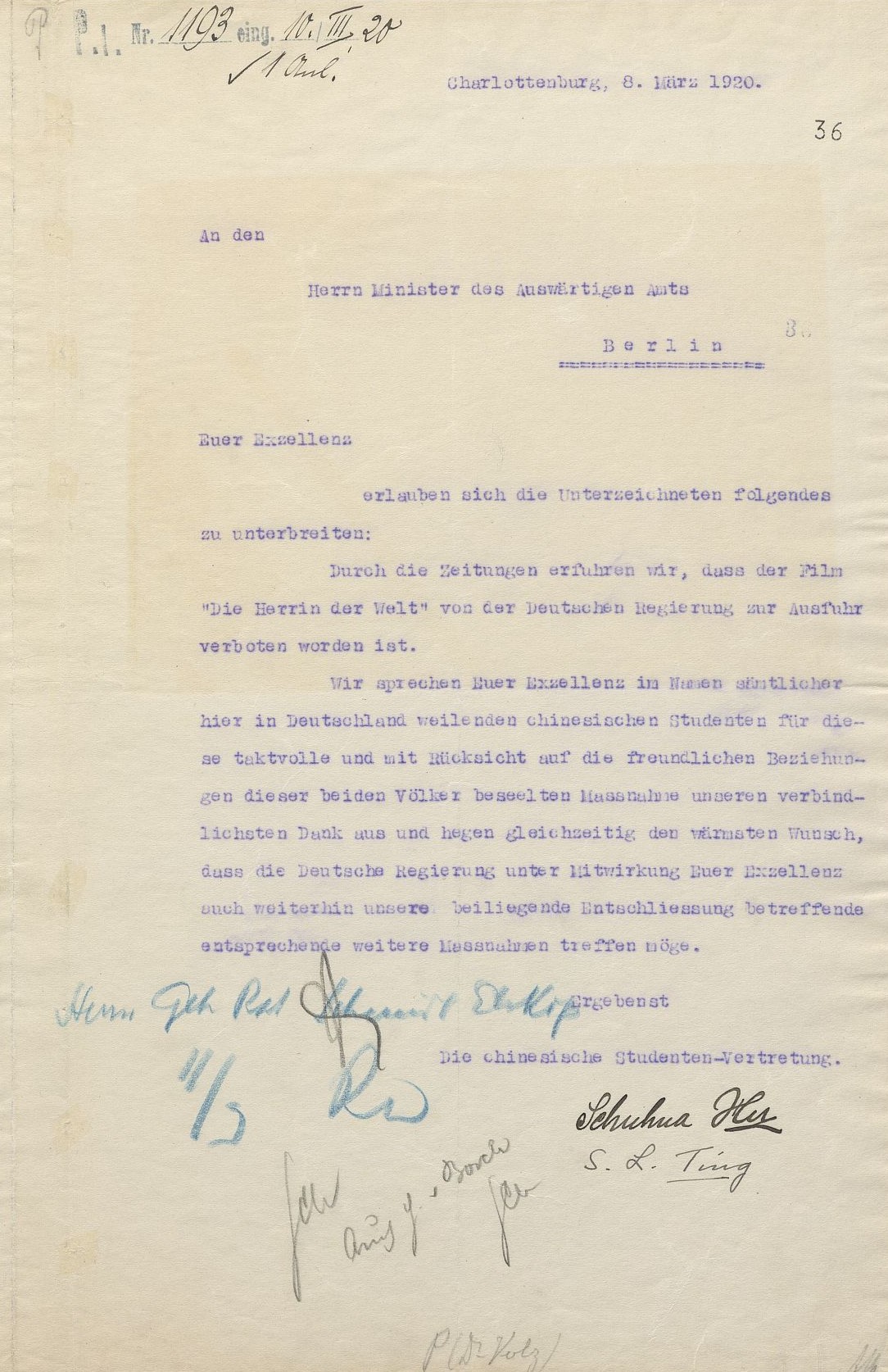
The dispute led to statements by representatives of German-Chinese groups and various China organizations. In the course of the discussions about the racist and colonial prejudices of the film, the members of the Chinese Student Association skilfully used various forms of protest. They were supported by statements by respected China experts, academics and representatives of various business organizations. Max Linde, Secretary General of the Association for the Far East, was one of the first to deal in detail with the content of the film. Stunned, he asked the hypothetical question: "How was it possible that one of our largest film companies threw such a concoction into the German people in order to give countless thousands of people a picture of China and its conditions day after day, evening after evening, according to which the four hundred million Chinese appear to be the excrement of humanity?" [24] Linde went into detail about individual film scenes and the characterization of the Chinese population. In particular, the brothel keeper is portrayed as a cruel Chinese who, with his "rock-hard face, in which not a muscle moves [...] feasts on the agonizing fear and anguish of his victim". [25] In order to give greater expression to their protests, the students turned to the Foreign Office and demanded an export ban on the film. On January 16, 1920, the Reich Commissioner for Export Issues prohibited the export of Parts I and III on the instructions of the Foreign Office.[26] Ufa's press department countered with a general statement, stating that the "male hero of the first part of the film [is] a thoroughly sympathetically drawn noble Chinese." In addition, there are brothels all over the world and it is known "that these brothels are called flower boats in Canton and form a specialty of this city." [27]
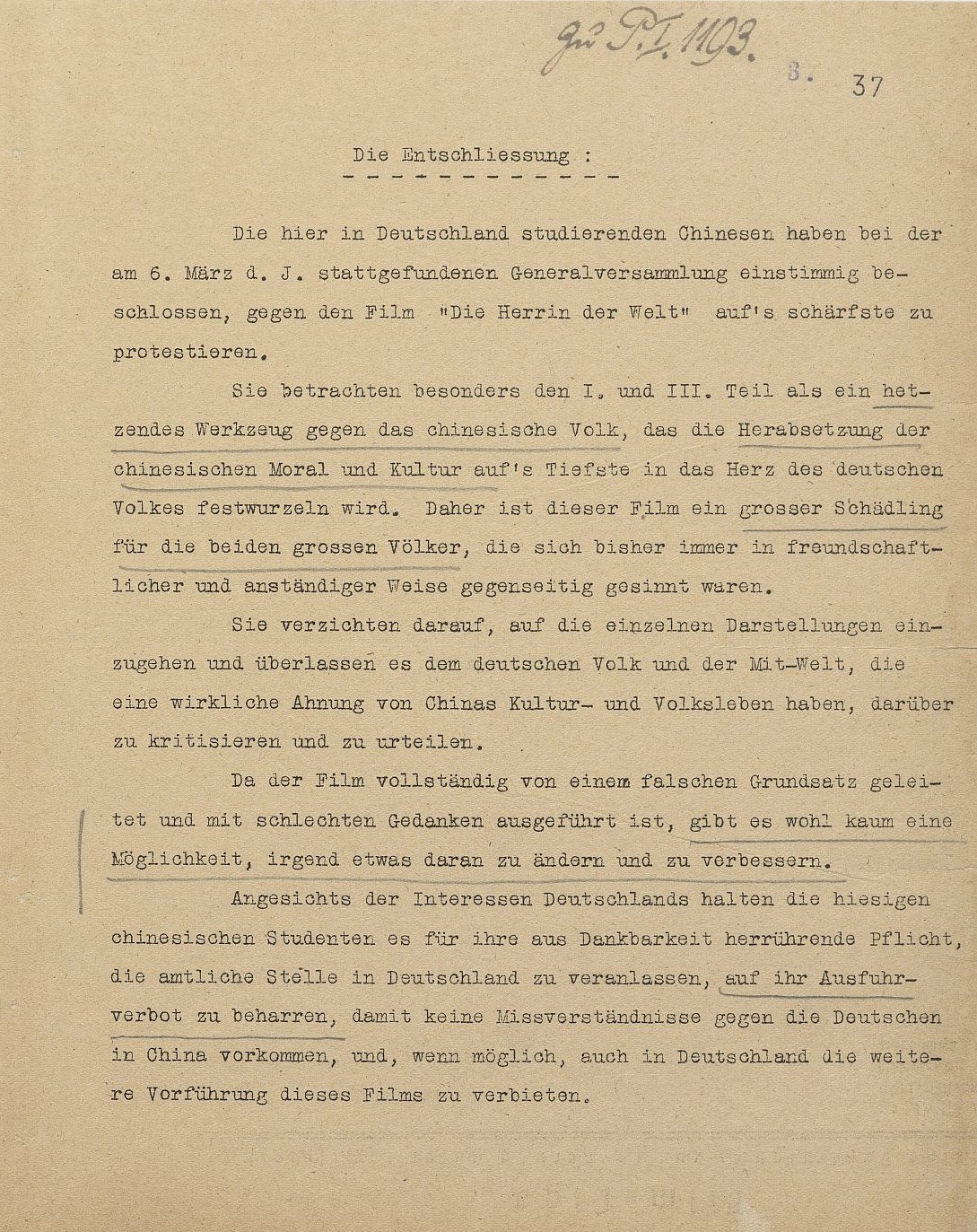
After a second screening in March 1920, which was attended by China experts as well as a representative of the Foreign Office, the students demanded that the film be banned from being shown in Germany. A committee of the Chinese Student Association decided to "protest in the strongest possible terms against the film 'Mistress of the World'." At the same time, the students distributed a leaflet in which they "described Parts I and II in particular as an incitement against the Chinese people, which will deeply root the disparagement of Chinese morality and culture in the heart of the German people." [28] The leaflet was signed by the above-mentioned spokesman of the protest, Hu Shuhua. In addition to further criticism of the content of all three parts, the protest note referred to the hitherto friendly German-Chinese relations. "In our opinion, the new German government has no reason to make an enemy of a foreign people." [29] After numerous meetings, expert reports and discussions, numerous changes were finally made at the personal decision of producer Joe May. The film was no longer set in Canton, but in a fictitious town of Lön-San and Maud was not kidnapped to a brothel, but to an obscure establishment, where she had to work as a dancer. All changes were included in the version that has survived to this day, so that the export ban of the Foreign Office was finally lifted in September 1920. [30]
It is difficult to judge which image of China the enthusiastic Berlin audience internalized. The premiere on December 5, 1919 in the Tauentzien Palace, which had recently been acquired by Ufa, was attended by Mia and Joe May, as well as Karl Figdor and Henry Sze. [31] In order to give the film the right setting, a dozen Chinese dressed in colorful silk and long braids distributed the program booklet in the anteroom "with their polite eternal smiles". [32] Despite the successful protests of the Chinese Student Association, the film series developed into a commercial success in Germany and throughout Europe. [33] It was only a flop in the USA.
The editing of the text was completed by Laura Frey after Dagmar Yu-Dembski's death. Both had previously worked together on exhibition research on Chinese anti-colonialism in Weimar Berlin.
Dagmar Yu-Dembski
- LOCATION
- Kantstraße 130b/131
- TODAY
- Kantstraße 130b/131
Citing the article
Dagmar Yu-Dembski: The Protest of Chinese Students against the Film The Mistress of the World. In: Kolonialismus begegnen. Decentralized Perspectives on Berlin's City History. URL: https://kolonialismus-begegnen.de/geschichten/herrin-der-welt/ (09.02.2024).
Literature & Sources
[1] Sch., A. F.: In the Chinese Restaurant. Mr. Wen and his Guests. In: Berliner Tageblatt. 05.06.1925. Cf. also Yü-Dembski, Dagmar: China in Berlin, 1918-1933. On Chinese Everyday Life and German China Enthusiasm. In: Kuo Heng-yü (ed.): Berlin and China. Three Hundred Years of Changeful Relationships. Berlin: 1987. Colloquium Verlag. pp. 117-130. Here: pp. 122-123.
[2] Cf. Liang Hsi-Huey: The Sino-German Connection. Alexander von Falkenhausen between China and Germany 1900-1941. p. 26.
[3] Cf. Harnisch, Thomas: Chinese Students in Germany. History and Impact of their Study Visits in the Years from 1860 to 1945. Hamburg: 1999. p. 94.
[4] Cf. Gütinger, Erich: Die Geschichte der Chinesen in Deutschland. An overview of the first 100 years since 1822. Münster: 2004. p. 220; Liang 1978: p. 31.
[5] Quoted from Nagl, Tobias: The Uncanny Machine. Race and Representation in Weimar Cinema. Munich: 2009. p. 130.
[6] Cf. Liang 1978: p. 23 ff.
[7] Nagl 2009: p. 130.
[8] Sch., A. F.: Im chinesische Restaurant. Herr Wen und seine Gäste. In: Berliner Tageblatt. 05.06.1925.
[9] China in Berlin. Dealers and Students. 1928. Collection of excerpts in the Berlin State Archives.
[10] Cf. Harting, Angela: Das "Chinahaus" am Kurfürstendamm. In: Der Bär von Berlin. Jahrbuch des Vereins für die Geschichte Berlins. Berlin: 2001. S. 51-74. Here: p. 58.
[11] Yen W. W.: East-West Kaleidoscope, 1877-1946. New York: 1974. St. John's University Press. p. 84. Quoted from Harting 2001: p. 60.
[12] Cf. Liang 1978: p. 37; Newspaper article Chinese against China evening. In: Vossische Zeitung. 21.02.1926.
[13] Cf. Nagl 2009: p. 138.
[14] Cf. Harnisch 1999: pp. 191-195.
[15] Cf. Stefanie Hetze: Von Mr. Wu und Nang-ping zu Ulun Iga – China und Chinesen im deutschen Film. In: Gransow, Bettina/Leutner, Mechthild (eds.): China: Nähe und Ferne. Zum 60. Geburtstag von Kuo Heng-yü. Frankfurt am Main: 1989. Peter Lang. S. 307-336. Here: S. 314f.
[16] Toeplitz, Jerzy: Geschichte des Films. Volume 1, 1895-1928. Berlin/GDR: 1972. p. 212. Quoted from Hetze 1989: pp.314-315.
[17] Quoted from Hetze 1989: p. 317.
[18] Quoted from Nagl 2009: p. 56. The author refers here to an article in the Neue Berliner Zeitung of 06.12.1919.
[19] Cf. ibid.: p. 59.
[20] Quoted from Hetze 1989: p. 318.
[21] Cf. ibid.
[22] Quoted from Hetze 1989: p. 318.
[23] Cf. ibid.: p. 318.
[24] Linde, Max: Film and Foreign Policy. In: Ostasiatische Rundschau. 1.2. 15.02.1920. p. 18.
[25] Ibid.
[26] Cf. Nagl 2009: p. 132.
[27] Files Mistress of the World, 19.01.1920, Federal Archives R 901/72197, pp. 1-229.
[28] Quoted from Nagl 2009: p. 138.
[29] Ibid.
[30] Cf. ibid.: p. 142.
[31] Cf. ibid.: p. 132.
[32] Cf. ibid.: p. 113.
[33] Cf. Hetze 1989: p. 320.
Tags
#Antikolonialismus #Charlottenburg #China #Der Rabbi of Kuan-Fu #Die Mistress of the World #Exotismus #Film #Hu Shuhua #Joe May #Kantstraße #Kommunistische Party of China #Kuomintang #Protest #Rassismus #Sun Yat-sen #Tauentzien Palace #Technische College #Tientsin #Verch & Flothow #Weimarer Republic