The Scherl publishing house under Alfred Hugenberg
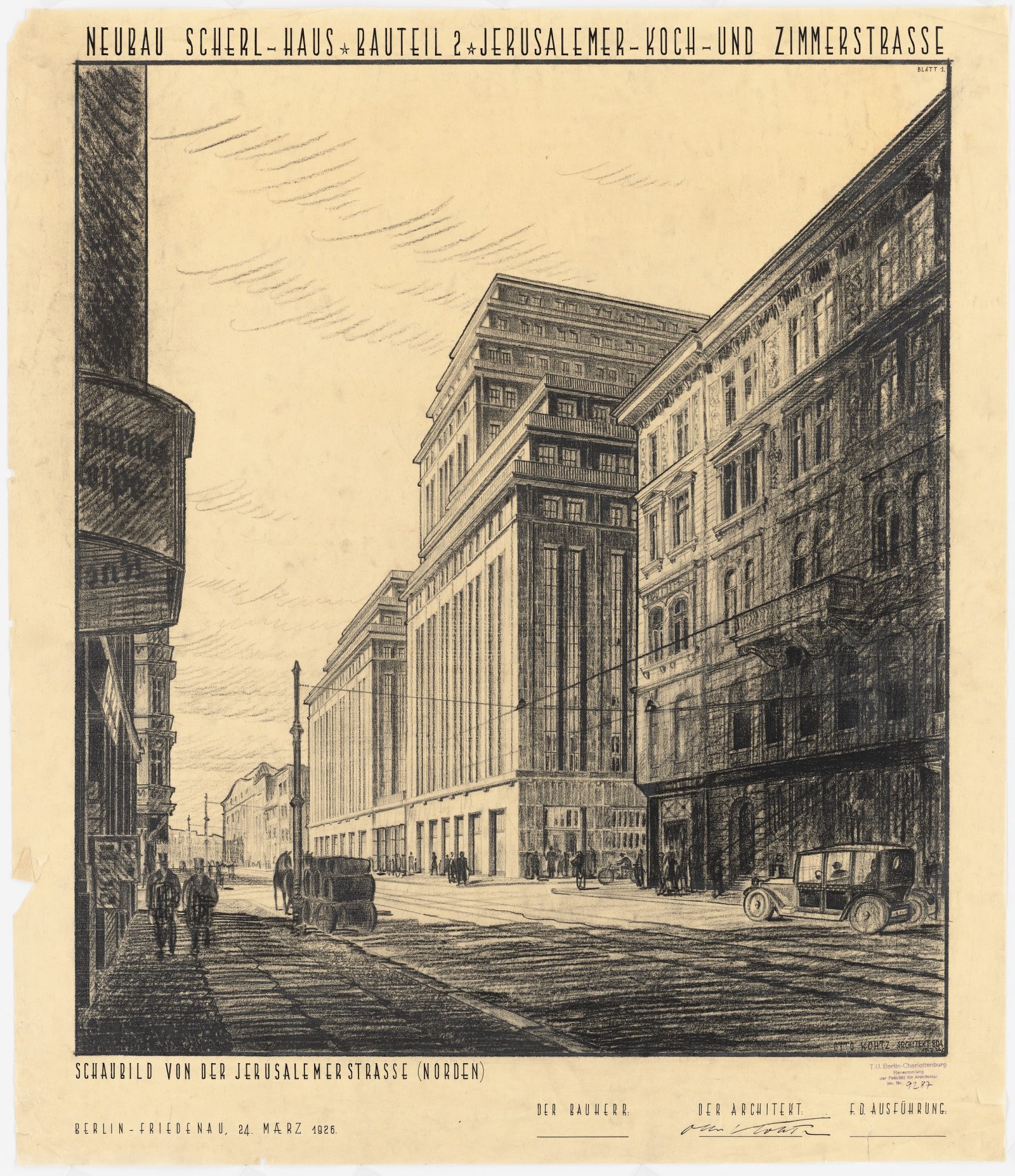
The Scherl publishing house was founded in 1883 by the major Berlin publisher August Scherl and had its editorial headquarters in the middle of Berlin's newspaper district on the site of today's Axel Springer Campus at Zimmerstraße 40. The editorial orientation of the publishing house followed the political views of its founder, which were national-monarchist oriented and connected to the Prussian ruling house. [1] As a result of an economic emergency, the Scherl publishing house was taken over by the co-founder of the All-German Association, Alfred Hugenberg, and systematically integrated into the Hugenberg Group from 1916 onwards. [2] With the Scherl publishing house as its central journalistic organ, the national-conservative Hugenberg empire, which united various advertising and news agencies as well as press publishers and film companies under one roof, advanced in the Weimar Republic to become an effective mouthpiece for the colonial revisionist and expansionist-oriented German National People's Party (DNVP) as well as numerous colonial associations and associations. [3] Following the model of the "unified press", Alfred Hugenberg exerted a dominant influence on the formation of opinion among the population in the Weimar Republic through his nationalist-oriented "media conglomerate". [4] Hugenberg's career combined various strands of German imperialism – settlement colonialism towards the European East, overseas colonial claims, and National Socialist expansion in Europe.
Alfred Hugenberg, who completed his studies in economics in 1888 with a dissertation on "Inner Colonization in Northwestern Germany",[5] took on a leading position in the "Royal Prussian Settlement Commission for West Prussia and Poland" from 1894, which promoted "internal colonization" in the eastern provinces as part of the Germanization policy. [6] As early as the end of the 18th century and the beginning of the 19th century, "inner colonization" or rural settlement was a central component of agricultural and settlement policy. As a result of the migration of the German-speaking population from the eastern provinces of Prussia to the west of the Reich, a new settlement of Germans in the provinces of Poznań and West Prussia was envisaged as part of the planned "internal colonization". This was to be achieved through a comprehensive "Germanization" of the territories, which at the same time included a program to displace the Polish-speaking population. This strategy was also a result of the previously failed attempts to assimilate the native Polish population. [7]
As a militant missionary of this "inner colonization" and radical representative of the "Prussian spirit", the young Hugenberg pursued the confiscation of Polish land and the expropriation of the local population. [8] He also saw the establishment of rural settlements in the rural-conservative east as a defense against socialist tendencies. [9] He held an important position within the "Society for the Promotion of Inner Colonization" (GRC), founded on April 12, 1912 by the government official Friedrich Ernst von Schwerin and the economist and settlement expert Max Sering. [10] The society defined "internal colonization" as a "planned establishment of new settlements in the homeland of the colonizing people [...]" and was oriented towards German overseas colonialism. [11] For the representatives of the GRC, it was a matter of the systematic appropriation and settlement of the supposedly "empty stretches of land" in the eastern provinces in order to realize the vision of the "German East" through the settlement of a German peasantry. [12] The idea of "inner colonization" and the revisionist orientation of an eastward expansion were consistently supported in Hugenberg's environment – he also functioned as a top functionary of several industrial associations and had excellent relations with political circles. [13]
After the German Empire had transferred the island of Zanzibar in today's Tanzania to the British in 1890 in exchange for Heligoland, thus showing a lack of interest in overseas expansion, Hugenberg was significantly involved in the founding of the so-called All-German Association, which in the following years developed into one of the most influential agitation associations of the German Empire. [14] The central tasks of the association were the promotion of national consciousness, the protection of Germans abroad and an active and radical foreign policy. The "continuation of the German colonial movement" and the "energetic German interest policy in Europe and at sea" were anchored in the statutes. [15]
With regard to the East, Hugenberg called in a memorandum written in 1915 for the "ruthless" Germanization of the annexed Polish territories, which provided for the settlement of Germans in the agricultural areas "after an ethnic land consolidation" of the local population[16] – this demand was understood not only as the preservation of Germanness, but also as the conquest of "new living space". [17] As far as German "ethnicity" was concerned, the association's statutes contain passages on the "racial purity" and "inequality of people" due to their "racial" anthropological characteristics. Hugenberg and his members of the association found orientation in the social Darwinist theories of eugenics, which was burgeoning in the 19th century. After the defeat in the First World War and the cession of the German colonies overseas, their return was demanded, but the association primarily pursued the return of the eastern provinces, which had also been ceded, and further expansion in the east[18] through a revision of the borders and a policy of Germanization. [19] The demands for the creation of new Lebensraum in the East, which sprouted in the environment of the All-Germans around Alfred Hugenberg, were finally taken up and continued by the National Socialists in the course of the propagated "Lebensraum im Osten" demand.
Alfred Hugenberg, who until the 1920s steered his political interests from the background through the All-German Association and his right-wing media empire, became increasingly politically active from 1924 onwards and took over the chairmanship of the DNVP from 1928,[20] which also included the right-wing extremist putschist Wolfgang Kapp and the expansionist ex-admiral Alfred von Tirpitz. The party's programme, which was determined by monarchist conservatism and a völkisch worldview and aimed at restoring the conditions of the pre-war years, became increasingly radicalised under Hugenberg. For the widespread dissemination of the colonial worldview, the DNVP of the Berliner Lokalanzeiger of the Scherl publishing house served as one of the highest-circulation papers of the time. Although this newspaper did not appear in public as the official journalistic organ of the party, its colonial revisionist program was repeatedly published there and made Hugenberg's political views socially acceptable. [21] Increasingly, the Scherl publishing house offered a suitable breeding ground for the burgeoning Nazi movement. [22] Hugenberg supported the NSDAP journalistically and politically, became Hitler's "stirrup holder" without realizing that his ally was increasingly pushing him to the sidelines. [23] In 1933, the Nazis forced the party to dissolve itself, and Hugenberg's press empire was also successively taken over by the Nazi regime and finally incorporated into the NSDAP's Central Publishing House in 1943. [24]
The Scherl publishing house in Kreuzberg and the biography of Alfred Hugenberg show in an exemplary way the connection between expansionist Germanization policies in the East, colonial efforts overseas and National Socialism. The installation of an information board about the Scherl publishing house is planned at the time of writing the essay; at the given time, however, it contains no references to the role of Hugenberg's media association in German imperialism.
Sina Knopf
- LOCATION
- Zimmerstr. 40-41
- TODAY
- Axel Springer high-rise building with Zimmerstrasse 32
Citing the article
Sina Knopf: Der Scherl-Verlag unter Alfred Hugenberg. In: Kolonialismus begegnen. Dezentrale Perspektiven auf die Berliner Stadtgeschichte. URL: https://kolonialismus-begegnen.de/geschichten/der-scherl-verlag-unter-alfred-hugenberg/ (03.03.2025).
Literature & Sources
[1] Geppert, Dominik, Press Wars. Public Sphere and Diplomacy in German-British Relations (1896-1912), Munich 2007, p. 245.
[2] Dietrich, Valeska, Alfred Hugenberg. Ein Manager in der Publizistik, Berlin 1960, p. 52.
[3] Cf. Jost, Rebekka, Ein tiefes Vergessen liegt auch über ihren Gräbern, Norderstedt 2020, p. 137; Bernhard, Ludwig, Der Hugenberg-Konzern. Psychologie und Technik einer Großorganisation der Presse, Berlin 1928, p. 94; Dietrich, Alfred Hugenberg. Ein Manager in der Publizistik, Berlin 1960, p. 52ff.
[4] Cf. Dietrich, Alfred Hugenberg. Ein Manager in der Publizistik, Berlin 1960, pp. 52ff.
[5] Hugenberg, Alfred, Innere Colonisation im Nordwesten Deutschlands, Strasbourg 1891, p. 531.
[6] Conrad, Sebastian, Deutsche Kolonialgeschichte, Munich 2008, p. 99.
[7] Baier, Roland, The German East as a Social Question. A Study on Prussian and German Settlement and Polish Policy in the Eastern Provinces during the Empire and the Weimar Republic, Cologne / Vienna 1980, p. 31.
[8] Honigmann, Georg, Capital Crimes or The Case of the Privy Councillor Hugenberg, Berlin 1997, p. 62.
[9] Cf. ibid., pp. 62ff.
[10] Lück, Heiner, On the development of agricultural settlement and land law since the late 19th century. A legal historical sketch, Halle an der Saale 2017, p. 17.
[11] Sering, Max / Von Dietze, Constantin, "Innere Kolonisation", in: Elster, Ludwig (ed.), Wörterbuch der Volkswirtschaftslehre, vol. 2, 4th ed., Jena 1932, pp. 403-420, here p. 403.
[12] Danilina, Anna, "A Moral Economy of the "Inner Colony". Cooperative, Reform and Race in the German Settlement Movement (1893-1926)", in: History and Society. Special Issue 26 – Moral Economies (2019), pp. 103-132, here p. 110f.
[13] Haar, Ingo, Historiker im Nationalsozialismus. Deutsche Geschichtswissenschaft und der "Volkstumskampf" im Osten, Göttingen 2002, p. 42.
[14] Holzbach, Heidrun, Das "System Hugenberg". Die Organisation bürgerlicher Sammlungspolitik vor dem Aufstieg der NSDAP, Stuttgart 1981, p. 2.
[15] Cf. Bonhard, Otto, Geschichte des Alldeutschen Verbandes. Leipzig / Berlin 1920, pp. 148f.; Mommsen, Wolfgang J., Imperialismus. Seine geistigen, politische und wirtschaftliche Grundlagen. Ein Quellen- und Arbeitsbuch, Hamburg 1977, p. 127.
[16] Wehler, Hans-Ulrich, Deutsche Gesellschaftsgeschichte. Vom Anfang des ersten Weltkrieges bis zur Gründung der zwei deutschen Staaten 1914-1949, Munich 2003, pp. 31f.
[17] Puschner, Uwe, Die völkische Bewegung im wilhelminischen Kaiserreich. Sprache – Rasse – Religion, Darmstadt 2001, p. 152.
[18] Cf. Bonhard, Geschichte des Alldeutschen Verbandes, Leipzig / Berlin 1920, pp. 248f.; Cf. Mommsen, Wolfgang J., Imperialismus. Seine geistigen, politische und wirtschaftliche Grundlagen. Ein Quellen- und Arbeitsbuch, Hamburg 1977, p. 127.
[19] Puschner, Uwe, "Die völkische Bewegung in Deutschland", in: Heer, Hannes (ed.), "Weltanschauung en marche". Die Bayreuther Festspiele und die Juden 1876 bis 1945, Würzburg 2013, pp. 151-187, here p. 156; Naber, Geert, "Brückenbauer zwischen kolonialer und völkischer Ideologie – Der "Alldeutsche Verband" 1891 bis 1939", Freiburg 2010, in: freiburg-postkolonial.de, March 2021, p. 2ff. Available online at: http://www.freiburg-postkolonial.de/pdf/2010-Naber-Alldeutscher-Verband.pdf [last accessed 09.06.2021].
[20] Weiß, Hermann / Hoser, Paul (eds.), "The German Nationals and the Destruction of the Weimar Republic. From the Diary of Reinhold Quaatz 1928-1933", In: Institut für Zeitgeschichte (ed.), Schriftenreihe der Vierteljahreshefte für Zeitgeschichte, Munich 1989, vol. 59, p. 16.
[21] Borchmeyer, Walter, Hugenbergs Ringen in deutschen Schicksalsstunden, Düsseldorf 1951, p. 30.
[22] Cf. Borchmeyer, Hugenbergs Ringen in deutschen Schicksalsstunden, Düsseldorf 1951, p. 29; Holzbach, Heidrun, Das "System Hugenberg". Die Organisation bürgerlicher Sammlungspolitik vor dem Aufstieg der NSDAP, Stuttgart 1981, p. 11; Wernecke, Wernecke/Heller, Peter (eds.), Der vergessene Führer. Alfred Hugenberg. Pressemacht und Nationalsozialismus, Hamburg 1982, p. 123.
[23] Cf. Borchmeyer, Hugenbergs Ringen in deutschen Schicksalsstunden, Düsseldorf 1951, p. 29.; Cf. Holzbach, Das "System Hugenberg". Die Organisation bürgerlicher Sammlungspolitik vor dem Aufstieg der NSDAP, Stuttgart 1981, p. 11.
[24] Files of the transition from the Scherl publishing house to the Wehrmacht publishing house and sale of the Scherl publishing house to the central publishing house of the NSDAP, 1943-45, vol. 13, Federal Archives Berlin-Lichterfelde, Sig. R43-II/469b.
Tags
#Alfred Hugenberg#Alfred von Tirpitz#Alldeutscher Verband#August Scherl#Auslandsdeutschtum#Axel Springer Campus#Berliner Zeitungsviertel#Carl Peters#Deutschnationale People's Party#DNVP#Eugenik#Expansionspolitik#Germanisierungspolitik#Gesellschaft for the Promotion of Inner Colonization#Helgoland-Zanzibar Treaty#Hugenberg Corporation#Innere Colonization in Northwestern Germany#Kolonialpropaganda#Kolonialrevisionismus#Kolonialverbände#Königlich-Prussian Settlement Commission for West Prussia and Poland#Kreuzberg#Nationalismus#Nationalsozialistische German Workers' Party#NSDAP#Ost Expansion#Polen#Presse#Rassenanthropologie#Rassismus#Revanchismus#Sozialdarwinismus#Versailler Treaty#Weimarer Republic#Wolfgang Kapp#Zeitungen