The Transvaal Exhibition on Kurfürstendamm (1897)
A "fairytale city from distant South Africa," enthused a Berlin journalist in September 1897 about the Transvaal industrial and "people's show" on Kurfürstendamm. [1] And it was indeed a fairytale city. Because what was shown there had little to do with the reality of the colonial gold industry, which emerged in South Africa at the end of the 19th century and still shapes the country today.
Nothing is left of the exhibition grounds, which a "society of local financiers"[2] had built at the beginning of 1897 "in an astonishingly short time [...] on the sandy desert on Kurfürstendamm". [3] So-called "people's shows" were to take place here on a regular basis. The first was the Transvaal exhibition in the summer of the same year. [4]
Anyone who spoke of the Transvaal at that time meant the South African Republic, which existed until 1902. This settler-colonial state had been founded in the mid-19th century by Boers of Dutch origin in the course of their land grab on the other side of the Vaal River. Berliners were familiar with the Transvaal – because at the end of the 1890s it was regularly in the headlines. [5]
About ten years earlier, in 1886, a huge gold deposit had been discovered on the Witwatersrand, a ridge in the Transvaal. Driven by international investors, a rapid industrialization and settlement process began. At the time of the Berlin Exhibition, the majority of the world's gold exports came from the Transvaal. Around 75 million pounds of foreign capital were invested here by 1899. [6] Not far from the goldfields on the Witwatersrand, a new major city, Johannesburg, emerged in a very short time.
The booming gold industry exacerbated imperial conflicts in the region. While the Boers continued to forcibly displace African societies in the course of the 19th century, they increasingly came into conflict with Britain's hegemonic claims as a result of the gold discoveries. German actors also contributed to the conflict dynamics. The already considerable German economic presence in the Transvaal had continued to grow in the years leading up to the Berlin exhibition. [7]
Johannesburg in Charlottenburg
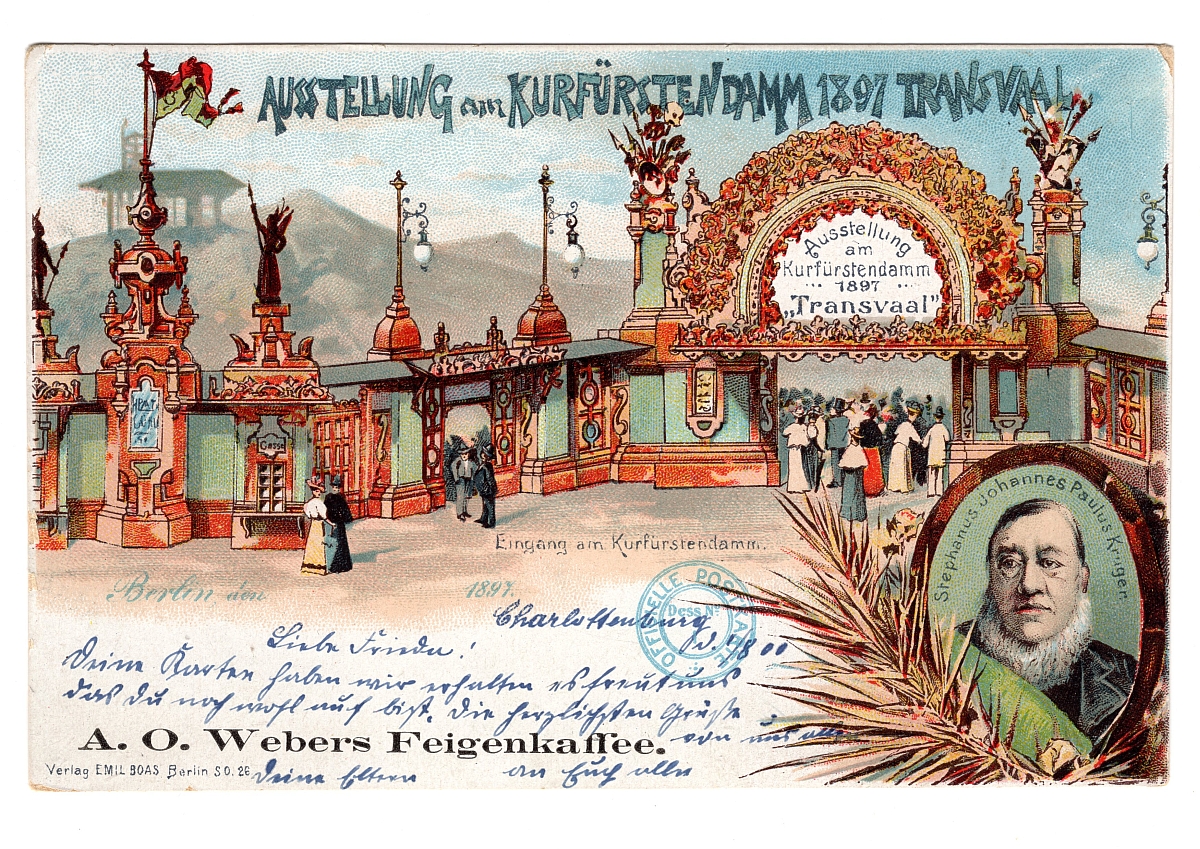
Where the commercial buildings at Kurfürstendamm 32 to 36 stand today was the main entrance to the exhibition. [8] Anyone who stepped through the opulent entrance portal (Fig. 1) found themselves in a fantasy version of colonial South Africa.
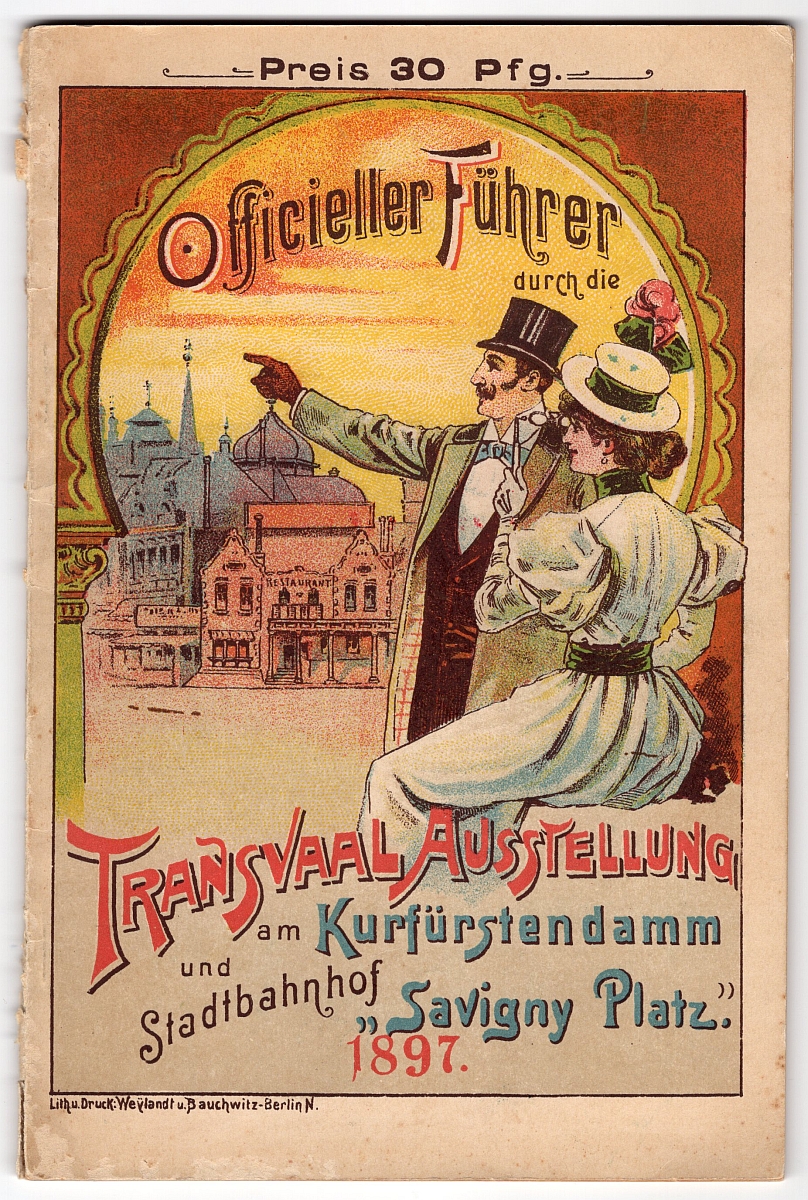
Replicas of well-known buildings served as a backdrop for the consumption of the Berlin bourgeoisie. A glance at the Official Guide to the Transvaal Exhibition (Fig. 2) shows the abundance of offers: champagne buffet in an artificial "Street of Johannesburg", beer served in a replica of Cecil Rhodes' home and potato pancakes in the "Gold Rush Quarter". [9] The latter, offered by the company W. Spiesecke, were advertised as already being "most famous" from the Treptow Trade and Colonial Exhibition of the previous year. [10]
The world and colonial exhibitions of the late 19th century were part of the metropolitan entertainment industry: local restaurants and handicrafts made money from their operations. But the exhibitions also aimed to strengthen the economic presence in colonized areas and promote the acceptance of colonial rule. [11] This also happened at the Transvaal exhibition – through the demonstration of industrial technology on the one hand, and the demonstration of people in so-called "people's shows" on the other.
What could be seen on Kurfürstendamm
The industrial part of the exhibition focused on gold mining on the Witwatersrand: "To illustrate [T]his gold deposits, as well as the operation in them as faithfully as possible, is the special task of our exhibition," the organizers wrote in an accompanying publication. [12]
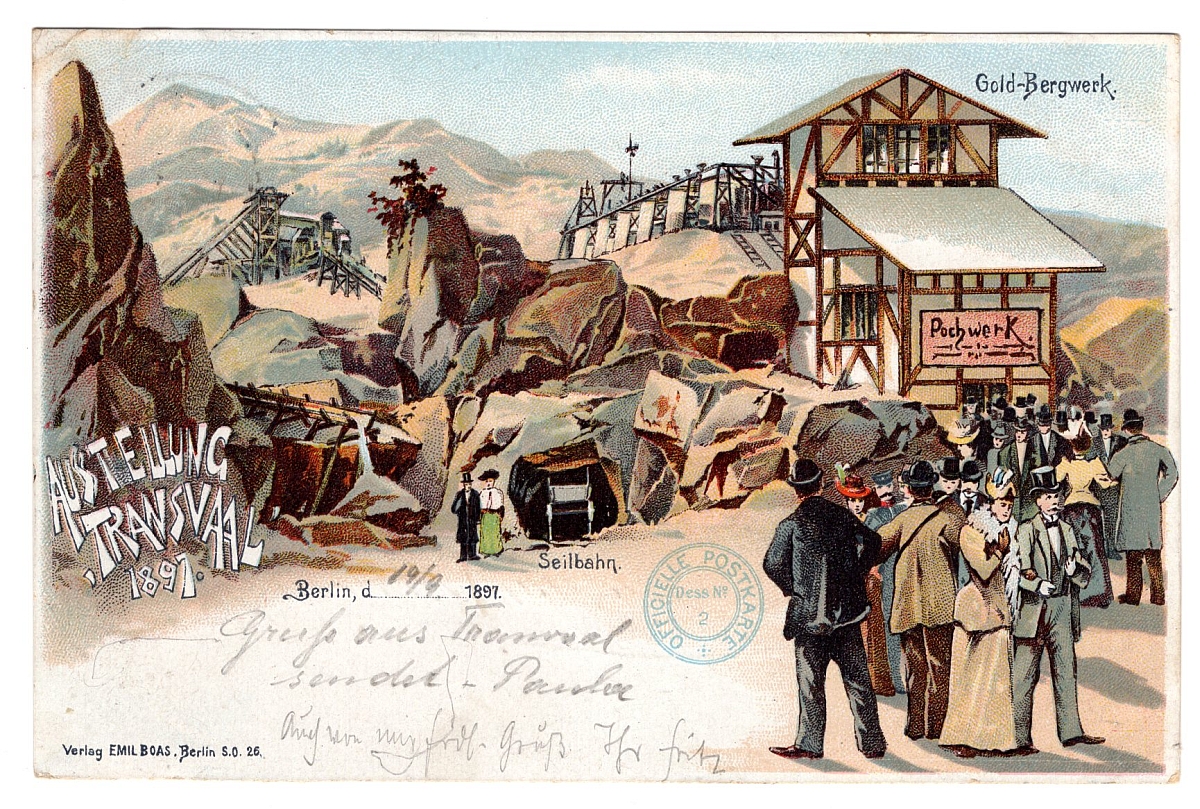
Near the main entrance, they had a mine built with a rocky backdrop, which was supposedly "as faithful as possible to the originals near Johannesburg". [13] Here, machines that played a role in gold mining were demonstrated. The entertainment element was not lacking here either. Even today, many amusement parks have so-called minenight trains, whose storylines romanticize the American gold rushes . At the Transvaal exhibition, visitors were able to ride through the replica mine in a "small mine railway" provided by the Fried. Krupp company – at the same time as the real gold rush in South Africa (Fig. 3). [14]
The exhibition organisers staged European superiority thinking spatially: opposite the mine, which was intended to demonstrate the modernity of German mechanical engineering, they had an artificial, deliberately simple "native village" built. Here, Africans performed dances and supposed scenes from village life. [15]
The people hired for this spectacle were probably among the 65 Lobedu from the Northern Transvaal who had been brought to Berlin by the missionary Fritz Reuter of the Berlin Missionary Society at the request of the exhibition organizers. The circumstances under which people from colonized areas took part in "Völkerschau" could be very different. The people appearing in the Transvaal exhibition were probably acting out of economic hardship. [16] In Berlin, it was their task to depict the racist ideas that Europeans had of African societies.
As is typical of colonial exhibitions, the exhibition organizers deliberately contrasted stereotypical and derogatory depictions of African societies in the "Völkerschau" with the demonstration of European technology. This constructed a supposed opposition between "civilization" and "savagery" that was intended to establish a European claim to power. [17]
The Transvaal exhibition painted a glorified, non-violent picture of colonial rule and work as a European "civilising mission". To this end, the exhibition organisers deliberately presented the African "Völkerschau" participants in two groups. On the one hand, a "pagan" group, supposedly free of the influence of the colonizers: they were portrayed as "idle and lazy people" who "merely moved to dance". [18] The other, "Christianized" group, on the other hand, was portrayed as diligent missionary students who performed Christian songs and crafts. Any African "productivity" or cultural achievement was portrayed as the result of the "civilizing" influence of white people – and thus denied African societies. Colonial domination as an alleged "civilizing mission" was the ideological core of 19th-century colonialism and motivated and justified numerous, often violent, interventions in local cultures and economies. [19]
The fact that the idea of a "civilising mission" made colonialism compatible with broad sections of the population is also shown by an exhibition review. For example, a journalist from the weekly newspaper Der Bär wrote after viewing the exhibition that Africans allegedly "like to indulge in "months of idleness [...] anyway, like children". The task of the mission is therefore "[i]n education, which must begin with getting used to work". [20]
In doing so, the reviewer repeated an assertion widespread in German colonial discourse: the colonial press, missions, and entrepreneurs often spoke of the supposed necessity of "education for work." [21] The insinuation of laziness had violent implications, because it served to justify coercive measures in colonial capitalism. Colonial states and corporations regularly invoked the rhetoric of laziness and the euphemism of "education" when they demanded and implemented forced proletarianization, violent discipline, and racial inequality in the organization of work. [22] Colonial working environments, especially on plantations and in mining, had nothing to do with the picturesque handicrafts on display at the exhibition.
What was not to be seen: The real gold industry on the Witwatersrand
In one respect, the description on Kurfürstendamm was correct: new machines and metallurgical processes were central to gold mining on the Witwatersrand, which was highly industrialized from the beginning. Although the gold deposit was huge, the concentration of the precious metal in the rock was low. It could only be mined profitably in deep pits, with the help of machines and chemical processes. Since this required large amounts of capital, the industry was dominated by financial consortia and large mining groups, whose directors were known as randlords . [23]
A large part of the capital came from England, but German banks also invested in the mines around Johannesburg, including Deutsche Bank under Georg von Siemens. It conducted financing business, invested in mining operations and a gold ore processing plant, which is also mentioned in the program booklet for the Transvaal exhibition. [24]
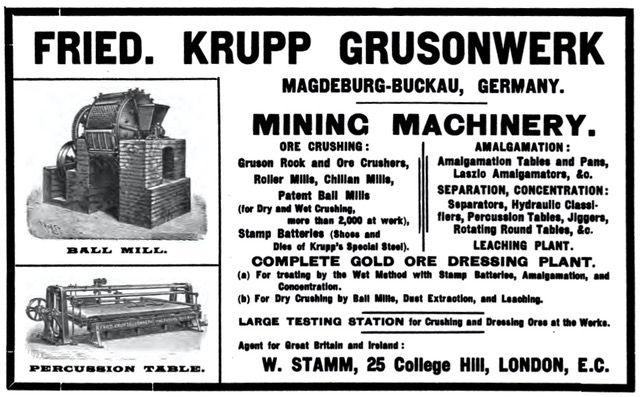
The machines used in the mines also often came from German companies. The geologist Karl Schmeisser, who was considered a German Transvaal expert, lobbied German mechanical engineering companies to compete with the British and Americans in this field. With success: in the years leading up to the exhibition, exports of heavy machinery from the German Reich to the Transvaal increased more than tenfold. The Fried. Krupp company, one of the largest German heavy industry companies, not only supplied the small mine railway to the exhibition on Ku'damm, but also operated a branch in Johannesburg. [25]
The Berlin-based electronics company Siemens & Halske was part of one of Europe's first multinational corporations and the largest electricity supplier to the Witwatersrand mining region. In 1894, the company was granted the concession to electrify Johannesburg and the surrounding mines. Like Krupp, Siemens had a presence in Johannesburg since the mid-1890s. [26]
Individual Germans were also involved as lobbyists and holders of public office in the creation of the legal framework for gold production in the Transvaal. [27]
Contrary to what the depiction on Kurfürstendamm suggested, however, the mines of Transvaal were not a pure machine world. Countless workers were needed to manage them. Most of the heavy labor was done by low-paid black miners. [28] Through their wage labor, local companies were integrated into the globalized Transvaal gold industry, whose profits flowed to the white elites of colonial South Africa and to the industrial centers of the north.
At the beginning of the boom in the Transvaal, Africans still occupied their own niches in the rapidly transforming economy. They recognized the needs of the new industry and became entrepreneurial. For example, some Zulu organized themselves in the washermen's guild AmaWasha and the Mfengu as transport service providers. [29]
But self-determined economic activity in the gold sector became increasingly difficult. The mine operators, like the Boer farmers, saw Black Africans as nothing more than a disposable mass of unskilled labor, which they wanted to be as cheap and controllable as possible. [30] The progressive land grabbing by the Boers increased the pressure for proletarianization – yet Africans were only willing to do dangerous work in the mines in emergencies. The gold industry and the Transvaal government were therefore busy for decades fine-tuning the means of pressure with which they recruited and controlled Black workers. [31]
In 1899, about 100,000 black miners worked on the Witwatersrand, mainly underground. They were initially recruited by private agencies, which also resorted to coercion. The men came from all over southern Africa, many from the Portuguese colony of Mozambique. They came to the Transvaal without their families, where they lived and worked under the most adverse conditions. [32]
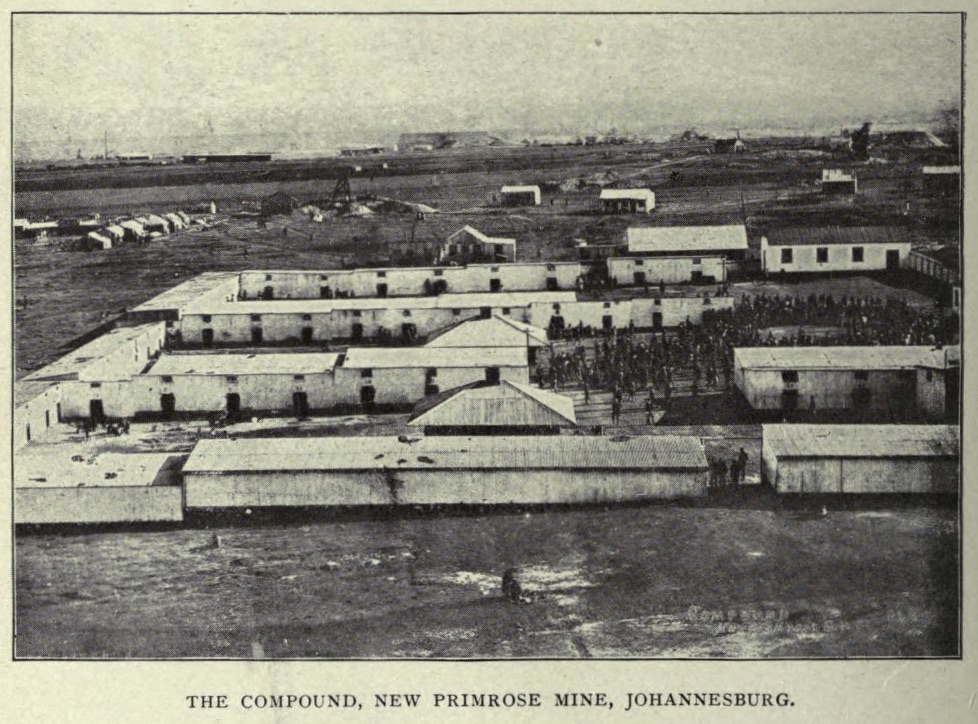
The migrant workers were segregated from social and cultural life in Johannesburg. During the term of their contract, which usually lasted one year, they lived in mass accommodation (compounds) on the mine site (Fig. 5). These were organised in a military-like manner; the lives of the workers were strictly monitored by a black compound police . [33]
Outside contemporaries described the medical care of the black miners in the compounds as disastrous. Many fell ill and died of infections after accidents at work and pneumonia, which would have been milder if better care had been provided. The living conditions and the inadequate meals, mainly consisting of maize porridge, exacerbated the situation. [34]
In their factories, the mine owners and managers established a racist work hierarchy. Black miners hammered holes in the tunnels for the dynamite that was later used to blast the rock. In doing so, they were always under the supervision and control of white foremen. [35] Harassment and assaults by foremen and compound police were part of the everyday life of Black workers. [36]
Wage inequality was also enormous. The white skilled workers were recruited in Europe and the USA with the prospect of high wages. According to one report, in the early 1890s they earned 16-18 shillings a day, while the black workers earned only 2-3 shillings. In order to save further wage costs for the black workers, many mine operators did not charge them for the strenuous shoveling away of the blasted rock as working time. [37]
The privileged position of the white foremen was no secret in this country. "[T]he positions of responsibility are occupied by whites and are paid excessively," could also be read in the program booklet for the Transvaal exhibition. [38]
The state and the mining sector cooperated in consolidating the racist work hierarchy. From 1893 onwards, so-called colour-bar laws were introduced in the Transvaal. These solidified the existing social practice of reserving supervisory activities in the mines and also the status of skilled workers exclusively to white employees. [39]
In the discussions about the first colour bar laws, it became clear that the existing wage differences were not based on skills, but represented racial inequality. Some employers spoke out against a colour bar . They wanted to employ Africans in skilled worker positions – in order to pay them less. In doing so, they themselves admitted that Black workers could carry out the tasks "reserved" for whites and, in some cases, de facto carried them out. However, with the legal colour bar and the short contract periods, Black workers were systematically denied opportunities for advancement. [40]
The low wages of black miners were enforced not only by denying them skilled worker status, but also by open repression. The compound police were intended to prevent strikes and so-called "desertions". The mining industry referred to the unauthorized leaving of the workplace as "desertion".
Since there was no way for Black miners to negotiate with employers (for example in trade unions), "desertion" was often the only way to resist and, if necessary, to obtain better conditions. Black workers tried to use the fact that the mines were constantly competing with each other for workers as a room for maneuver. They were lured away by competing mines with – mostly empty – promises of better salaries and conditions. [41]
Increasingly, however, the mining companies found their own practice of poaching dysfunctional and joined forces to jointly achieve low wages and control labor. In response to their lobbying, the Transvaal government passed a law in 1895 requiring Black workers to carry a passport tag at all times so that "deserters" could be identified and prosecuted. After trying to prevent people from moving and leaving their place of work, the mines collectively decided in 1896 to reduce the wages of Black workers by 30%. [42]
This work organization and workers' control already had central features of the later apartheid system. The migration system, the restriction of freedom of movement through passport laws, and the denial of social advancement through a colour bar would shape the lives of Black South Africans until the end of apartheid. [43] At the Transvaal exhibition, however, this social reality of the early South African gold industry was not visible.
Local potato pancakes, global gold rush
The backdrop city on Kurfürstendamm was an artificial place of metropolitan entertainment and at the same time referred to a real place: the gold region of the Transvaal. In Wedding, a Transvaal road still bears witness to the German entanglements with this colonial site. On the Ku'damm, there is no trace of the exhibition in the cityscape.
As part of Berlin's colonial history, the Transvaal exhibition illustrates that colonialism around 1900 took place in a globalized world. Germans acted as actors not only in German colonies, but in the entire colonial world.
Much of Germany's investment in Africa at the turn of the 20th century was made in colonies of other European powers, such as the Transvaal. [44] The Transvaal gold industry and its exploitative practices were the result of trans-imperial conflicts, collaborations, and transfers with German involvement. The financing, engineering, and personnel of many mining companies were of multinational origin. The racist labor organization in the mines and the control techniques that maintained them migrated from one colonial theater to the next. [45]
British, German, American and Boer actors competed with each other for advantages in the economy and politics of the Transvaal, but they all created and advocated a racist social and economic order.
The racist discourses about Africans also took place in several, interconnected Western public spheres. From American mine managers in South Africa to Karl Schmeisser, who taught at the Charlottenburg Mining Academy, to the "Völkerschau" of the Transvaal exhibition: the discourse on "education for work", the defamatory portrayal of Africans and the glorification of white supremacy – they all contributed to the legitimisation of social conditions in the colonies.[46]
Maren Fußwinkel
- LOCATION
- between Kurfürstendamm and Savignyplatz city station
- TODAY
- between Kurfürstendamm, Knesebeckstraße, Uhlandstraße and Kantstraße
Citing the article
Maren Fußwinkel: Die Transvaal-Ausstellung am Kurfürstendamm (1897). In: Kolonialismus begegnen. Dezentrale Perspektiven auf die Berliner Stadtgeschichte. URL: https://kolonialismus-begegnen.de/geschichten/die-transvaal-ausstellung-am-kurfuerstendamm-1897/ (04.11.2022).
Literature & Sources
[1] The Transvaal Exhibition in Berlin. In: Der Bär. Illustrated Weekly Journal for Patriotic History. 04.09.1897. pp. 426-427.
[2] Official guide to the Transvaal exhibition on Kurfürstendamm and Savigny-Platz city station. Berlin: 1897. Weylandt & Bauchwitz. S. 1. Available online: https://www.digi-hub.de/viewer/image/BV042897070/3/ (Accessed: 08.10.2021). The company was called "Ausstellung am Kurfürstendamm GmbH" – the shareholders are not yet known. The public faces of the company were the archaeologist Max Ohnefalsch-Richter and the "Völkerschau" entrepreneur Willy Möller. Cf. ibid.: p. 21.
[3] Der Bär 1897: p. 426.
[4] It is not yet known whether others followed.
[5]Cf. Bender, Steffen: Der Boer Krieg und die deutschsprachige Presse. Perception and Interpretation between Boer Euphoria and Anglophobia, 1899 – 1902. Paderborn/Munich (u.a.): 2009. p. 29.
[6]Cf. Tuffnell, Stephen: Engineering Inter-Imperialism: American Miners and the Transformation of Global Mining, 1871–1910. In: Journal of Global History 10.1 (2015). 53–76. Here: p. 56; Belich, James: Replenishing the Earth. The Settler Revolution and the Rise of the Anglo-world, 1783 – 1939. Oxford: 2009. Oxford University Press. p. 380.
[7] Cf. Rosenbach, Harald: Das Deutsche Reich, Great Britain and the Transvaal (1896 – 1902). Beginnings of German-British Alienation. Göttingen: 1993. Vandenhoeck & Ruprecht. pp. 26-37.
[8]Cf. Jochens, Birgit/Miltenberger, Sonja/Museum Charlottenburg-Wilmersdorf (eds.): Von Haus zu Haus am Kurfürstendamm. Geschichte und Geschichten über Berlins ersten Boulevard. Berlin: 2011. Textpunkt-Verlag. p. 44; Der Bär 1897: p. 426.
[9]Cf. Officieller Führer 1897: p. 6; 8; 31.
[10]Ibid.: p. 8.
[11]Cf. Möhring, Maren: Culinary Journeys on Site. Early Experience Gastronomy at Colonial and World Exhibitions. In: Historische Anthropologie 25.1. 2017. pp. 49–74.
[12] Transvaal, the large ethnographic-anthropological exhibition at the "Kurfürstendamm" or at the "Savigny-Platz" tram station, 1897, p. 2.
[13]Ibid.
[14] Official Guide 1897: p. 23.
[15]Cf. Van der Heyden, Ulrich: Die Kolonial- und die Transvaal-Ausstellung 1896/97. In: Ders./Zeller, Joachim (eds.): Kolonialmetropole Berlin. Eine Spurensuche. Berlin: 2002. S. 135–142. Here: p. 139.
[16] Cf. Van der Heyden 2002: p. 138. On the other hand, members of Cameroonian elites also traveled to the Treptow Colonial Exhibition, for example, in order to pursue diplomatic goals.
[17] Cf. Roman, Ines: Exotic Worlds – The Staging of Egypt in the Special Exhibition "Cairo" of the Berlin Trade Exhibition of 1896. Heidelberg: 2010. p. 26; Van der Heyden 2002: p. 135.
[18]Ibid.: p. 139.
[19]Cf. Conrad, Sebastian: Deutsche Kolonialgeschichte. 3rd edition. Munich: 2016. C. H. Beck. pp. 70f.
[20] The Transvaal Exhibition in Berlin. Conclusion. In: Der Bär. Illustrated Weekly for Patriotic History. 11.9.1897. p. 439. Cf. Conrad 2016: p. 70.
[21] Cf. Conrad, Sebastian: Globalisation and the Nation in Imperial Germany. Cambridge University Press. pp. 77-91.
[22] Cf. ibid. Mobilizing workers for colonial plantations and industries was a constant problem because the local population resisted. To advance their proletarianization, a number of direct and indirect coercive measures were discussed and applied: from tolerating existing slave economies to threatening and bribing local rulers to high taxation that forced people to engage in wage labor. All this, as well as the violent disciplining of workers, was discussed under the euphemism "education for work".
[23]Cf. Belich 2009: p. 379; Katz, Elaine N.: Revisiting the Origins of the Industrial Colour Bar in the Witwatersrand Gold Mining Industry, 1891-1899. In: Journal of Southern African Studies 25.1 (1999). pp. 73-97. Here: p. 77.
[24] Cf. Rosenbach 1993: p. 40ff. Siemens & Halske was also involved in this Rand Central Ore Reduction Co. Ltd. Cf. Officieller Führer 1897: p. 21.
[25] There are contradictory statements on the question of whether German or American machines dominated the Transvaal market. Cf. Tuffnell 2015: p. 61; Van Helten, J. J.: German Capital, the Netherlands Railway Company and the Political Economy of the Transvaal 1886-1900. In: The Journal of African History 19.3 (1978). S. 369–90. Here: p. 375f. Schmeisser travelled to the Transvaal in 1893 on behalf of the Prussian Minister of Trade, cf. Rosenbach 1993: p. 39. In: Journal of the Association of German Engineers. 21.02.1894. p. 449 and Germany's relations with the Transvaal. In: Die Grenzboten. Zeitschrift für Politik, Literatur und Kunst. 1896. First Quarter. pp. 305-310. Here: p. 307.
[26]Cf. Hebestreit, Franz: Gold Rush in South Africa. Siemens brings electricity to cities and mines. Available online: https://new.siemens.com/de/de/unternehmen/konzern/geschichte/stories/goldrausch-in-suedafrika.html (Accessed: 07.10.2021).
[27] Cf. Katz 1999: p. 76.
[28]Cf. Belich 2009: p. 382.
[29]Cf. Davie, Lucille: AmaWasha – Jozi's first black businessmen. In: The Heritage Portal. Available online: http://www.theheritageportal.co.za/article/amawasha-jozis-first-black-businessmen (accessed: 5.10.2021); Belich 2009: p. 384.
[30]Cf. Katz 1999: p. 77; Belich 2009: p. 382.
[31] Cf. Jeeves, Alan H.: Migrant Labour in South Africa's Mining Economy. The Struggle for the Gold Mines' Labour Supply 1890-1920. Kingston/Montreal: 1985. McGill-Queen's University Press. p. 4.
[32] Recruitment was a lucrative branch of the economy in its own right: the mine operators paid the agents high fees for the workers they needed en masse. Cf. Jeeves 1985: pp. 19ff.; 44ff.
[33] Zulu were recruited for these police tasks. Cf. Jeeves 1985: p. 22; 27.
[34] Cf. ibid.: pp. 22-27.
[35] Cf. Katz 1999: p. 77.
[36]Cf. Jeeves 1985: p. 27.
[37]Cf. Schmeisser 1894: p. 425; Jeeves 1985: p. 23; Katz 1999: p. 77.
[38] Official Guide 1897: p. 21.
[39] Cf. Katz 1999: pp. 84ff.; 91. Only the first colour bar laws used language that explicitly excluded "persons of colour" from certain activities. Although later versions used race-neutral language in the text of the law, in their concrete application they served to establish a colour bar, i.e. exclusive access to skilled and management positions for white South Africans.
[40]Cf. ibid.: p. 87; 95ff.
[41]Cf. Jeeves 1985: p. 22; 27; 43.
[42] Cf. ibid: pp. 42ff.
[43] Cf. ibid.: p. 3; Katz 1999: p. 95.
[44]Cf. Blackbourn, David: History of Germany 1780-1918. The Long Nineteenth Century, Malden (et al.): 2003 (Second Edition). Blackwell Publishing. p. 253.
[45]Cf. Schaper, Ulrike: Deutsche Kolonialgeschichte postkolonial schreiben: Was heißt das? In: Bundeszentrale für politische Bildung (ed.): Aus Politik und Zeitgeschichte 40-42: Deutsche Kolonialgeschichte. Bonn: 2019, pp. 11–16. Tuffnell 2015: pp. 53ff.
[46]Cf. Katz 1999: p. 82; Karl Adolf Schmeißer. In: Catalogus Professorum. Professors of TU Berlin and their predecessors. Available online: https://cp.tu-berlin.de/person/1799 (accessed 11.10.2021).
Tags
#Apartheid#Arbeitsmigration#Bergbau#Bergwerk#Buren#Charlottenburg#colour-bar laws#compounds#Deutsche Bank#Exotismus#Fritz Reuter#Georg von Siemens#Gewerbeausstellung#Goldbergbau#Goldindustrie#Industrialisierung#Industrie#Johannesburg#Karl Schmeisser#Kolonialausstellung#koloniale Continuities#Kolonialwaren#Konsum#Krupp#Kurfürstendamm#Maschinenbau#Minenarbeit#Mission#Randlords#Rassismus#Rohstoffe#Savignyplatz#Siemens & Halske#Südafrika#Transvaal#Völkerschau#Witwatersrand