August zu Eulenburg and the Prussian "East Asia Expedition"
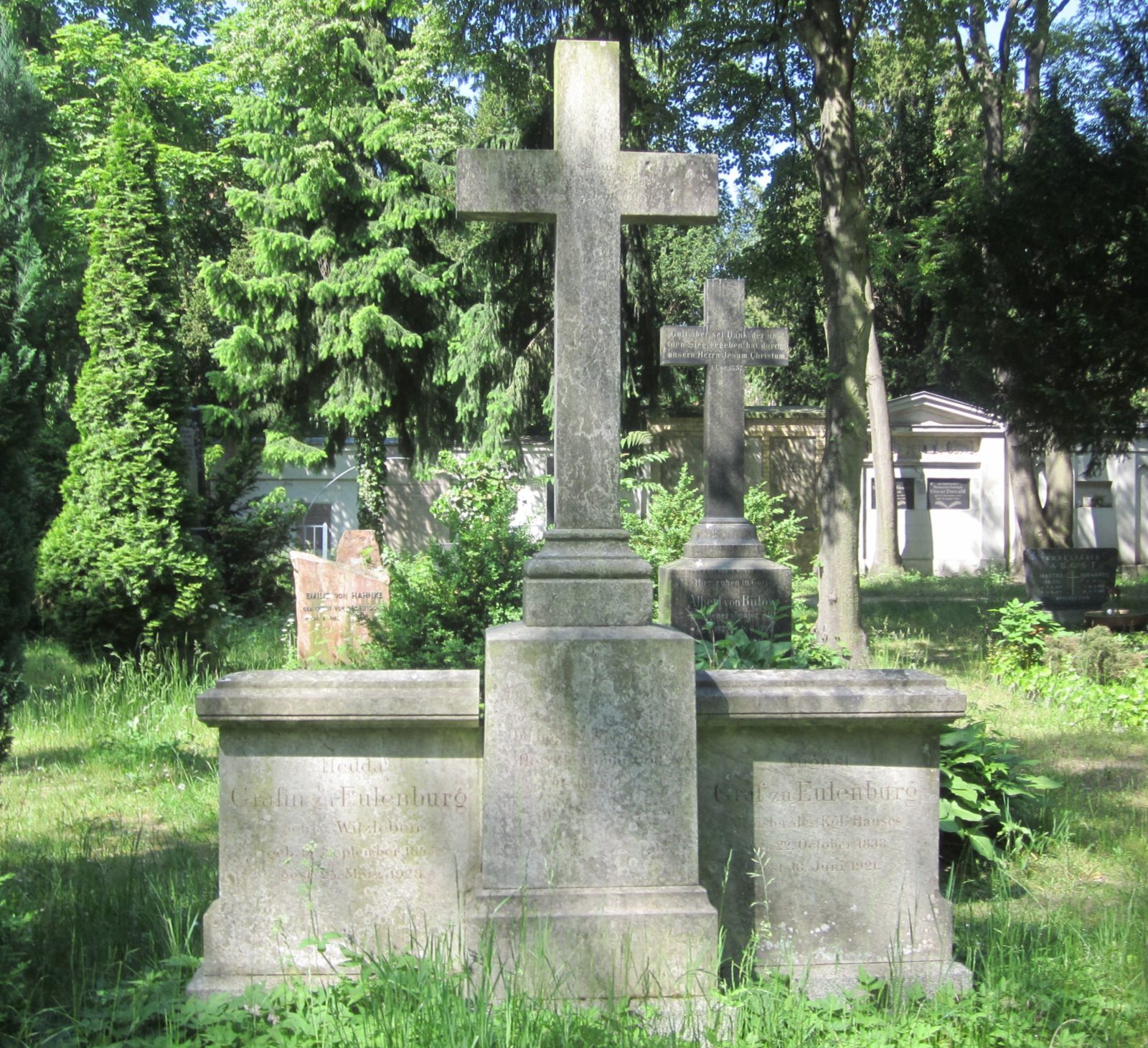
A whole series of graves, street names and monuments in Kreuzberg refer to the history of the no longer existing state of Prussia. Little is known today that even before the formation of the German Empire, there was reason about colonial conquests in Prussia and that the Prussian navy undertook "expeditions" to enforce trade treaties and establish bases. In Kreuzberg, however, there is a veritable ensemble of memories of this chapter of Prussian history, which consists of two central streets in the former postal delivery district Südost 36, Adalbertstraße and Admiralstraße, as well as a grave in Cemetery I of the Dreifaltigkeitsgemeinde (entrance on today's Mehringdamm), that August zu Eulenburg. This ensemble includes another street, this time in Neukölln, which commemorates Ernst Friedel, who, as a city councillor, was primarily involved in the creation of important parks (such as Victoria Park with Karl Friedrich Schinkel's victory monument in Kreuzberg). Prince Adalbert (Adalbertstrasse was named after him in 1847, Admiralstrasse in 1869) was instrumental in the creation of a German navy and aggressively advocated the creation of overseas bases at an early stage – anticipating the imperialist naval policy of the later German Empire. August zu Eulenburg took part in the so-called East Asia Expedition from 1860 to 62, which Prussia sent out in the name of all German states to agree on trade treaties with Japan, China and Siam (today's Thailand), if necessary to enforce them. Ernst Friedel, on the other hand, wrote an entire "study" in 1867, "The Founding of Prussian-German Colonies in the Indian and Great Oceans with Special Consideration of East Asia", in order to make the colonial acquisition of Formosa (today's Taiwan) palatable to the Prussian leadership.
Prince Heinrich Wilhelm Adalbert of Prussia was born in 1811 as the nephew of King Frederick William III. He was interested in seafaring at an early age, which, according to his biographer, was due to the fact that he was friends with the son of Court Marshal Louis Graf von der Groeben. The latter, in turn, was a direct descendant of Otto Friedrich von der Groeben, who led the expedition in 1682 that ultimately led to the founding of the colony of Groß-Friedrichsburg in present-day Ghana. [1] The "lack of a naval power of its own"[2] became Adalbert's major theme, and in 1848 he presented a "Memorandum on the Formation of a German War Fleet". In it, he already wrote that a functioning fleet "could, if necessary, enforce for our young flag in Chinese waters the respect that the other seafaring nations already enjoy there". [3] In 1849 he became "Commander-in-Chief of all equipped war vessels", in 1854 "Admiral of the Prussian Coasts" and Commander-in-Chief of the Royal Prussian Navy.
In 1856 he sailed in the Mediterranean on board the largest warship ever built in Prussia, the steamer corvette Danzig, and ordered the first overseas intervention by a German navy. He took advantage of a case of piracy four years earlier (undoubtedly a problem for merchant shipping in those days) to give the order to land on his own initiative on 7 August at Cape Tres Forcas in what is now the Rif area near Melilla and Nador. The corps of 66 men could hardly get beyond the beach in view of the unfavourable landing site and the local superiority and soon withdrew – the "balance" on the Prussian side was seven dead, 12 seriously and 10 slightly injured. Potential victims on the other hand are not mentioned in the literature, which is usually affirmative on this topic. [4]
The incident played hardly any role militarily or politically; the Prussian leadership, however, met Adalbert with restraint afterwards. At the same time, however, the Admiralty identified the Rif region as a possible destination for a German emigrant colony in a memorandum. [5] Prince Adalbert remained true to his program and was finally heard again when Prussia decided to send an "expedition" to Japan, China and Siam in August 1859. In May 1860, he gave a so-called immediate lecture in Berlin (immediately to the Prussian king) to Prince Regent Wilhelm (who represented the sick king, later he became Wilhelm I). He spoke about colonial affairs and named the east coast of Patagonia (today Argentina at the southern tip of Latin America) and the Solomon Islands in the South Pacific (the northern part of the archipelago actually became a German "protectorate" in 1886) as areas that could be considered for a strategic seizure. In later memorandums, the Admiralty added the island of Formosa, today's Taiwan. [6]
The equipping of an "expedition" to East Asia was mainly justified by the prospects of flourishing trade. In 1842, Great Britain had defeated China in the First Opium War and thus also gained access to the other European powers – China was in a state of semi-colonial dependence. In 1853, an "expedition" under the command of Commodore Matthew Calbraith Perry had landed in Japan and forced the government there to conclude trade treaties that were extremely advantageous to the USA under threat of force. In the same year, a Russian "expedition" under Admiral Yevfimiy Vasilyevich Putyatin landed. Previously, Japan had successfully completed itself for over 200 years; only the Dutch were allowed to trade via the artificial islet of Dejima in the Bay of Nagasaki. In this case, too, treaties with all imperialist powers soon followed.
Until 1859, the continentally oriented Prussian government had shown little interest in expanding into East Asia. This changed in 1859 when the Austrian warship Novara returned from a circumnavigation of the world. Prussia saw this as a threat to its leading role among the German states. It can be assumed that competition with Austria originally contributed more to the equipment of the "expedition" than a genuine colonial interest. [7] In addition, the navy symbolized a pan-German national prestige. [8] The predominantly liberal deputies in St. Paul's Church had already decided in 1848 to found a German navy – certainly also with a view to future imperial international standing. However, the imperial fleet that was then created remained small and was even soon wound up again – some ships were subsequently transferred to Prussia. In the consciousness of the population, however, the navy remained the only project that embodied the unity of Germany. Companies like Krupp built warships without regard to cost coverage; ordinary people donated considerable sums. The schooner "Frauenlob", which was to take part in the East Asia "expedition", was mainly financed by donations from women. [9]
Prussia thus began the largest naval enterprise since 1848 in the service of the German cause – the trade treaties to be concluded were to apply not only to Prussia, but to the entire German Customs Union. This was also recognized by the non-Prussian participants of the "expedition". Gustav Spieß, representative of the Saxon Chamber of Commerce, later wrote in his memoirs of the trip: "What jubilation was loud when one could hope that Prussia would support this work in a national, German sense." [10] However, the Prussian navy – Prince Adalbert never tired of emphasizing this – was not prepared for this mission. Four ships took part, the warships "Arcona" and "Thetis", the transport ship "Elbe" and the aforementioned schooner "Frauenlob". Putting together a crew proved to be difficult – many of the 652 men had no experience with seafaring, and this was also true for the officers. Against this background, the voyage became a series of bankruptcies and mishaps – crew members deserted; the "Arcona" dragged itself from accident to accident, and the "Frauenlob" even sank with the entire crew in a typhoon off Japan. On Formosa, of all places, the "Elbe" became involved in the squadron's only battle. Shore-goers in search of provisions had been attacked by residents. The ship's artillery responded by wiping out the village and part of the inhabitants – a harbinger of later "punitive expeditions" in the fight against indigenous resistance. [11]
The fact that violence was otherwise avoided and that colonization projects were also shelved was due not only to military weakness but also to the leader of the expedition, Friedrich Graf zu Eulenburg, after whom the "expedition" is often named. Frederick's nephews were August zu Eulenburg, who was buried in Kreuzberg, and Philip zu Eulenburg, who in turn gave his name to what was perhaps the greatest scandal of the later Empire. Frederick proved to be "a bon vivant and a diplomat who was reluctant to make any efforts" [12]. The Count's letters, which were later published by Philip, give a vivid impression of this: Eulenburg fills pages and pages with descriptions of evening parties, rides, country outings, sightseeing, the weather or even his own well-being. [13] After his appointment as leader of the expedition, Frederick had studied the memoirs of Commodore Perry[14] and had travelled to Paris to receive advice from Lord Elgin and Baron Gros, the leaders of the East Asian activities of England and France. As far as dominance in East Asia was concerned, the European powers at the time showed solidarity, which in turn did not prevent them from competing: the Prussians were virtually urged by the French to colonise Formosa, which was intended to help undermine British dominance in China. In Berlin, the Formosa affair was finally discussed back and forth until Eulenburg was instructed to explore the possibilities in Formosa. The "expedition" had just returned to Nagasaki from signing the contract in China, where Eulenburg was writing a response that basically declared that he would ignore the order. [15]
Nevertheless, the "expedition" as a whole can be characterized as imperialist. The trade treaties that were to be concluded turned out unfavorably for the countries concerned, with the Japanese, Chinese and Siamese negotiators hardly being able to understand the direction of some passages. Eulenburg also addressed this openly in a letter from Japan: "The people have no idea of the real meaning and scope of the treaty provisions." [16] Behind the "negotiations" was the concentrated military power not only of the Prussian "gunboat diplomacy", but of all the Western powers, which, as I said, showed astonishing solidarity. Eulenburg's letters and the "Official Sources" on the "expedition" in four volumes[17] also show that his first visits were always to the legations of the other imperialist powers. As a great power, Prussia saw itself not only entitled, but quasi obliged, to enter "world traffic" "belatedly" but in a robust way. This is clearly expressed in the evaluation of the treaty with Japan in the "official sources", whereby the intervention is already dressed up as a "cultural mission" at this point in time: "The present period marks the beginning of Germany's civilising activity on a large scale, the development of which will become a major moment in world history for the next centuries (...). It is not overpopulation, the desire for adventure or the ease of maritime traffic that drives them out, (...), but the inner vitality of the nation (...) and the unconscious vocation of Germanic education, the most beautiful fruit of modern history, to spread and assert itself." [18]
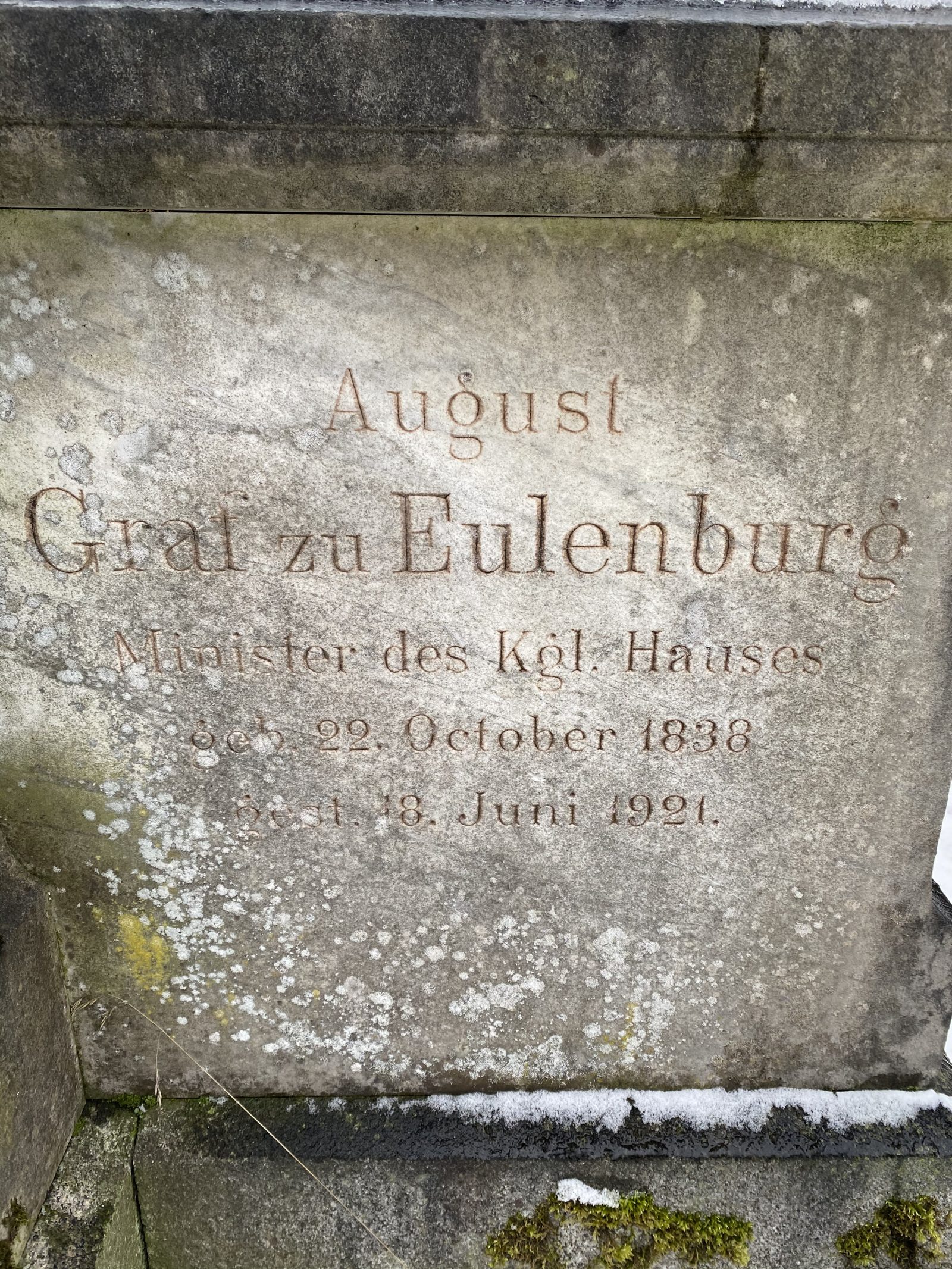
August zu Eulenburg was actually a lieutenant in the infantry, but became attaché to this "mission" under his uncle. Not too much is known about August's work during the two years, but he must have done mainly practical tasks. He is mentioned several times in Friedrich's letters: August gets on horseback armed with other participants to find out something about the murder of the Dutch translator Henry Heusken[19]; August enters at five o'clock in the morning and reports the arrival of a French steamer[20]. Other attachés were undoubtedly more important. As befits "expeditions", the maritime, oceanographic and navigational experiences – for Prussia outside Europe for the first time – were to be collected and evaluated on the journey. Minister of Culture August von Bethmann-Hollweg had commissioned the Berlin Academy of Sciences to select the best botanists, zoologists, geologists, geographers and two artists. [21]
These researchers, who willingly accompanied an imperialist "expedition", all came from the environment or network of Alexander von Humboldt, who has been frequently discussed in recent years, who had already ennobled the sending of the "Novara" as the "great and noble undertaking in honour of the common German fatherland"[22], but died shortly before the voyage of the Prussian warships. Two people are worth a brief, closer look. The painter Wilhelm Heine was a direct friend of Humboldt, who also helped him to flee to New York after the failed revolution of 1848. Heine joined the Perry "expedition" there – his drawings, in turn, had a massive influence on the image of East Asia in Prussia. During this "expedition" he kept in touch with Philipp Franz von Siebold, who is revered today as the "founder of international research on Japan" (Wikipedia), who at that time sought to support or bring about the "opening" of Japan with self-financed memoranda to the imperialist powers. [23] Another person to be mentioned here is Ferdinand Freiherr von Richthofen, a geologist by training, who separated from the scientists of the "expedition" (who had taken a different route after leaving Japan) off Siam. [24]
After some confusion, Richthofen was able to embark on geographical research trips to China from 1868 onwards, the printed "results" of which brought him worldwide fame. The second volume is undoubtedly important for the German discussion of colonialism, in which Richthofen points out the importance of a port in the later "leased area" of Kiautschou. [25] Richthofen had previously approached the Prussian government with memoranda on possible ports in China. In the chapter on "The Mountainous Country of Shan-Tung" it becomes clear how the traveling scientist from the metropolis is always involved in the violence of appropriation in the imperialist age, how he chases after or in this case precedes the conquest. At the end of the chapter, Richthofen describes the coast of Kiautschou with its maritime potential and its coal-rich hinterland on the Shandong peninsula (in fact, he had not even visited the coast himself) with a view to a (German) annexation: "The advantages of a foreign settlement" are immense, Richthofen stressed, and in view of China's inevitable "upswing" in "material, intellectual and industrial terms" urged that "the foreign powers secure the greatest possible advantages". [26]
When the "expedition" arrives in Japan, a situation arises for the Japanese negotiators that has been very aptly described in a book title as "negotiating with imperialism". [27] Eulenberg wants the same treaties as the other powers, and the warships and, above all, the solidarity of the Western powers – fragile, but also intact at crucial moments – ensure that the Japanese side has to agree to the conditions. What is astonishing at all places of the "expedition" is the matter-of-factness with which the Prussian diplomats insist on their right to receive unequal "friendship" and trade treaties. The only chance for the Japanese negotiators is ultimately endless delays, which makes Eulenbug angry. "I was glad that I was finally rid of these guys," he complained on September 21, 1860, "they are beginning to ennuate me." [28]
He also does not receive any reasonable information about the country, as he repeatedly says that they "cheerfully start talking, but in the course of half an hour contradict each other ten times and lie as if printed". [29] Although people from the West are often attacked and the translator even falls victim to an assassination attempt, Eulenberg warms to Japan because of its similarity: "We rode into the vicinity of the city (Jeddo, today's Tokyo), which is quite beautiful and vividly reminds us of the Prussian Oberland." [30] In the end, the treaty is concluded, although the Japanese negotiators successfully refuse to transfer the clauses to the other German states – the complicated structure of the Zollverein (rightly) appears to them as an additional threat, and they feel downright snubbed by the demand. The extent to which such demands and finally the treaties are nevertheless perceived as a defeat is shown by the fact that one of the two negotiators, the State Councillor for Foreign Affairs, Hori Oribe no kami Toshihiro, commits suicide by "seppuku", i.e. by a ritualized type of suicide that presupposes a loss of face due to a breach of duty. [31]
While Eulenburg exercises patience in Japan, he is far more demanding in China. This also had to do with the negative perception of the country and its inhabitants, which had already been established since the Opium War. The "official sources" reveal an undisguised imperialist view: the participants see only chaos, dirt, crowds, labyrinths, drug use, cruelty, inexplicable rituals or equally inexplicable idleness. [32] Although China offers documents of a past high culture everywhere, the Prussians observe signs of neglect and a blatant lack of energy right next to it: China gives the "impression of deep decay". [33] While the Europeans have gone out to actively write history, the former hegemonic power appears in all things only "stationary"[34] as Reinhold von Werner, the commander of the Elbe, said.
In fact, the colonial regime was already intact when the Prussians arrived: the envoys of the European powers and the USA acted de facto like colonial governors from a large number of territorial bases; trade was duty-free for the merchants; the people from the West were not subject to Chinese jurisdiction and the "Chinese were usually treated like people of the lower class", so they were sometimes beaten indiscriminately in the street. [35] While the Prussians still imagine that their advantage over the other nations lies in the fact that they regard the "colored races" as "fellow human beings"[36], even the uncritical historical studies come to the conclusion that the expedition members in China quickly imitate "the airs and graces of the other powers": "The Prussians learned the colonial bad habits amazingly quickly". [37]
As far as Siam, i.e. today's Thailand, is concerned, the behaviour and also the later descriptions are much friendlier, which simply has to do with the fact that the kingdom is aware of its weak position and already holds out the prospect of signing the treaty during the first talks. Nevertheless, shortly before signing, Eulenberg even follows up with demands. [38] Some of the blatantly racist remarks in the "official sources" show that the descriptions would probably have turned out like in China if Siam had not been cooperative. The religious practices are characterized as "flat symbolism" and "unadulterated nonsense" and add to the "bottomless inconsistency of corrupt Buddhism".[39] In a conversation with Eulenburg in December 1861, the king analyzes the expansionist ambitions of the Western powers very carefully: first come explorers, he says, then traders, soon the first Europeans settle, finally they own "entire empires". When asked whether Prussia intended to acquire colonies, Eulenburg replied that Prussia would "hardly keep its eye on tropical regions" in this matter, which was an outright lie, because Eulenburg had already commented on Berlin's wishes to explore colonial options in October. [40]
In fact, the discussion was anything but settled. In the 1860s, the topic was also discussed in public, for example by Ernst August Friedel, who is honored with a street in Neukölln. Friedel met regularly with Franz Maurer, an editor of the Vossische Zeitung, and later with the geographer and African traveler Otto Kersten, who eventually founded the short-lived "Central Association for Commercial Geography and Promotion of German Interests Abroad". [41] This group talked about colonial affairs and decided that each member should publish a pamphlet on a territory that would be eligible for colonization. Friedel had already vehemently brought Formosa into play in the Vossische Zeitung in 1865 and published his book on the "Founding of Prussian-German Colonies" in 1867. [42] The diplomat Max von Brandt, on the other hand, a member of the "expedition" and later consul of the German Empire in Japan and envoy to China, concentrated on Korea (then a protectorate of China) in 1870 and even undertook a reconnaissance trip to Fusan (today's Busan) with the armoured deck cruiser "Hertha". [43] At the same time, Adolf Bastian (the later founder of the Berlin Museum of Ethnology), who was often wrongly regarded as an opponent of colonialism, published a memorandum entitled "Germany's Interests in East Asia" with some members of the Society for Geography. The authors emphasized that in view of the "convulsions" to be expected in China, only those nations could secure their trade advantages "which are able to develop a formidable power before the eyes of those half-barbarians, who have thus found a firm foothold in the seas there and are able to direct their operations from there."[44]
The "acquisition of a German naval station" called for in the memorandum then took place: first by sending out an East Asia squadron and in 1897 by occupying the later "leased area" of Kiautschou. It would hardly be presumptuous to regard the East Asia "expedition" as a forerunner of this violent appropriation. [45] In his memoirs, Alfred von Tirpitz, who later became the designer of the imperialist naval policy of the German Empire, mentions the Prussian "expedition" as the "glorious deed" of the Prussian navy, which otherwise had little "tradition". [46] Wilhelm II was very interested in China – especially in the threat that supposedly emanated from there. As early as 1895, the Emperor commissioned the lithograph "Peoples of Europe, Preserve Your Most Holy Goods" based on his own design, which he then gave to the Russian Tsar. It shows the Archangel Michael leading the European nations against a Buddha floating in the clouds. A little later, Wilhelm showed that he considered the "yellows" to be true devils with his infamous "Hun Speech" on the occasion of the dispatch of the German Expeditionary Corps to combat the Boxer Rebellion, with which the German head of state officially ordered the war of annihilation.
At that time, more precisely from 1890 to 1914, August zu Eulenburg served as court marshal of the emperor. His tasks included the organization of receptions and audiences, trips and state visits, as well as the supervision of the royal household. It remains pure speculation, but it does not seem unlikely that the experiences and opinions of such a close collaborator of the emperor were incorporated into his feelings of threat, his imperial intentions and his ruthless attitude towards Asia.
Mark Terkessidis
- LOCATION
- Cemetery I of the Trinity Community (at Blücherplatz)
- TODAY
- Trinity Cemetery I, 10961 Berlin Address: Mehringdamm 21
Citing the article
Mark Terkessidis: August zu Eulenburg und die preußische "Ostasien-Expedition". In: Kolonialismus begegnen. Dezentrale Perspektiven auf die Berliner Stadtgeschichte. URL: https://kolonialismus-begegnen.de/geschichten/august-zu-eulenburg-und-die-preussische-ostasien-expedition/ (03.03.2025).
Literature & Sources
[1] Cf. Duppler, Jörg, Prince Adalbert of Prussia. Founder of the German Navy, Herford 1986, p.23.
[2] Adalbert, Prince of Prussia, Memorandum on the Formation of a German War Fleet, Potsdam 1848. p. 1.
[3] Ibid., p. 20.
[4] Cf. Duppler, Prince Adalbert of Prussia. Founder of the German Navy, pp. 68f.; Petter, Wolfgang, Die überseeische Stützpunktpolitik der preußisch-deutschen Kriegsmarine 1859-1883, Inaugural-Dissertation, Freiburg 1975, pp. 36ff.; Boelcke, Willi A., So kam das Meer zu uns. Die preußisch-deutsche Kriegsmarine 1822 bis 1914. Berlin 1981, p.68.
[5] Cf. Petter, Die überseeische Stützpunktpolitik der preußisch-deutschen Kriegsmarine 1859-1883. Interest in the region was not to wane later on, as the active participation of the later German Empire in the imperial race for Morocco was to show. After the Second World War, there was a recruitment agreement with Morocco for workers, most of whom came to the Federal Republic from the Rif region.
[6] Cf. Siemers, Bruno, "Preußische Kolonialpolitik 1861-62", in: Nippon. Zeitschrift für Japanologie, 3 (1937), p. p.22.
[7] Cf. Lorenz, Reinhold, Japan and Central Europe. From Solferino to the Vienna World Exhibition (1859-73), Brno 1944, pp.17-50.
[8] Salewski, Michael, Die Deutschen und die See. Studien zur deutschen Marinegeschichte des 19. und 20. Jahrhunderts, vol. 1, Historische Mitteilungen: Beiheft 25, Stuttgart 1998, pp. 24ff.
[9] Ibid., p.16.
[10] Spieß, Gutav, Die preußische Expedition nach Ostasien während der Jahre 1860 – 1862, Berlin 1864, p.3.
[11] Cf. Martin, Bernd, "Die Preussische Ostasienexpedition und der vertrag über Freundschaft, Handel und Schiffahrt mit Japan (24 January 1861)", in: Krebs, Gerhard (ed.), Japan und Preußen, Munich 2002, pp. 87ff.
[12] Ibid., p.86.
[13] Cf. Graf zu Eulenburg-Hertefeld, Philip (ed.), Ostasien 1860-1862 in den Briefen des Grafen Fritz zu Eulenburg, Berlin 1900.
[14] Perry, Commodore M.C., The Expedition of an American Squadron to the China Sea and Japan, Performed in the Years 1853, 1853 and 1854, Washington 1856.
[15] Cf. Siemers, Preußische Kolonialpolitik 1861-62, pp. 28f; Petter, Die überseeische Stützpunktpolitik der preußisch-deutschen Kriegsmarine 1859-1883, pp. 70ff.
[16] Graf zu Eulenburg-Hertefeld, Ostasien 1860-1862 in den Briefen des Grafen Fritz zu Eulenburg, p.142.
[17] The Prussian Expedition to East Asia. According to official sources, First to Fourth Volume, Berlin 1864 – 1873.
[18] Ibid., Volume Two (1866), p. 165.
[19] Graf zu Eulenburg-Hertefeld, Ostasien 1860-1862 in den Briefen des Grafen Fritz zu Eulenburg, p. 150.
[20] Ibid., p. 179.
[21] Dobson, Sebastian, "Humboldt in Japan" in: Id. / Saaler, Sven (eds.), Under the Eyes of the Prussian Eagle: Lithographs, Drawings and Photographs of the Participants of the Eulenberg Expedition in Japan, 1860-61, Munich 2011, pp. 87ff.
[22] Quoted. after ibid., p. 83.
[23] Von Siebold, Philipp Franz, Urkundliche Darstellung der Endebungen von Niederland und Russland zur öffnungs Japans für die Schiffahrt und den Seehandel aller Nationen, Bonn 1854; Plutschow, Herbert, Philipp Franz von Siebold and the Opening of Japan. A Re-Evaluation, Folkestone 2007, pp. 53ff.
[24] Cf. Eming, Ralf, "Stahnsdorf: Letzte Ruhestätte des Geographen Ferdinand von Richthofen", in: Van der Heyden, Ulrich / Zeller, Joachim ( eds.), Kolonialismus hierzulande. Eine Spurensuche in Deutschland, Erfurt 2007, pp. 107 – 112.
[25] Freiherr von Richthofen, Ferdinand, China. Results of our own travels, Second volume, Das Nördliche China, Berlin 1882, pp. 261ff.
[26] Ibid., p. 266.
[27] Cf. Auslin, Michael R., Negotioating with Imerialism. The Unequal Treaties and the Culture of Japanese Diplomacy, Cambridge 2004.
[28] Graf zu Eulenburg-Hertefeld, Ostasien 1860-1862 in den Briefen des Grafen Fritz zu Eulenburg, p.77.
[29] Ibid., p. 100.
[30] Ibid., p. 70.
[31] Cf. Pantzer, Peter, "On the Signing of the Prussian-Japanese Treaty of Friendship and Trade and Shipping", in: Dobson / Saaler, Under the Eyes of the Prussian Eagle: Lithographs, Drawings and Photographs of the Participants of the Eulenberg Expedition in Japan, p. 62.
[32] Cf. The Prussian Expedition to East Asia, Third Volume (1873), pp. 381ff.
[33] Cf. ibid., p. 385.
[34] Von Werner, Reinhold, Die preussische Expedition nach China, Japan und Siam in den Jahren 1860, 1861 und 1862, 2nd edition, Leipzig 1873, p. 116.
[35] Stoecker, Helmuth, Germany and China in the 19th Century. The Penetration of German Capitalism, Berlin 1958, p. 25.
[36] Cf. Die Preußische Expedition nach Ostasien, Volume II (1866), p. 167.
[37] Salewski, The Germans and the Sea. Studies on the German Naval History of the 19th and 20th Centuries, p. 59.
[38] Cf. Die Preußische Expedition nach Ostasien, Fourth Volume (1873), p. 273.
[39] Ibid., p. 296.
[40] Ibid., p. 264.
[41] Cf. Bade, Klaus J., Friedrich Fabri and Imperialism in the Bismarck Era. Revolution – Depression – Expansion, Freiburg i.Br. 1975. Available online at: https://www.imis.uni-osnabrueck.de/fileadmin/4_Publikationen/PDFs/BadeFabri.pdf [last access: 28.05.2021]. Online edition: Osnabrück 2005, p.83. Note 3.
[42] Friedel, Ernst, Die gründung preußisch-deutscher Colonien im Indische und Großen Ozean mit besonderer Rücksicht auf das östliche Asien, Berlin 1867.
[43] Cf. Stoecker, Germany and China in the 19th Century. The Penetration of German Capitalism, pp. 78f.
[44] Bastian, Adolf Deutschlands Interessen in Ostasien. Printed as a manuscript, Berlin 1871, p. 45.
[45] Ibid., p. 43.
[46] Von Tirpitz, Alfred, Erinnerungen. Leipzig 1919, p. 9.
Tags
#Admiralstraße#Adolf Bastian#Alfred von Tirpitz#Arcona#August von Bethmann-Hollweg#Berliner Academy of Sciences#Besetzung#China#Elbe#Ernst Friedel#europäisches Colonial Regime#Expedition#Expeditionen#Ferdinand Freiherr von Richthofen#Flottenpolitik#Formosa#Forschung#Franz Maurer#Frauenlob#Friedhof I der Dreifaltigkeitsgemeinde Adalbertstraße#Handelsverträge#Imperialismus#Japan#Kiautschou#Korea#Kreuzberg#Kriegsschiffe#Louis Graf von der Groeben#Marine#Max von Brandt#Ostasien#Otto Kersten#Philip Franz von Siebold#Preußen#Prinz Heinrich Wilhelm Adalbert von Preußen#Shandong#Siam#Taiwan#Thailand#Thetis#überseeische Stützpunkte#Vossische Zeitung#Wilhelm Heine#Wilhelm II