The foundation of the Sarotti company
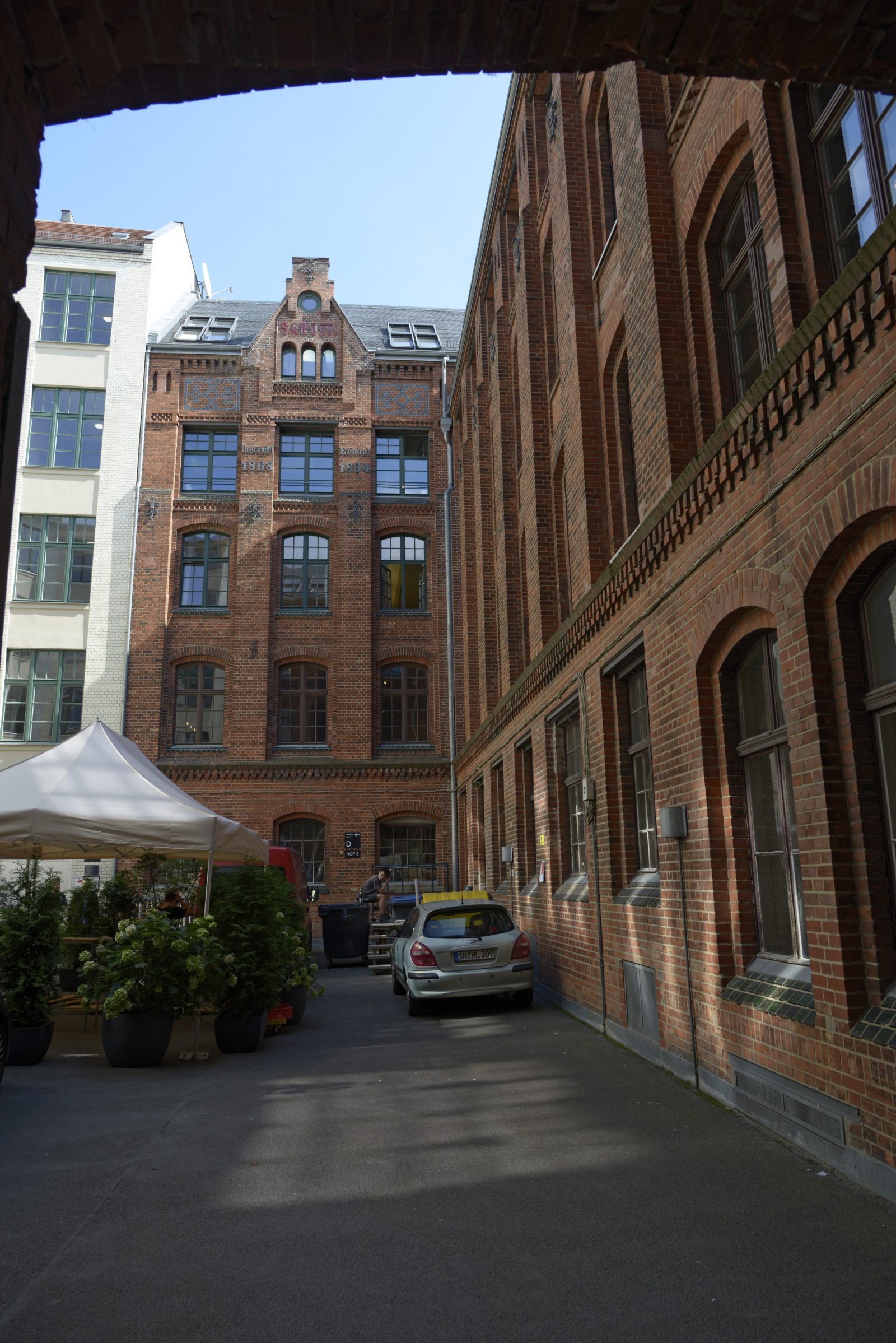
A chapter in the history of the Sarotti chocolate factory took place from 1881 to 1913 on Mehringdamm in Kreuzberg. Today, this Berlin institution is commemorated by the partially preserved commercial architecture and the well-known company logo on a façade of the Sarotti courtyards, the Sarotti Moor (hereinafter: M*), which was controversially discussed against the background of Germany's colonial past. [1]
For a long time, chocolate was a luxury good that only a few could afford. It was not until the 19th century that colonial expansion also changed consumer habits in Europe. Direct access to raw materials – in the case of chocolate: cocoa beans, cane sugar and spices – shorter transport routes, but also new chemical processes and the increasing mechanisation of manufacturing processes meant that cocoa, just like coffee, tea and tobacco, now became affordable for broader social groups. Chocolate became a consumer good for the masses as a drink, bar or praline. [2]
Originally from Mexico and Central America, the cocoa plant was cultivated in Central and South America. Brought to Europe by the Spanish colonizers in the 16th century, the cocoa bean spread there more and more in the 18th century. The production of cocoa beans was associated with the expropriation of fertile land and deep interference with local property relations, as well as working conditions that were often characterized by violence and coercion. [3]
The increasing spread of chocolate as a food was accompanied by major geographical shifts in cocoa cultivation: Spanish colonizers had brought cocoa cultivation from its Mesoamerican origins to northern South America, making Venezuela the world's main producer. Before 1900, cocoa came mainly from Venezuela, Ecuador and the Brazilian Amazon. The growing demand for cocoa in Europe ensured that the colonial powers increasingly established cocoa plantations in Africa as well. During the 19th century, the Brazilian state of Bahia, Trinidad and the Dominican Republic dominated cocoa cultivation. At the beginning of the 20th century, the Portuguese island colony of São Tomé and Príncipe briefly became the world's largest producer. In 1911, the British colony of the Gold Coast (Ghana) finally took over a permanent lead. [4] The situation was similar with the second essential component of chocolate, sugar. It also had to be sourced from tropical areas until around the middle of the 19th century. [5]
Where exactly Sarotti obtained cocoa from in his early days is not documented. The Stollwerck factory in Cologne, on the other hand, is known to have established direct relations with West African cocoa farmers in the second half of the 19th century and to participate in the economic exploitation of Cameroon. From 1885 until the British and French takeovers in 1915/16, the country was a German colony. [6] In 1896, the Cameroon Cocoa Society was founded. However, its task, the marketing of a "colonial chocolate", failed due to the need to mix cocoa beans of different origins. Much to the delight of Wilhelm II, Stollwerck brought out a "German Colonial Chocolate", which ostensibly consisted exclusively of cocoa beans from German colonies. Overall, however, cocoa from German colonies accounted for only a vanishingly small share of cocoa imports. [7]
The Sarotti chocolate factory was one of the leading companies in the chocolate industry, along with Stollwerk in Cologne and Hartwig & Vogel in Dresden. Like most producers, Sarotti had emerged from a craft business in the 19th century, expanded steadily and developed into a "joint-stock company [...] of large-scale industry"[8] by the First World War. A phenomenon that can be observed throughout Europe: C. J. van Houten was founded in Zoon in 1815, F. C. Cailler in Vevey in 1819, Ph. Suchard in Neuchâtel in 1826 and Cadbury in Birmingham in 1831. [9] At the end of the 19th century, chocolate factories already existed in all major German cities, producing around 1,700 tons (1880) of chocolate annually. The German Reich was one of the largest cocoa importers in Europe. [10]
The Sarotti chocolate factory began in 1868, when the young Stuttgart confectioner Hugo Hoffmann (1843–1911), who had studied praline production in Paris, opened a "craft business for the production of fine chocolates, fondants and fruit pies" at M*-Straße 10 in Berlin. It is possible that this address inspired Julius Gipkens (1883–1968) to invent the Sarotti-M* fifty years later. Soon the premises were too small and the company moved to a shed at Dorotheenstraße 60 in 1870.[11] The company benefited from the economic upswing of the metropolis after the Franco-German War of 1870/71 and the growing circle of middle-class buyers. Machines were increasingly used in production, which accelerated the work processes. Hoffmann was able to expand its range, which from this point on also included chocolates and cocoa powder. [12]
In 1872, Hoffmann had the opportunity to take over the elegant and well-known sales business, the confectionery shop Felix & Sarotti, at Friedrichstraße 191. From 1881 onwards, Hoffmann produced his goods under the name Sarotti, the origin of which has not yet been conclusively clarified. [13] It is possible that the "exotic" sound, which promised excellent marketing opportunities, was the decisive factor in this decision.
At the beginning of the 1880s, due to a lack of space and increasing industrial production, it was necessary to relocate the flourishing production again. Hoffmann finally found a plot of land that offered space for the construction of further production areas at Belle-Alliance-Straße 81 (today Mehringdamm 57). [14] In 1903, the company opened up to outside capital with the founding of Sarotti Chocoladen- & Cacao-Industrie Aktiengesellschaft. [15]
In 1884, the Felix & Sarotti store moved from Friedrichstrasse to the company's own building at Leipziger Strasse 88, which from then on housed the company's headquarters. Not only in Berlin, but throughout Germany, more and more Sarottis shops gradually opened. [16]
Regardless of the large extent of the Kreuzberg factory site – in 1904/06 the two neighboring properties Belle-Alliance-Straße 82 and 83 and corresponding production areas were added – it finally proved to be too small around 1910. In the meantime, the number of employees and workers had grown to 1,800, most of them women, who were mainly active in chocolate production. A huge new factory building on an area of almost 50,000 square meters at Teilestraße 12/13 in Tempelhof, conveniently located on the Teltow Canal and the railway, was now intended to remedy the situation. With the commissioning of the Tempelhof plant in 1913, the Kreuzberg era of the Sarotti chocolate factory came to an end.
As a result, Sarotti developed into one of the largest chocolate manufacturers in the German Empire. [17] The technical facilities of the modern factory made it possible to process 10,000 kg of cocoa per day. [18]
In 1928, the majority of shares in Sarotti AG went to the Swiss Nestlé Group, which sold the brand name to Stollwerck in 1998, whereupon Sarotti production was completely relocated to the Stollwerck plant in Berlin-Marienfelde.
In order to stand out from the mass of chocolates and other confectionery, more and more branded products emerged in the 19th century, and with them an advertising industry. Since the 1880s, this industry has made use of pictorial formulas of the foreign and exotic, especially when it came to the marketing of colonial goods (tobacco, tea, cocoa, coffee, alcoholic beverages, etc.), which "to this day have a quasi-'natural' affinity for the foreign"[19]. Thus, advertising and merchandise design took up contemporary "stereotypes of racial inferiority," such as the "primitive black as servant (previously slave) or power nature"[20][20]. "For the white consumer, consuming exoticism and colonial products meant internalizing the subjugation of colonial peoples."
Sarotti AG, like many other companies, also tried to develop a contemporary marketing and advertising strategy. In 1896, the company was represented at the Berlin Trade Exhibition in Treptow, which attracted an audience of millions and also hosted the first German Colonial Exhibition, which was intended to provide information about the German "protected areas". Sarotti presented itself alongside food producers and coffee, alcohol and tobacco manufacturers in an elaborately designed, "oriental" pavilion at the carp pond, where visitors could experience the production of chocolate. Goods, most of whose raw materials came from colonies, were thus presented in the immediate vicinity of the "village", also located on the carp pond, where men, women and children from Africa and Oceania lived in buildings supposedly typical of the German colonies and "demonstrated" their everyday life and crafts to visitors as living exhibits against an ethnographic backdrop [Fig. 1]. [22]
In 1908, Sarotti's management hired the graphic designer Julius Gipkens to design packaging. The young autodidact was a member of the Deutscher Werkbund, which had set itself the task of establishing a new, objective commodity aesthetic, and also designed advertising motifs for Stollwerck and the Garbáty cigarette company, among others. [23] It was also he who created the Sarotti-M* in 1918, one of the most popular figures in the history of German advertising.
On the occasion of the company's fiftieth anniversary, which fell in the last months of the First World War, he designed a new trademark that showed three M* with trays and under which the company name was emblazoned in blue cursive. In 1922, the three M* were reduced to just one and registered as a trademark. The loss of the colonies after the First World War by the Treaty of Versailles was still fresh and voices in society were raised calling for their recovery. [24] In these post-war years, the Sarotti-M* now had the task of reviving the company's sales. [25]
In the black figure with a large head, short limbs and childlike proportions, dressed in beaked shoes, harem pants, embroidered jacket and turban, who looks at the viewer with large round eyes and strides forward holding a tray in her hand, Gipkens had intertwined several stereotypes: The figure of "the black man" was already extremely popular in early advertising and was also present in the company's advertising before the invention of the Sarotti-M*. [26] As a "stable icon of the foreigner", it was directly associated with products such as coffee and chocolate due to its colour and origin. Ethnic characteristics were often caricatured and explicitly emphasised, thus racially coding. [27] As a servant, as in the case of Sarotti-M*, Page, cook, waiter or shoe shiner, the character was ascribed a clear subaltern role. The poster motif that Julius Gipkens had designed in 1911 for a banana-flavored cocoa by Sarotti and thus for a product that was doubly "exotic" due to its ingredients – two black men dressed only in loincloths, carrying a huge banana tree on their shoulders between them with the help of a stick – also plays with racist clichés of half-naked "primitive natives".
In addition, as in the case of the Sarotti-M*, there was often the combination of strangeness and childishness, whereby "simplicity and naivety – that which is biologically and historically immature in the modern world of civilisation" met "the popular children's bonus of the cute and sweet"[28]. In addition, the advertising figure of Sarotti with his "exotic" fairytale-like clothing tied in with oriental clichés that were also extremely popular in advertising. The image of the serving childlike black man goes back a long way. In the 17th century, he can be found, often serving precious drinks such as cocoa or coffee, in paintings that are supposed to depict aristocratic festive or everyday life. Even then, some of these servants were dressed in "turquoise" clothing, which in turn took into account the prevailing "Turkish fashion" in architecture, art and music at the time. [29]
In the decades that followed, the Sarotti M* could be seen in countless variants on packaging, posters, postcards, advertisements, later on mugs and in films, and even brought to life, often in the form of costumed black children. [30] [Fig. 2] From the 1990s onwards, Sarotti AG was increasingly confronted with accusations of racism. However, it was not until 2004 that Stollwerck changed the company logo to a magician, who, as it says on the company's website, "brings traditional products to the market in a new and modern design"[32]. The M* was transformed into a magician juggling with stars with golden skin, balancing on a crescent moon and yet remaining confusingly similar to the Sarotti M*. Although less explicitly, the new company logo continues to tie in with a colonial visual language with its combination of "exoticism" and childishness or primitiveness.[33]




Lisa Hackmann
- LOCATION
- Belle-Alliance-Str. 81, 82, 83
- TODAY
- Mehringdamm 53, 55, 57
Citing the article
Lisa Hackmann: The Founding of the Sarotti Company. In: Kolonialismus begegnen. Decentralised Perspectives on Berlin's City History. URL: https://kolonialismus-begegnen.de/geschichten/die-gruendung-der-firma-sarotti/ (03.03.2025).
Literature & Sources
[1] Cf. Landesdenkmalamt Berlin, "Sarotti-Schokoladenfabrik" (Obj.-Doc.-Nr.: 09031070). Available online at: https://www.berlin.de/landesdenkmalamt/denkmale/liste-karte-datenbank/denkmaldatenbank/daobj.php?obj_dok_nr=09031070 [last accessed 24.01.2021].
[2] Cf. Ganz, Cornelia, "Süße Versuchung. Die Schokoladenfabrik Sarotti", in: Kunstamt Kreuzberg (ed.), Made in Kreuzberg. Produkte aus Handwerk und Industrie, Berlin 1996, pp. 83–88, here p. 88; Deutsches Historisches Museum (ed.), German Colonialism. Fragments of its History and Present, Berlin 2016, p. 131.
[3] Cf. Conrad, Sebastian, Deutsche Kolonialgeschichte, Munich 2019, p. 55.
[4] Cf. Clarence-Smith, William Gervase, Cocoa and Chocolate, 1765–1914, London / New York 2005, p. 5; Higgs, Catherine, Chocolate Islands. Cocoa, Slavery, and Colonial Africa, Athens 2012; Hund, Wulf D., Wie die Deutschen weiß werden. Kleine (Heimat)Geschichte des Rassismus, Stuttgart 2017, p. 107.
[5] Cf. Gudermann, Rita, Der Sarotti-Mohr. Die bewegte Geschichte einer Werbefigur, Berlin 2004, p. 22.
[6] Cf. Langbehn, Volker, "Der Sarotti-Mohr", in: Zimmerer, Jürgen (ed.), Kein Platz an der Sonne. Erinnerungsorte der deutsche Kolonialgeschichte, Bonn 2013, pp. 119–133, here p. 120.
[7] Cf. Badenberg, Nana, "Usambara-Kaffee und Kamerun-Kakao im Kolonialwarenhandel", in: Hold, Alexander / Scherpe, Klaus R. (eds.), Mit Deutschland um die Welt. Eine Kulturgeschichte des Fremden in der Kolonialzeit, Stuttgart / Weimar 2004, pp. 94–105, here p. 97; Clarence-Smith, Cocoa and Chocolate, 1765–1914, p. 41.
[8] Badenberg, Usambara-Kaffee und Kamerun-Kakao im Kolonialwarenhandel, p. 102.
[9] Cf. whole, Sweet Temptation. The Sarotti Chocolate Factory, p. 87.
[10] Cf. Gudermann, Der Sarotti-Mohr. Die bewegte Geschichte einer Werbefigur, p. 31; Clarence-Smith, Cocoa and Chocolate, 1765–1914, p. 40.
[11] Cf. Lanwer, Agnes, "Die Firma Sarotti. Belle-Alliance-Straße 81 (heute Mehringdamm 53–57)", in: Engel, Helmut / Jersch-Wenzel, Steffi / Treue, Wilhelm (eds.), Geschichtslandschaft Berlin. Orte und Ereignisse. Vol. 5, Kreuzberg, Berlin 1994, pp. 457–472, here p. 460; Gudermann, Der Sarotti-Mohr. Die bewegte Geschichte einer Werbefigur, p. 26.
[12] Cf. Lanwer, Die Firma Sarotti. Belle-Alliance-Straße 81 (today Mehringdamm 53–57), pp. 460f.
[13] Cf. Gudermann, Der Sarotti-Mohr. Die bewegte Geschichte einer Werbefigur, pp. 11–13, 24–26, 36.
[14] Cf. Westhafen, Werner von, "Die Sarottihöfe", in: Kreuzberger Chronik, issue 66, 05.2009 https://www.kreuzberger-chronik.de/chroniken/2009/mai/strasse.html .
[15] Cf. Gudermann, Der Sarotti-Mohr. Die bewegte Geschichte einer Werbefigur, p. 37f.
[16] Cf. Lanwer, Die Firma Sarotti. Belle-Alliance-Straße 81 (today Mehringdamm 53–57), p. 465.
[17] Cf. ibid., p. 468; Gudermann, Der Sarotti-Mohr. Die bewegte Geschichte einer Werbefigur, p. 48.
[18] Cf. Landesdenkmalamt Berlin, "Sarotti AG (Obj.-Doc.-Nr.:09055130)". Available online at: https://www.berlin.de/landesdenkmalamt/denkmale/liste-karte-datenbank/denkmaldatenbank/daobj.php?obj_dok_nr=09055130 [last accessed 24.01.2021].
[19] Scherpe, Klaus R., "Scenarios of Colonialism in the Media of the German Empire", in: Jörn Leonard, Jörn / Renner, Rolf G. (eds.), Koloniale Vergangenheiten – (post-)imperiale Gegenwart, Berlin 2010, pp. 165–184, here p. 174; cf. also Zeller, Joachim, Bilderschule der Herrenmenschen, Berlin 2008, pp. 221–229.
[20] Scherpe, Scenarios of Colonialism in the Media of the German Empire, p. 174.
[21] Zeller, Bilderschule der Herrenmenschen, p. 221.
[22] Cf. Bezirksamt Treptow von Berlin (ed.), Die Berliner Gewerbeausstellung 1896 in Bildern, Berlin 1997, p. 46; Badenberg, Nana, "Zwischen Kairo und Alt-Berlin. Sommer 1896. Die deutschen Kolonien als Ware und Werbung auf der Gewerbe-Ausstellung in Treptow", in: Hold, Alexander / Scherpe, Klaus R. (eds.), Mit Deutschland um die Welt. Eine Kulturgeschichte des Fremden in der Kolonialzeit, Stuttgart / Weimar 2004, pp. 190–199. here p. 193; Gudermann, Der Sarotti-Mohr. Die bewegte Geschichte einer Werbefigur, p. 37.
[23] Cf. Gudermann, Der Sarotti-Mohr. Die bewegte Geschichte einer Werbefigur, p. 67.
[24] Cf. Heyden, Ullrich van der, "Der Sarotti-Mohr", in: Id. / Zeller, Joachim (eds.), Kolonialmetropole Berlin. Eine Spurensuche, Berlin 2002, pp. 93–95, here p. 95.
[25] Cf. Lanwer, Die Firma Sarotti. Belle-Alliance-Straße 81 (today Mehringdamm 53–57,), p. 469; Gudermann, Der Sarotti-Mohr. Die bewegte Geschichte einer Werbefigur, pp. 7, 57f.
[26] Cf. Zeller, Bilderschule der Herrenmenschen, pp. 222–229; Hund, Wie die Deutschen weiß werden. Kleine (Heimat)Geschichte des Rassismus, pp. 106–108.
[27] Cf. Scherpe, Klaus R., "Reklame für Salem Aleikum. 11 January 1909: Die Dresdner Cigarettenfabrik Yenidze wird eine Moscheekuppel", in: Mit Deutschland um die Welt. Eine Kulturgeschichte des Fremdes in der Kolonialzeit, Stuttgart / Weimar 2004, pp. 381–388, here p. 384f.
[28] Ibid., p. 385.
[29] Cf. Wolter, Stefanie, The Marketing of the Foreign. Exoticism and the Beginnings of Mass Consumption, Frankfurt am Main 2005, p. 68f.
[30] Cf. Gudermann, Der Sarotti-Mohr. Die bewegte Geschichte einer Werbefigur; Langbehn, Der Sarotti-Mohr.
[31] Berlin State Monuments Office, "Sarotti Chocolate Factory" (Obj.-Doc.-No.: 09031070). Available online at: https://www.berlin.de/landesdenkmalamt/denkmale/liste-karte-datenbank/denkmaldatenbank/daobj.php?obj_dok_nr=09031070 [last accessed 24.01.2021].
[32] Sarotti website. Available online at: https://www.sarotti.de/historie/ [last accessed 24.01.2021].
[33] Cf. Langbehn, Der Sarotti-Mohr, p. 130f.
Tags
#Amerika#Anbau#ArbeitTempelhof#Berlin-Marienfelde#Bilder#Bürgertum#Deutscher Werkbund#Exotismus#Fabriken#Felix & Sarotti#Firmenlogo#Frauen#Friedrichstraße#Garbáty#Gewerbeausstellung#Gewürze#Hugo Hoffmann#Industrie#Julius Gipkens#Kakao#Kolonialausstellung#Konsum#Leipziger Straße#Luxus#Motive#Nestlé#Orentalismus#Plakate#Plantagen#Pluderhose#Rassismus#Rohstoffe#Sarotti Chocoladen- & Cacao-Industrie Aktiengesellschaft#Sarotti-Höfe#Sarotti-Mohr#Schnabelschuhe#Schokolade#Stollwerck#Tablett#Teltowkanal#Treptow#Turban#Verkaufsläden#Vermarktung#Werbung#Zucker