DWM: Weapons for German Colonies – Example of German East Africa
The contributions of the Reinickendorf Museum, which are presented on the page "Kolonialismus begegnung", have been carefully curated in the context of the special exhibition "Colonial Traces in Reinickendorf's Industrial History". The contributions have been thoroughly reviewed and revised for digital presentation. We recommend reading the comprehensive introductory text on Reinickendorf's colonial past (link) in advance.
Weapons and drinking bottles for German colonies
Company: Deutsche Waffen- und Munitionsfabriken AG (DWM)
Founded: 1889 as Deutsche Metallpatronenfabrik AG in Karlsruhe, renamed in 1896 as Deutsche Waffen- und Munitionsfabrik AG with headquarters in Berlin
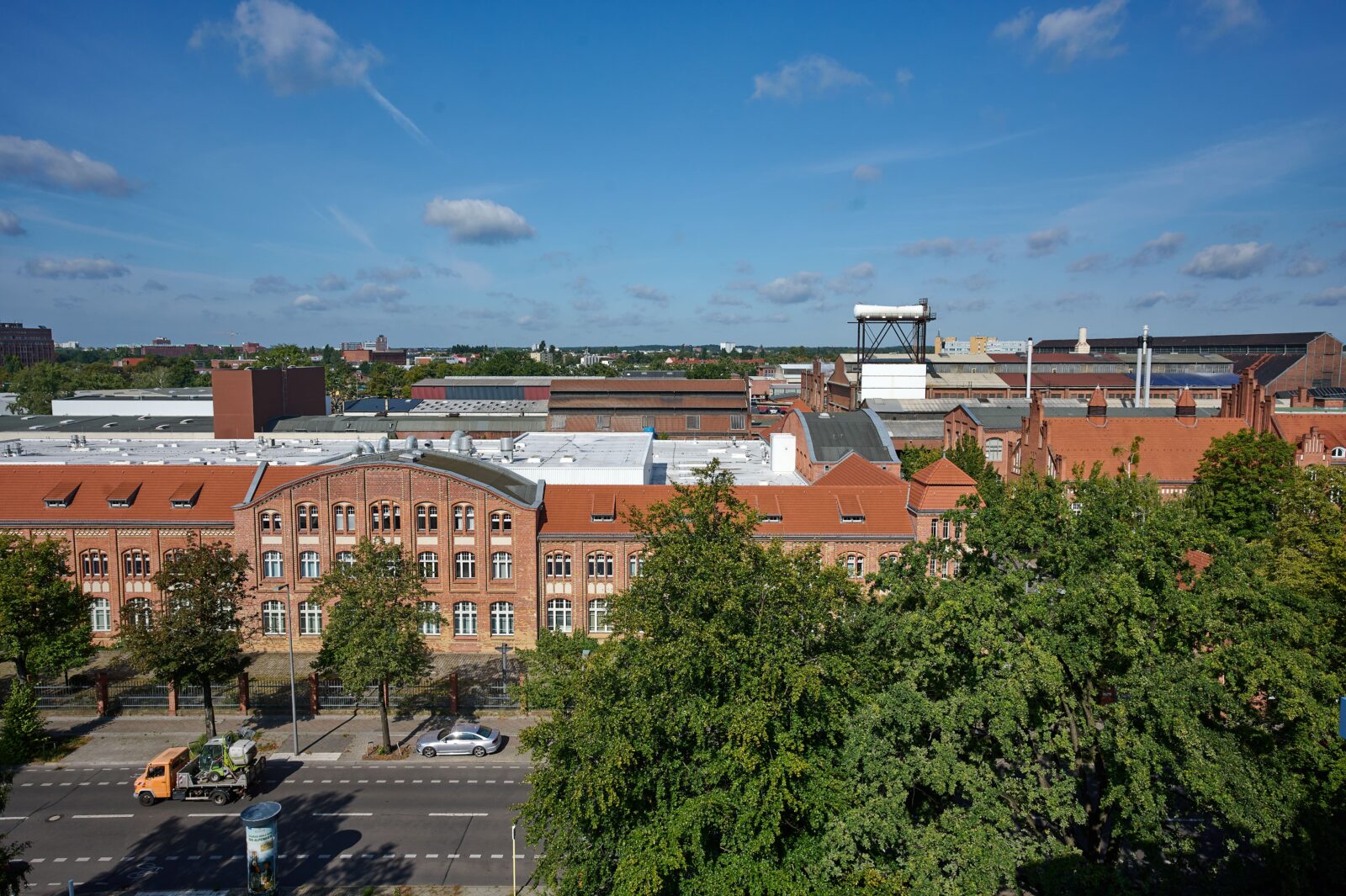
Reinickendorf: from 1907 production of ball bearings in Wittenau, 1914 construction of a weapons factory in Wittenau, Eichborndamm
Production: Weapons, ammunition, machine tools, ball bearings
Productivity: Net profit 1915: approx. 11 million marks
Employees: 1914 approx. 8,600
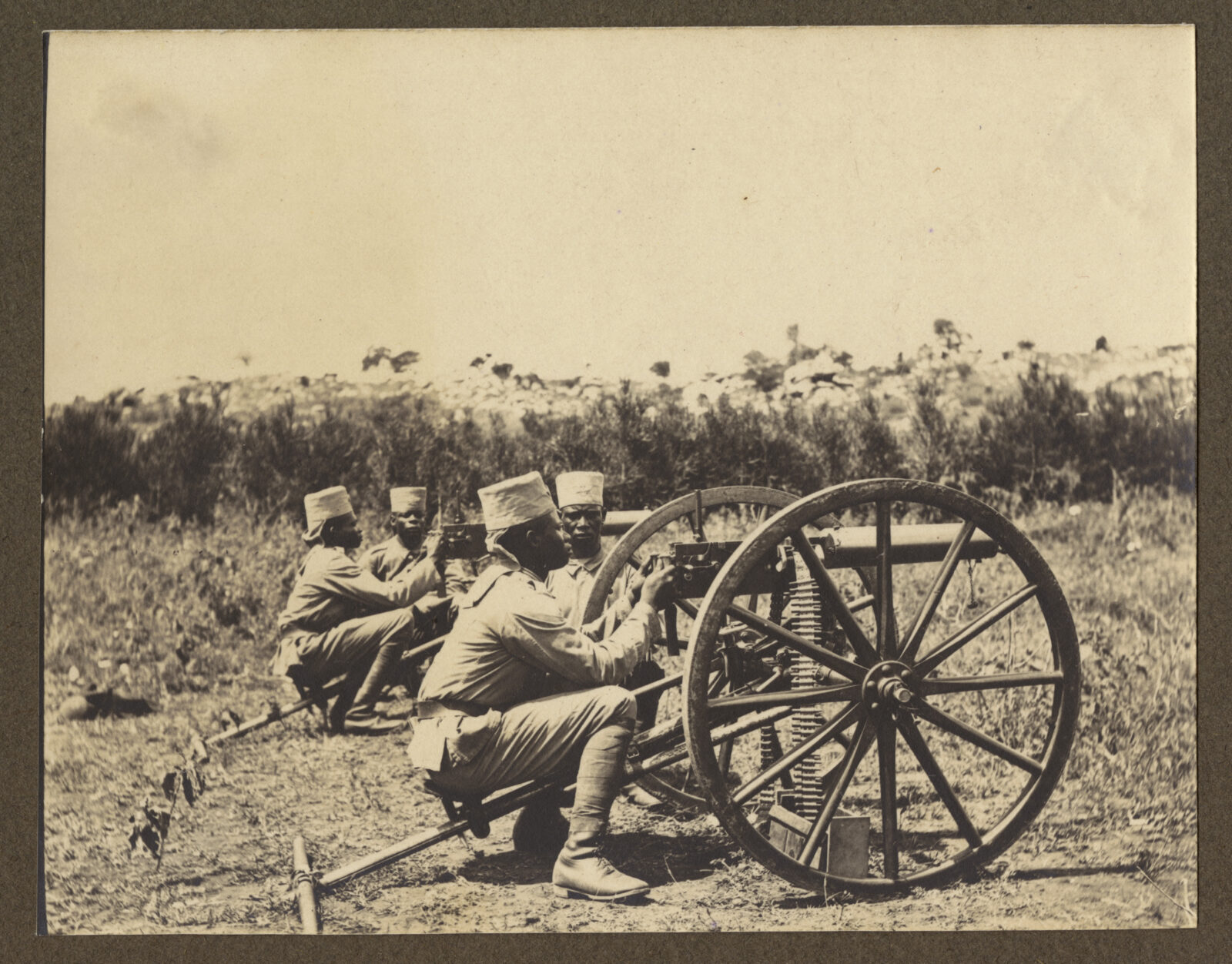
In 1913, the German Weapons and Ammunition Factories (DWM) delivered, among other things, mounts on which machine guns were mounted and leather-lined canteens for the Imperial Police Headquarters in Douala (Cameroon). Previously, DWM had already supplied Maxim machine guns to the German military. These rifles, which had been developed in 1885 by the British-American entrepreneur Hiram Maxim, had been used in the German colonies since 1901. DWM, which manufactured and sold weapons, ammunition, machine tools and ball bearings from 1889 to 1949, had a production facility in Reinickendorf on Eichborndamm from 1908. Initially founded in Karlsruhe as a merger of several companies, it moved its headquarters to Berlin in 1897. Production was initially carried out in Martinikenfelde (today Moabit) and in Hollmannstraße (today Kreuzberg). The arms business and production for armies all over the world was going so well that in 1906 a – according to a description of the company's history – "approx. 130 acres of land [...] in Wittenau near Berlin" was acquired, "on which a modernly equipped factory for the production of ball bearings and steel balls meeting all the requirements of modern times was built". (1)
Maxim/Machine Gun
In the video (link), the British-American inventor Sir Hiram Stevens Maxim (1840–1916) presents the first machine gun in 1885. Instead of single shots, continuous fire was now possible. The weapon could fire about 500 rounds per minute, which corresponded to the performance of 100 bolt-action rifles in use at the time. Numerous armies were equipped with the Maxim machine guns. It was first used by the British in 1893 to conquer Matabeleland in Rhodesia (now Zimbabwe). The mass lethal effect of the machine gun was described by the British writer Hillaire Belloc with the cynical verse: "Whatever happens, we have got/the Maxim Gun, and they have not". (2) With the founding of DWM in 1896, the production of Maxim machine guns also began. In 1899, a separate department was set up for their production. The success of the company led to expansion to Reinickendorf in 1906/07. (3)
Use of military equipment in German East Africa
Colonialism was characterized by violence, not least because of the unequal military conditions. Military equipment from DWM's Reinickendorf production facility was used from 1907 onwards. In that year, the company expanded its department for the production of Maxim machine guns and took on orders that presumably also served to equip the "Schutztroppen" in the colonies. Weapons production in the factory on Eichborndamm began in 1914. The income from the production of ball bearings there and from weapons at other locations flowed into the construction of the factory facilities on the one hand, and on the other hand, it basically enabled DWM to expand weapons production. Weapons manufactured in Reinickendorf from 1914 onwards were probably also used in the colonies.
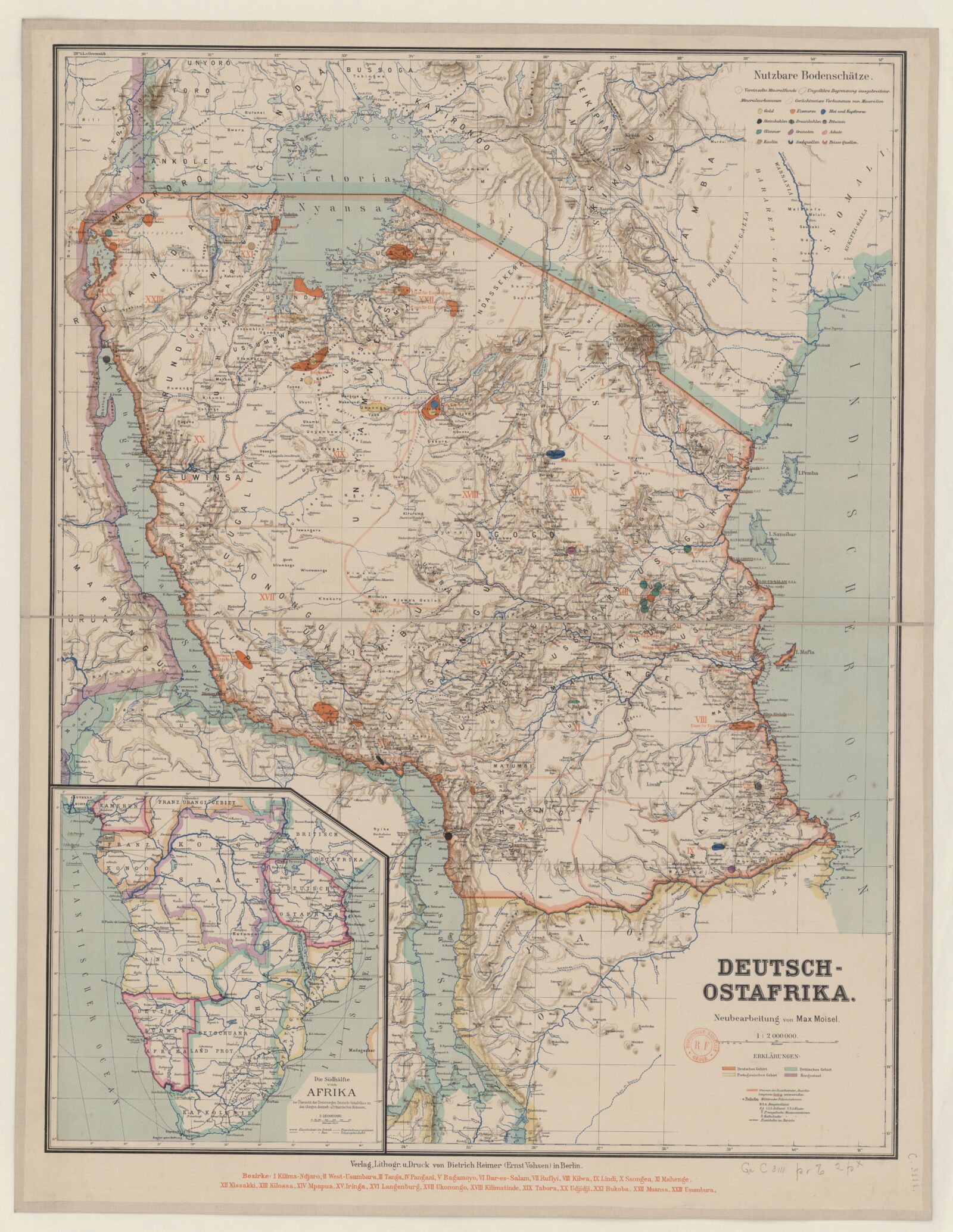
The colony of German East Africa
German colony: 1884 to 1918
Area: 995,000 km² (Federal Republic of Germany: 357,000 km²); today mainly Tanzania, Rwanda, Burundi, Mozambique
Population: 1885 approx. 8 million, around 1913 approx. 5,300 Germans
Economy: Trade: slave trade, ivory, furs, wool; Plantation economy: rubber, tobacco, cotton, coffee; Imports were mainly railway equipment, machinery
Military: In 1913 over 400 German officers and over 2,600 African soldiers (Askari)
The colony of German East Africa was located on the east coast of subtropical Africa, shaped by Mount Kilimanjaro and Lake Victoria. During colonial times, about 8 million people lived there. 90 percent were Bantu, in the northeast Maasai and on the coast Arab traders from Oman settled, who maintained a lively trade, including slaves, in the interior. (4) In addition to rubber cultivation, ivory, furs, hides, wool and fibers were traded. Tropical fruits, tobacco, cotton, coffee, tea, hemp and vanilla were grown on plantations. (5) Overall, however, the expenditure for the colony (18.97 million marks) was higher than the income (15.58 million marks). The Deutsche Kolonial-Eisenbahn-Bau- und Betriebsgesellschaft (DKEBBG), which operated two railway lines with a total length of around 350 kilometres, invested in the infrastructure for the transport of goods traffic. (6)
The history of the colony of German East Africa is closely linked to the name of the colonial criminal and racist Carl Peters (1856–1918). His activities laid the foundation for colonial expansion in the early to mid-1880s. Peters had co-founded the Society for German Colonization in 1884, then traveled to East Africa and concluded "protection treaties" with local rulers, which he often signed with deceptions and threats. (7) Peters' ruthless actions with corporal punishments and executions went too far even for the rulers in Berlin at the end of the 1890s, and he was dismissed from service in 1897 after disciplinary proceedings. After the Berlin "Congo Conference" of 1884/85, Kaiser Wilhelm I signed the "Letter of Protection" for the occupied East African territories on 27 February 1885. In April 1885, a "protection treaty" was concluded with the German East African Society (DOAG), which was co-founded by Peters, among others. (8) The protection treaty entitled the DOAG to take possession of apparently ownerless land, granted mining rights and privileges in railway construction. The brutal suppression of the Maji-Maji uprising by German troops (1905–1907) is considered one of the largest colonial wars on the African continent. After heavy losses – new Maxim machine guns, manufactured by the German arms and ammunition factories in Berlin – the troops of the Maji Maji movement had resorted to guerrilla tactics. Agricultural land, villages and supplies were destroyed and livestock were killed. Between 75,000 and 300,000 people died from war and hunger. (9)

Facts & Files
- LOCATION
- Eichborndamm 105-107 13403 Berlin
- TODAY
- Eichborndamm 105-107 13403 Berlin
Citing the article
Facts & Files : DWM: Weapons for German Colonies – Example German East Africa. In: Kolonialismus begegnen. Decentralized Perspectives on Berlin's City History. URL: https://kolonialismus-begegnen.de/geschichten/dwm-waffen-fuer-deutsche-kolonien-beispiel-deutsch-ostafrika/ (05.11.2024).
Literature & Sources
(1) Deutsche Waffen- und Munitionsfabriken: Handbuch der Deutschen Aktiengesellschaften 1914, pp.987–988f.
(2) Sebastian Conrad: German Colonial History. C.H.Beck Wissen, Volume 2448, 4th, revised edition, original edition, Munich 2019, p. 55.
(3) Deutsche Waffen- und Munitionsfabriken in Berlin, Wittenau, AG: Annual Reports, Berlin 1907-1919, letters dated 09.08.1912 and 26.02.1913.
(4) Sebastian Conrad: German Colonial History. C.H.Beck Wissen, Volume 2448, 4th, revised edition, original edition, Munich 2019, p. 37.
(5) Kolonial-Handels-Adressbuch 1912, Joh. Tesch (ed.), 16th year, Berlin 1912, p. 52.
(6) Winfried Speitkamp: German Colonial History. Reclam Non-Fiction, Updated and Expanded Edition, Ditzingen 2021, p. 33; The Colony German-East Africa, URL: https://www.dhm.de/lemo/kapitel/kaiserreich/aussenpolitik/ostafrika.
(7) Winfried Speitkamp: German Colonial History. Reclam Non-Fiction, Updated and Expanded Edition, Ditzingen 2021, p. 21.
(8) Sebastian Conrad: German Colonial History. C.H.Beck Wissen, Volume 2448, 4th, revised edition, original edition, Munich 2019, p. 41.
(9) Winfried Speitkamp: German Colonial History. Reclam Non-Fiction, Updated and Expanded Edition, Ditzingen 2021, pp. 131-132; Felix Brahm: Merchandise of Power. The Arms Trade between Europe and East Africa, Frankfurt, M., New York 2022, p. 264.
Tags
#Askari#Aufstand#Ausbeutung#Baumwolle#Burundi#Carl Peters#German-East Africa#DWM#Eisenbahn#Elfenbein#Hanf#Infrastruktur#Kaffee#Kaiser Wilhelm I. #Kautschuk#Kolonialkrieg#Kolonialrecht#Kolonialverbrechen#Kongokonferenz#Krieg#Maji-Maji#Maschinengewehr#Maxim#Mobilität#Plantagen#Ruanda#Südfrüchte#Tabak#Tansania#Tee#Vanille#Waffen#Waffenproduktion#Widerstand#Wittenau#Zwangsarbeit