Grocery stores in today's Marzahn-Hellersdorf
Today, the Berlin district of Marzahn-Hellersdorf is best known for its large housing estates. During the time of the German Empire – and thus during the time of German colonial rule – the districts of Biesdorf, Kaulsdorf, Mahlsdorf, Marzahn and Hellersdorf, which today belong to the district, were still villages. It was not until the end of the 19th century that the villages were connected to Berlin by railway stations and incorporated into Berlin in 1920 as part of the Lichtenberg district. [1] For some time now, the capital has been the focus of research and reappraisal of German colonial history. The colonial past of Berlin's outskirts and the surrounding area of Brandenburg is often ignored.
Colonialism usually appears as an urban phenomenon. Berlin as a colonial metropolis with its colonial political offices, bourgeois colonial associations and (pseudo-)scientific societies is an example of this. This focus falls short of describing colonialism as a phenomenon affecting society as a whole. Colonial traces can also be found in other population groups and in the periphery of the Empire. [2] A vivid example of the integration of rural areas into colonial structures are so-called colonial goods shops. These opened all over the empire from the end of the 19th century and often existed until the middle of the 20th century – even in the villages and settlement areas of the time that today belong to the district of Marzahn-Hellersdorf. [3]
The example of the colonial goods shops shows colonial traces in Marzahn-Hellersdorf. But what are colonial goods and where, how and when were they sold in the district? Where did the products come from and under what conditions were they produced? What was the social significance of their consumption and what debates went hand in hand with the import of colonial goods? This article approaches the questions raised on the basis of exemplary colonial goods shops from Biesdorf, Kaulsdorf and Marzahn and at the same time places the shops in the district in the context of global trade and power relations.
Colonial goods and colonial goods shops
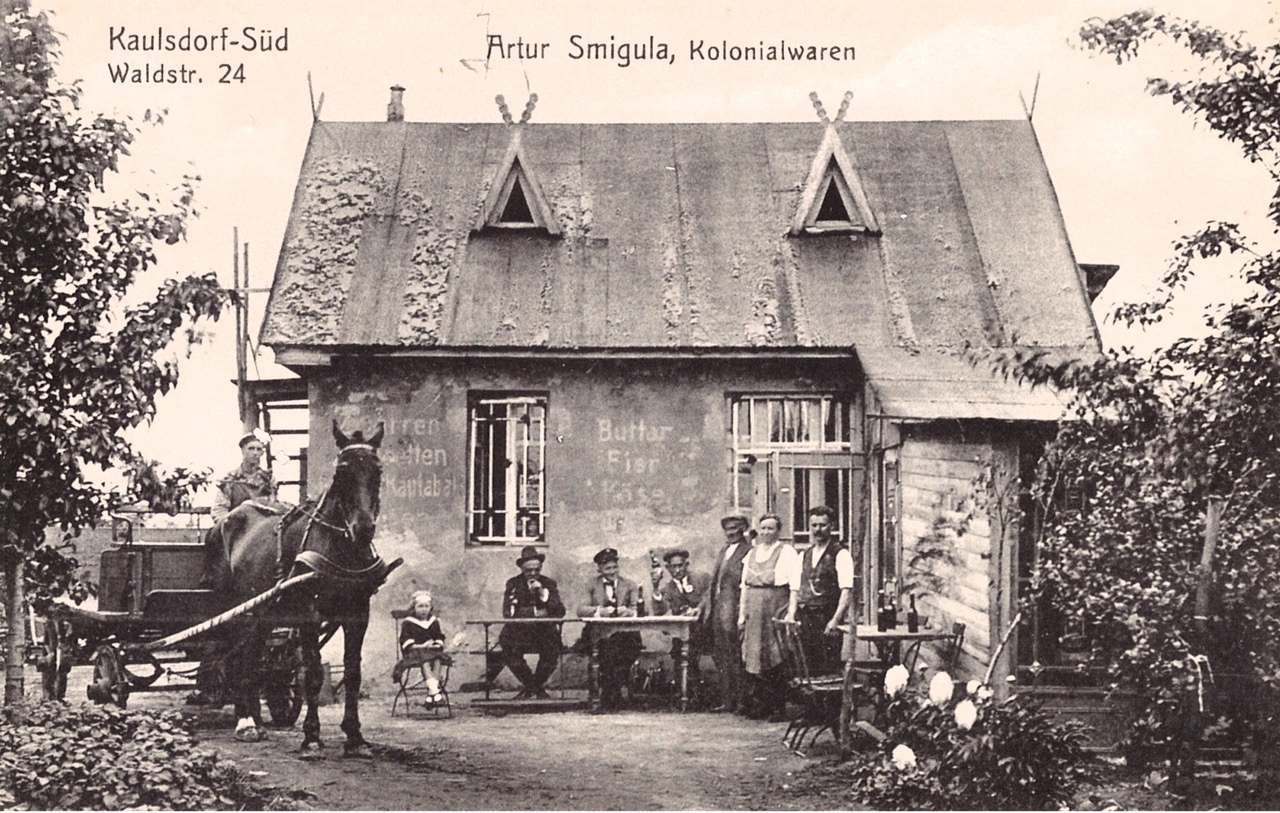
From the 18th century onwards, the term "colonial goods" became common for long-distance trade goods that had been imported to Europe as luxury goods since the early modern period. Colonial goods are thus the result and at the same time an expression of early globalization processes. [4] The goods were raw materials such as ivory, jute or indigo as well as luxury goods such as spices, tea, tobacco or fruit. [5] These were initially offered in department stores specializing in colonial goods. The so-called "Colonial House" in Lützowstraße in Schöneberg was the largest colonial trading house in the German Empire. As such, it had a representative trading building with magnificent facades, crowning domes and colonial motifs with "exoticizing" depictions of colonized people. In addition to imported food and beverages, the shelves also included so-called ethnographics such as jewellery, sculptures and weapons, everyday objects and gallantry goods such as furs, ostrich eggs or ivory carvings. [6] Only a few colonial goods shops had such splendour and the supposedly "exotic" decoration of the Schöneberg "colonial house". In the countryside – and thus also in the area of today's Marzahn-Hellersdorf district – these were mostly small family businesses with a sales room integrated into the residential building, which bore the character of junk and general stores (Fig. 1). [7]
In the 20th century, the term "colonial goods" was increasingly used synonymously with "food" and meant not only imported goods but also basic foodstuffs and everyday goods. Consequently, the contemporary categorisation as a colonial goods shop does not provide direct information about the range of products offered there and its origin. At the same time, there were shops that offered colonial products such as coffee, tea or tobacco, but did not explicitly refer to the origin of the goods in the shop name. This makes it difficult to record the colonial goods trade in the district.
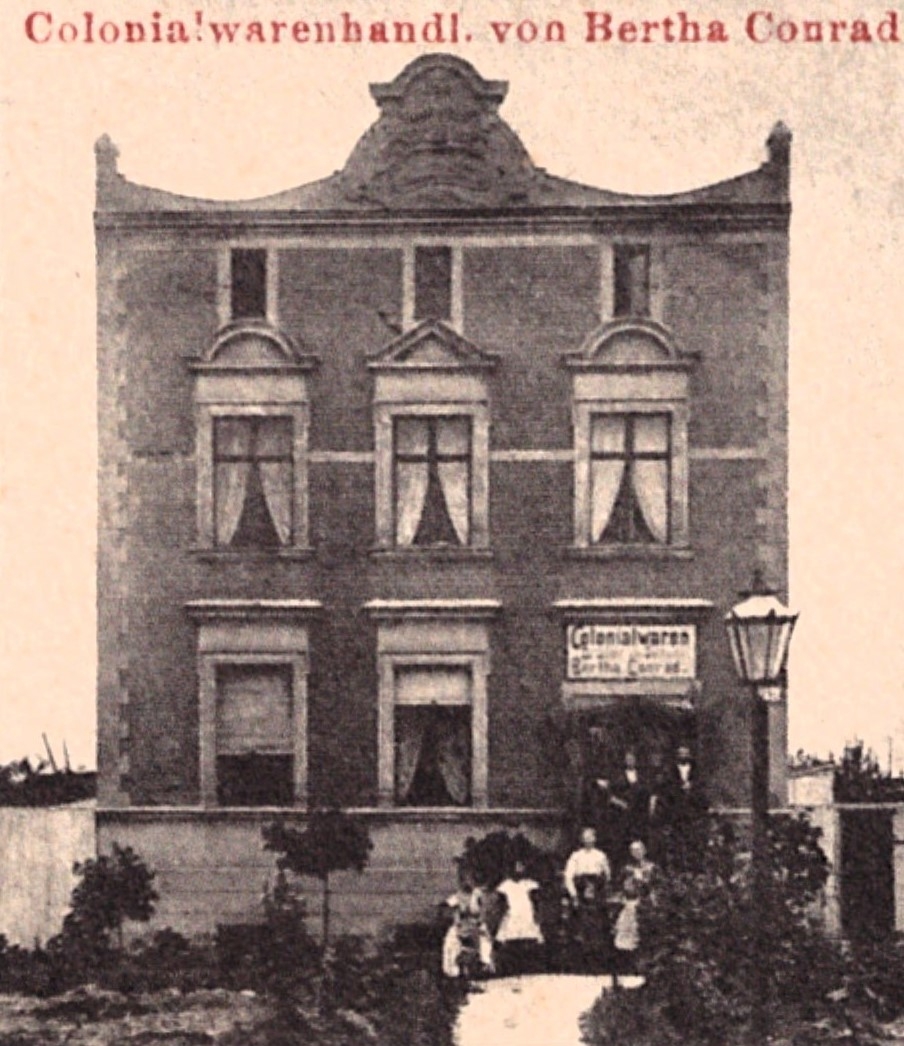
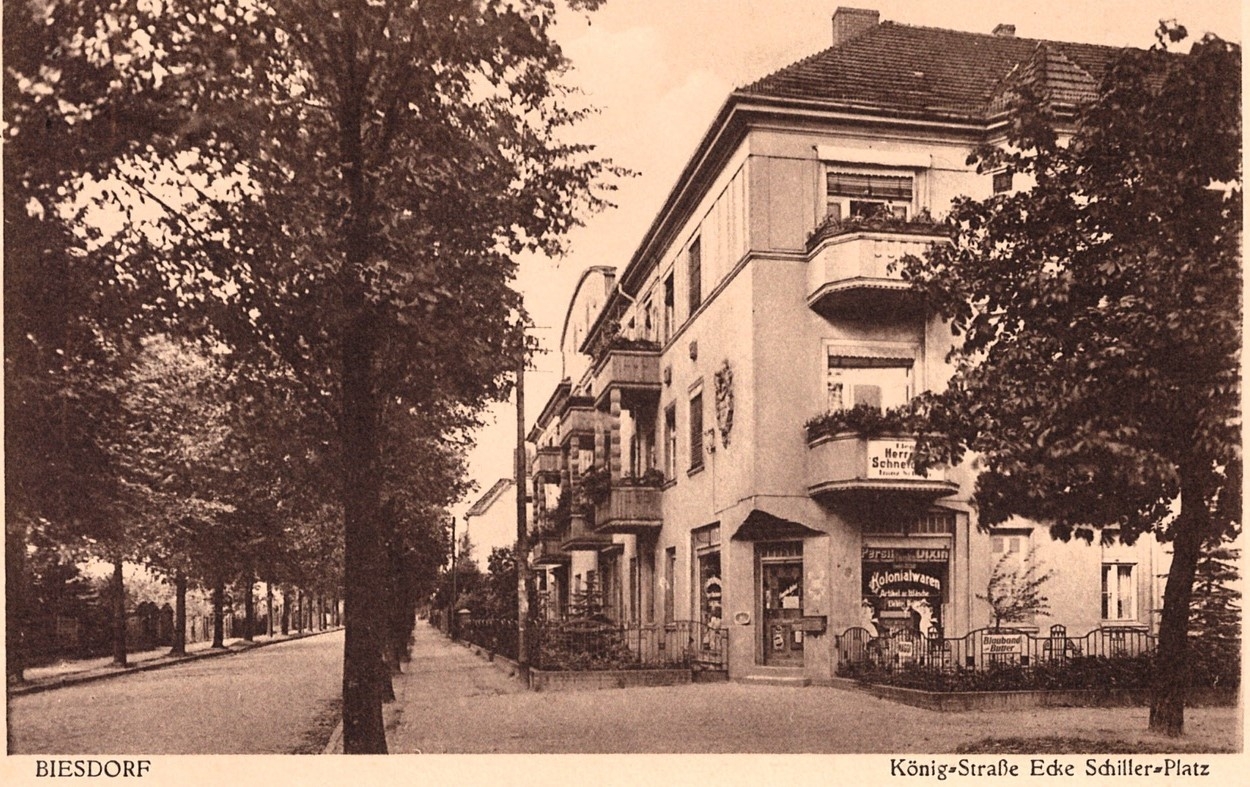
A large number of shops in Marzahn-Hellersdorf that were run by women is remarkable. This is due to the fact that the small shops often meant additional income for the families. One example is Bertha Conrad's shop in Biesdorf-Nord. From 1908 to 1918 she ran a grocery store at Kaiserstraße 64 (today Eckermannstraße 160), while her husband Gustav worked as a carpenter. In the 1920s, Bertha Conrad ran a kiosk with refreshments at the train station, where she sold chocolate, tobacco and cigarettes, among other things. Their daughter Franziska Bickel (née Conrad) was also the owner of a grocery store at Königstraße 17 in Biesdorf, today Otto-Nagel-Straße (Figs. 2 and 3), from 1922 to 1929.
Grocery stores as glocal places
In the first half of the 20th century, colonial goods shops were part of everyday life – both in the city and in the countryside. The sale and consumption of colonial goods and commodities made the villages and settlement areas links in the global exploitation chain of colonial resources. The local shops related the villages to the rest of the world or the overseas world. The historian Johanna Strunge therefore refers to colonial goods shops as glocal places. [8] Glocal is composed of global and local: The local colonial goods shops in Marzahn-Hellersdorf were interwoven into a global history of consumption.
Their history is part of German colonialism and at the same time goes beyond it – both temporally and spatially. The colonial goods shops in Marzahn-Hellersdorf continued to exist even after the period of formal German colonial rule, which ended with the defeat of the German Reich in the First World War. Many colonial goods shops in Marzahn-Hellersdorf did not even open until the time of the Weimar Republic or National Socialism. Some continued to exist after the Second World War until the term "colonial goods" disappeared from language use in the GDR. However, many of the former colonial goods shops in the district continued to be run as regular grocery stores or functioned as convenience stores. Examples of this are the Padlowski grocery store, which existed in Alt-Marzahn until the 1940s and housed a convenience store from 1955 to 1969, or the grocery stores at Zanderstraße 23 and Hönower Straße 184 in Mahlsdorf, which went from being a grocery store to a delicatessen and finally to a consumer store. The store that Ella and Otto Staaks ran as a grocery store in Biesdorf (Alt-Biesdorf 62) from 1930 to 1940 also lasted for a long time. For decades, the family ran the store as a grocery store. With the closure of the business due to economic and pensions, the last grocery store in Alt-Biesdorf closed in 2002.
Not only in terms of time, but also in terms of import regions, the colonial goods trade was not limited to the German colonies. On the contrary, even during the time of German colonial rule, production there covered only a small part of the demand for colonial goods in the Empire. [9] The "colonial German" market share of cocoa was just 2.2 percent in 1904. 10] The success of German "colonial coffee" was also marginal. [11] The products from the German colonies were often of inferior quality and priced. Only a few nationally-minded colonial enthusiasts were willing to pay this price, who intended to strengthen the German colonial economy with their personal purchase decision. [12] Instead of its own colonies, the German Empire's most important trading partners in Africa were Morocco, Egypt, and South Africa – regions under British or French influence. [13] However, for the most part, the luxury foods did not come from colonies at all. Ninety percent of the coffee came from Latin America, where it was at least not officially produced under colonial conditions. In 1900, Brazil was the largest single supplier of coffee to Germany and Ecuador was the largest single supplier of cocoa. [14] However, coffee advertising, with its illustrations and product descriptions, often suggested a colonial origin of the beans and thus contradicted the actual origin. [15] This suggests that the colonized world exerted a fascination and attraction on German consumers. [16]
Colonial goods: From luxury to everyday product
The history of colonial goods stores is related to a changing consumer culture. Goods imported from overseas, especially spices and tea, initially had the character of luxury goods. They not only offered the opportunity to experience new tastes. Surrounded by a supposedly "exotic" aura, they also enabled a kind of imaginative travel and an escape from everyday eating habits. At the same time, the consumption of rare and expensive foods demonstrated status and prosperity. [17]
In the second half of the 19th century, colonial goods increasingly developed into everyday mass goods. [18] In particular, the consumption of luxury foods such as coffee, tea, cocoa, tobacco or spices increased. Falling prices gave broader sections of the population access to colonial goods. Historian David Ciarlo attributes the price reduction to the increase in production due to the capitalist plantation system and slave labour as well as to improved transatlantic transport options. Sugar consumption increased from one pound to just under 14 kilograms per capita between 1800 and 1900 and to around 22 kilograms by 1912. [19] The "magic of the exotic" surrounding colonial goods, according to historian Jürgen Osterhammel, had been exhausted by the end of the 19th century. It had shifted from culinary delights to visual impressions, for example in colonial exhibitions or so-called "ethnological exhibitions". [20]
The colonial commodity coffee
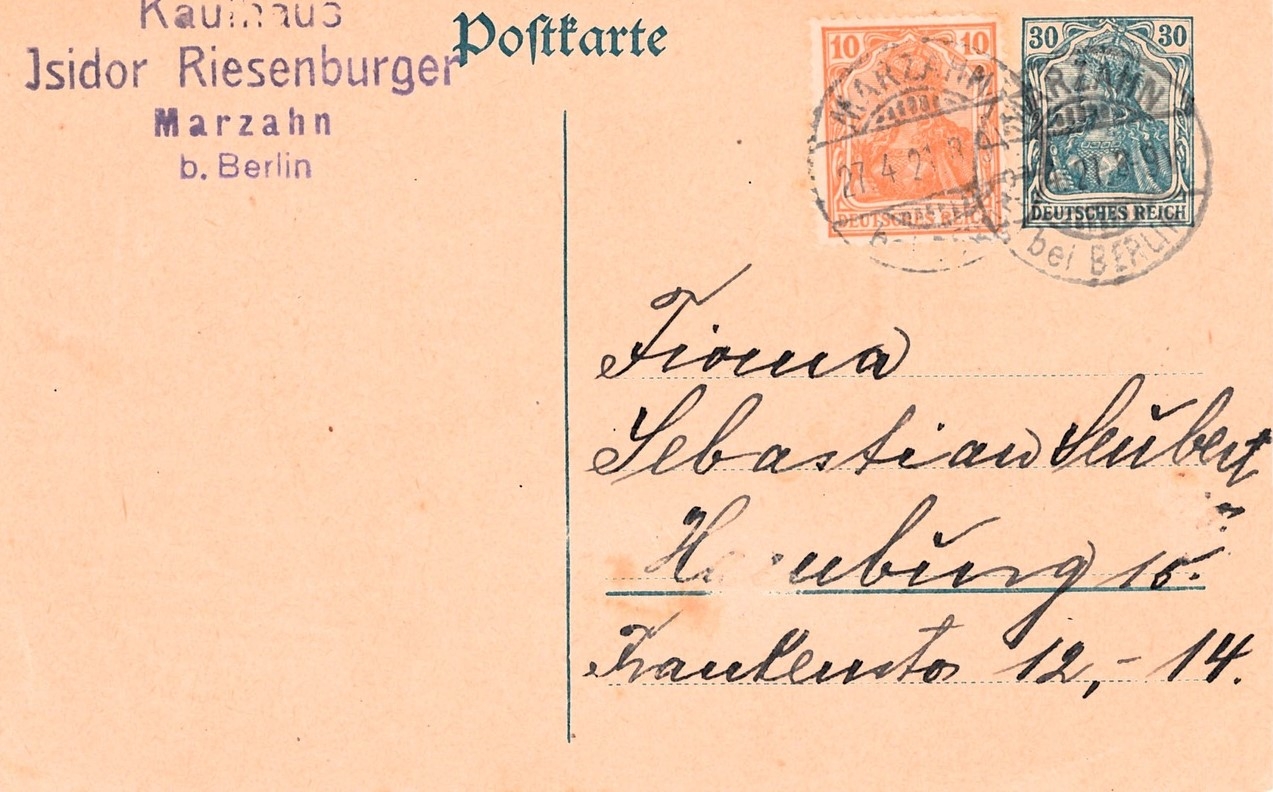
The consumption of coffee illustrates the transformation of colonial goods from a luxury to an everyday product. Initially reserved for the upper class as a status ritual, drinking coffee was a daily eating habit at the turn of the century, part of everyday working life and a popular leisure activity. This applied to all social circles, even if the method of preparation and the places of consumption differed considerably. [21] In Marzahn-Hellersdorf, coffee could be purchased in various grocery stores and grocery stores (Figs. 4 and 5). In 1922, the first branch of Kaiser's Kaffee in the district opened at Fritz-Reuter-Straße 11 in Mahlsdorf.
Coffee was not only a colonial commodity, but also the subject of colonial politics and propaganda. Although coffee consumption was high at the end of the 19th century, coffee beans remained expensive. Accordingly, the quality of coffee declined along the socio-economic strata, and at the lower end coffee was stretched or prepared with substitute products made from grain. This resulted in a general desire for cheap coffee beans, which was taken up by the colonial movement for agitation and cleverly made politically useful. Their argument was that importing coffee from other colonial growing regions was too expensive, but that growing it in its own German colonies would make coffee affordable for all sections of the population. The debate about the trade in colonial goods must therefore also be understood in the context of social contradictions in the Empire. In the sense of a social-imperialist interpretation, the disposal of cheap colonial goods was not only part of the outward-looking world power politics, but also of the inward-looking social policy. [22] Thus, the German colonial project was legitimized as a means of satisfying mass consumer needs in the Empire.[23]
Colonial goods, domination and violence
The short-term promise of equality in relation to the reduction of class differences in the empire remained unfulfilled. However, it went hand in hand with the establishment of a system of inequality and dependence between the colonizing and colonized worlds. [24] Colonial rule meant oppression and exploitation for the local population. The establishment of plantations geared towards the export of colonial goods was based on ruthless land policies and violent expropriations. The plantations had miserable working conditions; workers were often recruited under duress and treated inhumanely. [25]
Access to cheap colonial goods was only possible through a colonial and economic policy that was essentially repressive and exploitative. According to Ciarlo, the aspect of domination inherent in colonial goods was not concealed from consumers, but was emphasized in the presentation of the products. Ciarlo assumes that the power differences even made the goods more attractive: "Consumers thus find themselves in the situation of the colonial masters, whose superiority derives from the consumption of colonial goods." [26]
Thus, the discourse on colonial goods – negating social reality – homogenized consumers, regardless of their social class, into Europeans on the side of consumption as opposed to the colonized on the side of production. Coffee advertising also contributed to the construction of supposed European-African opposites with images of "exoticism" and difference and consolidated ideas of a European self and the colonized other. [27]
What role can colonial goods shops be attributed to in the context of violent colonial rule? In 1899, the Deutsche Kolonialzeitung described the above-mentioned German "colonial house" as useful for the colonial movement. [28] The historian Joachim Zeller also attributes a central role to the trading house in the dissemination and popularization of colonial goods. This is much less the case for the colonial goods stores in Marzahn-Hellersdorf. As general stores, they were more part of a local supply structure than a direct expression of unfulfilled longings, colonial enthusiasm, or extravagant consumer behavior of the villagers. Rather, the shops met the demand for goods that had already become mass products and staple foods at the time of the openings. The significance of the colonial goods shops in Marzahn-Hellersdorf results less from the centrality of individual shops such as the "Colonial House", but from the sum of the shops that belonged to the local retail trade in all districts for around half a century. The colonial goods shops in the district were part of everyday culture in the colonial era and illustrate the omnipresence of colonialism. As glocal places, local shops such as those in Marzahn-Hellersdorf were interwoven into a network of imperial trade relations and power relations and are part of a divided European colonial past.
In 2005, a shop called the "Colonial Market" opened for a short time in the large Marzahn housing estate. He advertised "shiploads directly from the producer" and constant "new imports from all over the world" as well as a "low price guarantee within a radius of 8 kilometres". Germany's colonial past is more present today than it was in 2005. As a result, postcolonial debates about Europe's colonial heritage, restitution and political responsibility reach a wider public. The opening of a "colonial market" would only be possible today under protest from the postcolonial public and could possibly be prevented by them.
 Collection
 Collection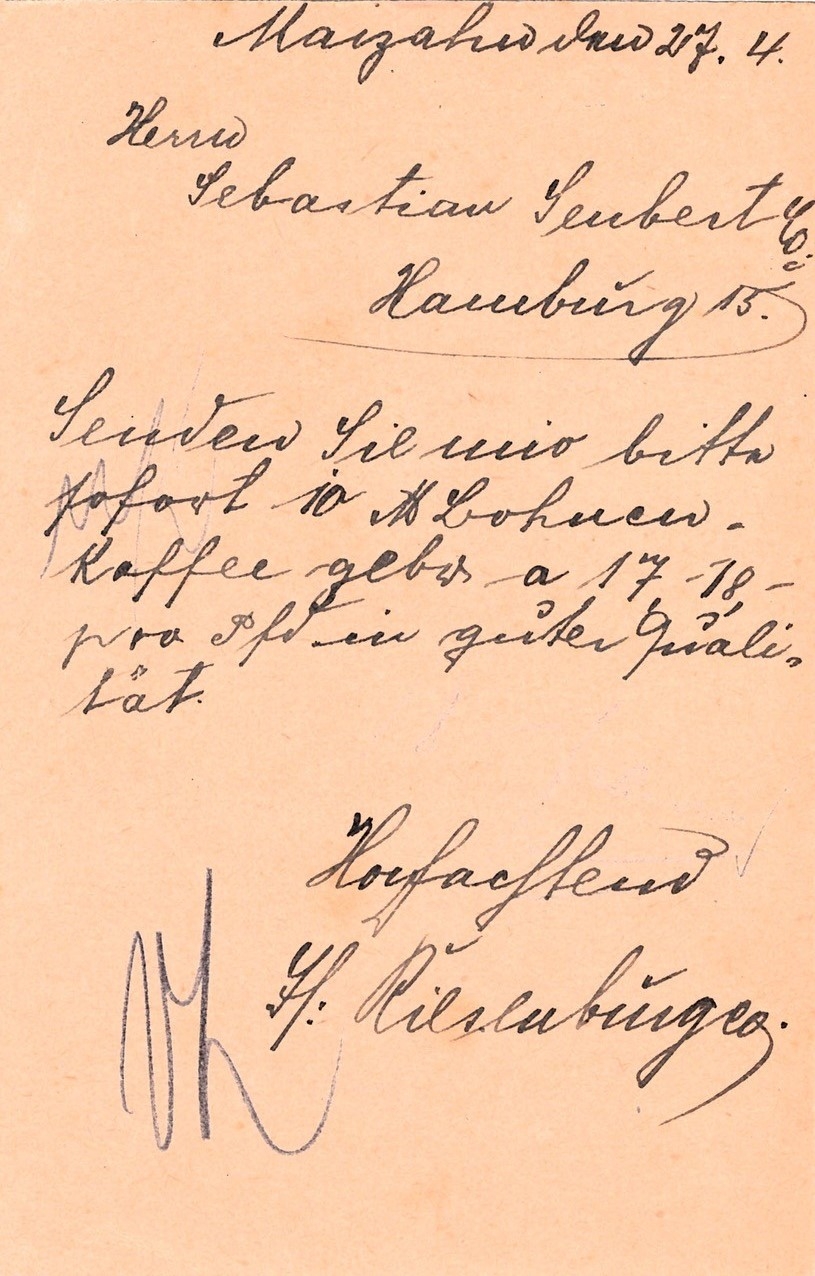
Marie Schneider
- LOCATION
- TODAY
Citing the article
Marie Schneider: Colonial goods stores in today's Marzahn-Hellersdorf. In: Kolonialismus begegnen. Decentralised perspectives on Berlin's urban history. URL: https://kolonialismus-begegnen.de/geschichten/kolonialwarenlaeden-im-heutigen-marzahn-hellersdorf/ (16.11.2023).
Literature & Sources
[1] Marzahn-Hellersdorf district office. "Historical" [accessed on 25.09.2023: https://www.berlin.de/ba-marzahn-hellersdorf/ueber-den-bezirk/historisches/].
[2] Rebekka Habermas, "Colonies in the Countryside: Doing Mission in Imperial Germany", Journal of Social History 50, No. 3 (2017): 502–3.
[3] All information on the colonial goods shops in Marzahn-Hellersdorf refers to the results of research on the subject commissioned by the Marzahn-Hellersdorf District Museum and carried out by Karl-Heinz Gärtner. In particular, local address directories and business directories from the time of the German Empire, the Weimar Republic and National Socialism were examined, supplemented by a wide range of source material from archives and private collections.
[4] Reinhard Wendt, "Kolonialwaren", in Europäische Erinnerungsorte, Band 3: Europa und die Welt, ed. von Pim den Boer et al. (Munich, 2012), 207–8.
[5] Claus Füllberg-Stolberg, Peter Kriedte, and Volker Wünderich, "Vorbemerkung", in Kolonialwaren für Europa. Zur Sozialgeschichte der Genussmittel, ed. by Claus Füllberg-Stolberg, Peter Kriedte, and Volker Wünderich (Berlin, 1994), 9. On the difficulty of a more detailed definition of the term 'colonial goods', see Jürgen Osterhammel, "Warenökonomie und Mobilitätsfolklore", ed. by Ulrike Gleixner et al., Zeitschrift für Ideengeschichte XV, No. 1 (2021): 13.
[6] Joachim Zeller, "Das 'Deutsche Kolonialhaus' in der Berliner Lützowstraße", in Kolonialmetropole Berlin. Eine Spurensuche, ed. by Joachim Zeller and Ulrich van der Heyden (Berlin, 2002), 84–85.
[7] In the case of the Marzahn-Hellersdorf stores, the private and business addresses rarely differed from each other in the address books used as a source basis. See also: Hessen (post)kolonial. "Kolonialwarenladen" [accessed on 25.09.2023: https://www.online.uni-marburg.de/hessen-postkolonial/doku.php?id=de:unternehmen:lebens-_und_genussmittel:kolonialwarenlaeden].
[8] Cf. Johanna Strunge, "Musealierte Kolonialwarenläden – Exponate einer glokale Konsumgeschichte", Historische Anthropologie, 30, no. 1 (2022): 72–91.
[9] David Ciarlo, "The Aura of the Exotic. Advertising Representation of Colonial Goods in the Empire", in Konsum im 19. und 20. Jahrhundert, ed. by Christian Kleinschmidt and Jan Logemann, 2020, 252.
[10] Zeller, "The 'German Colonial House' in Berlin's Lützowstraße", 89.
[11] Julia Laura Rischbieter, "(Trans)National Consumer Cultures: Coffee as a Colonial Product in the German Kaiserreich", in Hybrid Cultures – Nervous States: Britain and Germany in a (Post)Colonial World, ed. by Ulrike Lindner et al. (Boston, 2011), 116.
[12] Ciarlo, "The Aura of the Exotic", 252.
[13] Strunge, "Musealierte Kolonialwarenladen", 78.
[14] Ciarlo, "The Aura of the Exotic", 248; Rischbieter, "(Trans)National Consumer Cultures", 116.
[15] Rischbieter, "(Trans)National Consumer Cultures", 118–19.
[16] Ciarlo, "The Aura of the Exotic", 240–41; Rischbieter, "(Trans)National Consumer Cultures", 125.
[17] Ciarlo, "The Aura of the Exotic", 238.
[18] Osterhammel, "Commodity Economy and Mobility Folklore", 13. Ciarlo, "The Aura of the Exotic", 240–42.
[19] Ciarlo, "The Aura of the Exotic", 248; Reinhard Wendt, "The Saccharification of the World", ed. by Ulrike Gleixner et al., Zeitschrift für Ideengeschichte XV, No. 1 (2021): 34. In addition, sugar lost its character as a colonial commodity, as imported cane sugar was increasingly replaced by domestic beet sugar or pushed out of the market (ibid.).
[20] Osterhammel, "Commodity Economy and Mobility Folklore", 13. Cf. also: Ciarlo, "The Aura of the Exotic", 248.
[21] Rischbieter, "(Trans)National Consumer Cultures", 109, 124.
[22] Volker Wünderich, "Die Kolonialware Kaffee von der Produktion in Guatemala bis zum Verbrauch in Deutschland. Aus der transatlantischen Biographie eines 'produktiven' Genussmittel (1860-1895)", in Kolonialwaren für Europa. Zur Sozialgeschichte der Genussmittel, ed. by Claus Füllberg-Stolberg, Peter Kriedte, and Volker Wünderich (Berlin, 1994), 59–60.
[23] Cf. Rischbieter, "(Trans)National Consumer Cultures", 116, 124.
[24] Cf. Gerhard Pfeisinger, "Colonial Goods in the World Economy", in Colonial Goods: the Creation of the Unequal World, ed. by Gerhard Pfeisinger and Stefan Schennach (Göttingen, 1989), 11.
[25] Sebastian Conrad, German Colonial History (Munich, 2011), 30,36.
[26] Ciarlo, "The Aura of the Exotic", 242–43, citation 259.
[27] Rischbieter, "(Trans)National Consumer Cultures", 116, 121, 124.
[28] Zeller, "The 'German Colonial House' in Berlin's Lützowstraße", 87–88.
Literature
Ciarlo, David. "The Aura of the Exotic. Advertising Representation of Colonial Goods in the Empire". In Konsum im 19. und 20. Jahrhundert, edited by Christian Kleinschmidt and Jan Logemann, 235–61, 2020.
Conrad, Sebastian. German Colonial History. Munich, 2011.
Füllberg-Stolberg, Claus, Peter Kriedte, and Volker Wünderich. "Vorbemerkung". In Kolonialwaren für Europa. Zur Sozialgeschichte der Genussmittel, edited by Claus Füllberg-Stolberg, Peter Kriedte, and Volker Wünderich, 9–10. Berlin, 1994.
Habermas, Rebekka. "Colonies in the Countryside: Doing Mission in Imperial Germany". Journal of Social History 50, No. 3 (2017): 502–17.
Osterhammel, Jürgen. "Commodity Economy and Mobility Folklore". Edited by Ulrike Gleixner, Alexandra Kemmerer, Michael Matthiesen, and Hermann Parzinger. Journal of the History of Ideas XV, No. 1 (2021): 5–13.
Pfeisinger, Gerhard. "Colonial Goods in the World Economy". In Colonial Goods: the Creation of the Unequal World, edited by Gerhard Pfeisinger and Stefan Schennach, 9–18. Göttingen, 1989.
Rischbieter, Julia Laura. "(Trans)National Consumer Cultures: Coffee as a Colonial Product in the German Kaiserreich". In Hybrid Cultures – Nervous States: Britain and Germany in a (Post)Colonial World, edited by Ulrike Lindner, Maren Möhring, Mark Stein, and Silke Stroh, 107–26. Boston, 2011.
Strunge, Johanna. "Museumized Colonial Goods Shops – Exhibits of a Glocal Consumer History". Historical Anthropology, 30, No. 1 (2022): 72–91.
Wendt, Reinhard. "The Saccharification of the World". Edited by Ulrike Gleixner, Alexandra Kemmerer, Michael Matthiesen, and Hermann Parzinger. Journal of the History of Ideas XV, No. 1 (2021): 26–35.
———. "Colonial Goods". In European Places of Remembrance, Volume 3: Europe and the World, edited by Pim den Boer, Heinz Duchhardt, Georg Kreis, and Wolfgang Schmale, 207–13. Munich, 2012.
Wünderich, Volker. "Die Kolonialware Kaffee von der Produktion in Guatemala bis zum Verbrauch in Deutschland. Aus der transatlantischen Biographie eines 'produktiven' Genussmittel (1860-1895)". In Kolonialwaren für Europa. Zur Sozialgeschichte der Genussmittel, edited by Claus Füllberg-Stolberg, Peter Kriedte, and Volker Wünderich, 37–60, Berlin, 1994.
Zeller, Joachim. "Das 'Deutsche Kolonialhaus' in der Berliner Lützowstraße". In Kolonialmetropole Berlin. Eine Spurensuche, edited by Joachim Zeller and Ulrich van der Heyden, 84–93. Berlin, 2002.