Borsig: Locomotives for German colonies – example Cameroon
The contributions of the Reinickendorf Museum, which are presented on the page "Kolonialismus begegnung", have been carefully curated in the context of the special exhibition "Colonial Traces in Reinickendorf's Industrial History". The contributions have been thoroughly reviewed and revised for digital presentation. We recommend reading the comprehensive introductory text on Reinickendorf's colonial past (link) in advance.
Locomotives for German colonies
Company: A. Borsig GmbH
Founded: 1837 in Berlin by August Borsig (1804-1854)
Reinickendorf: from 1896 in Tegel
Production: locomotives, machines
Productivity: 10,000th locomotive is delivered in 1918
Employees: 1912 approx. 8,000
The Borsig company was one of the leading German locomotive manufacturers, delivering its products all over the world. From 1900 to 1911, Borsig delivered locomotives to the German colonies of German East Africa (today's Tanzania, Burundi and Rwanda), Cameroon and Togo, as well as to the Kiautschou area in China (formally referred to as the "leased area").
History of the company
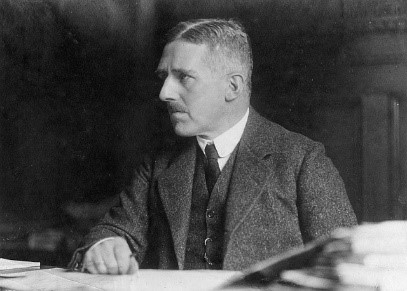
In 1837, the mechanical engineer August Borsig founded an iron foundry in Berlin-Mitte, where repairs were initially carried out on English steam locomotives before Borsig began building his own locomotives. In 1847, Borsig built his own ironworks in Moabit in order to be able to further expand the flourishing business. Until 1853, Borsig took over the monopoly production in the locomotive business in the Kingdom of Prussia. In the same year, the company delivered the first engines to other European countries. In 1854, the company founder died and his son Albert (1829-1878) took over the business. When Albert Borsig died in 1878, the management of the company passed to a board of trustees until 1894, as none of his three sons Ernst (1869-1933), Arnold (1867-1897) and Conrad (1873-1945) were of age. (1) In 1896, a plot of land in Tegel was finally acquired and the company moved here from Moabit. The first factory hall was completed as early as 1898. The modern plant with 220,000 m² was conveniently located on the Havel and had a rail connection. (2) Borsig became the second largest locomotive manufacturer in the world. During the time of deliveries of Borsig locomotives to the colonies (1900 to 1911), Arnold Borsig's two younger brothers, Ernst (1869-1933) and Conrad (1873-1945), determined the fate of the family business as owners. Together with his brother Ernst, Conrad Borsig was elevated to the Prussian nobility in 1909. Both Borsig brothers were among the richest men in Prussia at that time. (3) In the course of the Great Depression, the locomotive business collapsed in 1931 and was taken over by AEG. The family withdrew from the company. (4)
Delivery of locomotives to German colonies
As a leading German locomotive manufacturer, the Borsig company delivered its products all over the world – including to various German colonies. A total of 27 passenger and freight locomotives were sent there. The first four of these 27 locomotives went to the "Schantung Railway Company" (China) in 1900, in which Arnold Borsig himself held shares. Arnold's brother Conrad was also involved in the East African Mining and Plantation Company. The purpose of this company was the establishment and operation of mines, plantations and trading enterprises in Africa as well as participation in other colonial enterprises. (5) The most extensive locomotive deliveries went to the African colonies. The "Deutsche Kolonial-Eisenbahn-Bau- und Betriebsgesellschaft" (DKEBBG) concluded contracts with the German Reich, represented by the Colonial Department of the Foreign Office, for the construction of railway lines. In 1909, a locomotive from Borsig was delivered to the DKEBBG for use in the colony of Togo. Also in 1909 and 1910, nine locomotives went to German East Africa to the "East African Railway Company" Berlin. They were used by the East African Central Railway, which, at 1250 kilometres, was also the longest railway line built by Germans in the colonies. (6)
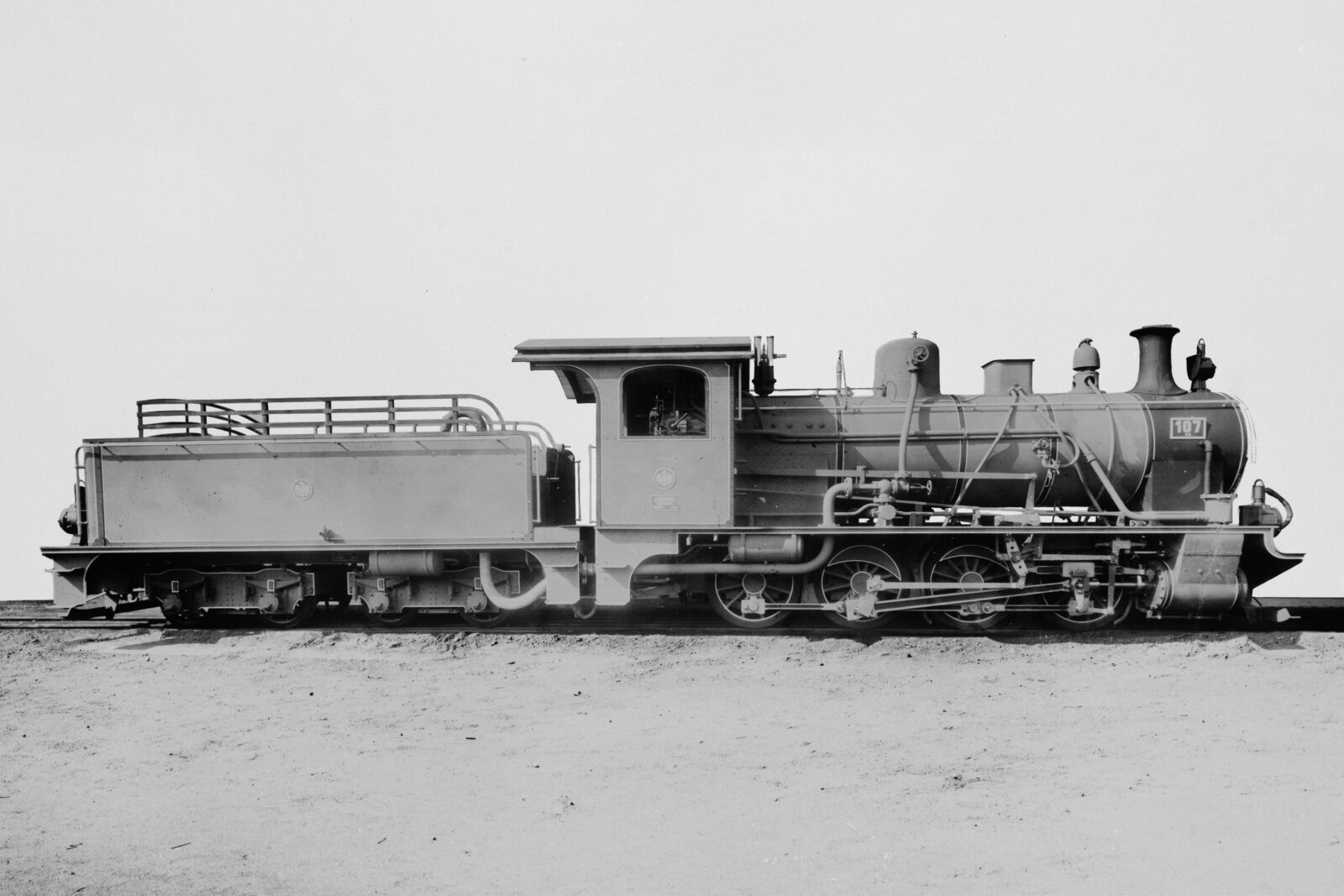
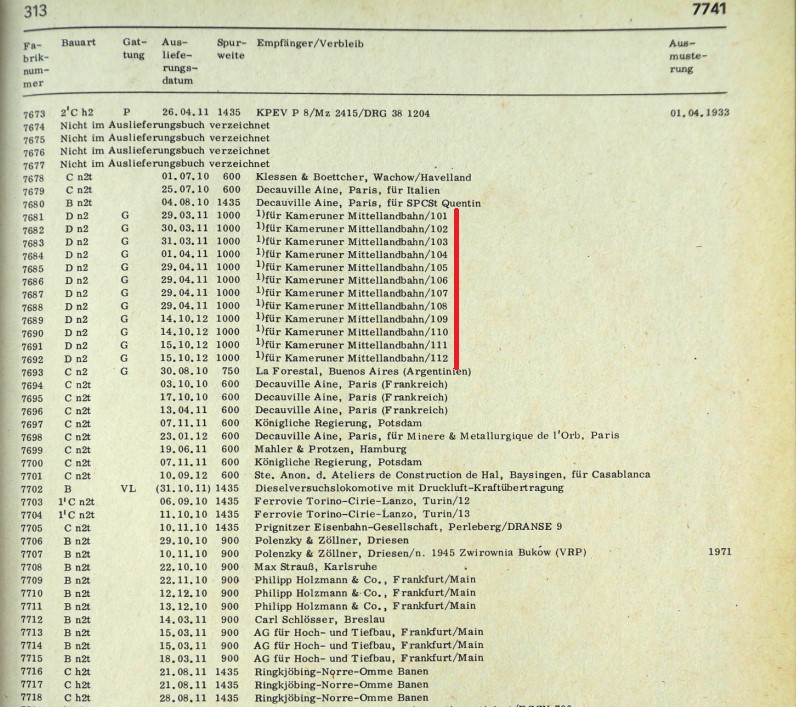
Borsig delivered twelve locomotives, including the one shown here, to Cameroon in West Africa in 1911 for the Cameroon Mittelland Railway, the construction of which had begun in 1908. The customer was also DKEBBG. (7)
The Colony of Cameroon
Period German colony: 1884-1916
Area: 790,000 km² (Federal Republic of Germany: 357,000 km²); today mainly Cameroon and parts of Nigeria
Population: 1913 approx. 3.8 million, approx. 1,000 Germans
Economy: Trade and plantation economy, cocoa, rubber, ivory; import mainly of railway equipment, machinery
Military: Around 1914 about 60 German officers, almost 100 non-commissioned officers and over 1,500 African soldiers (askari)
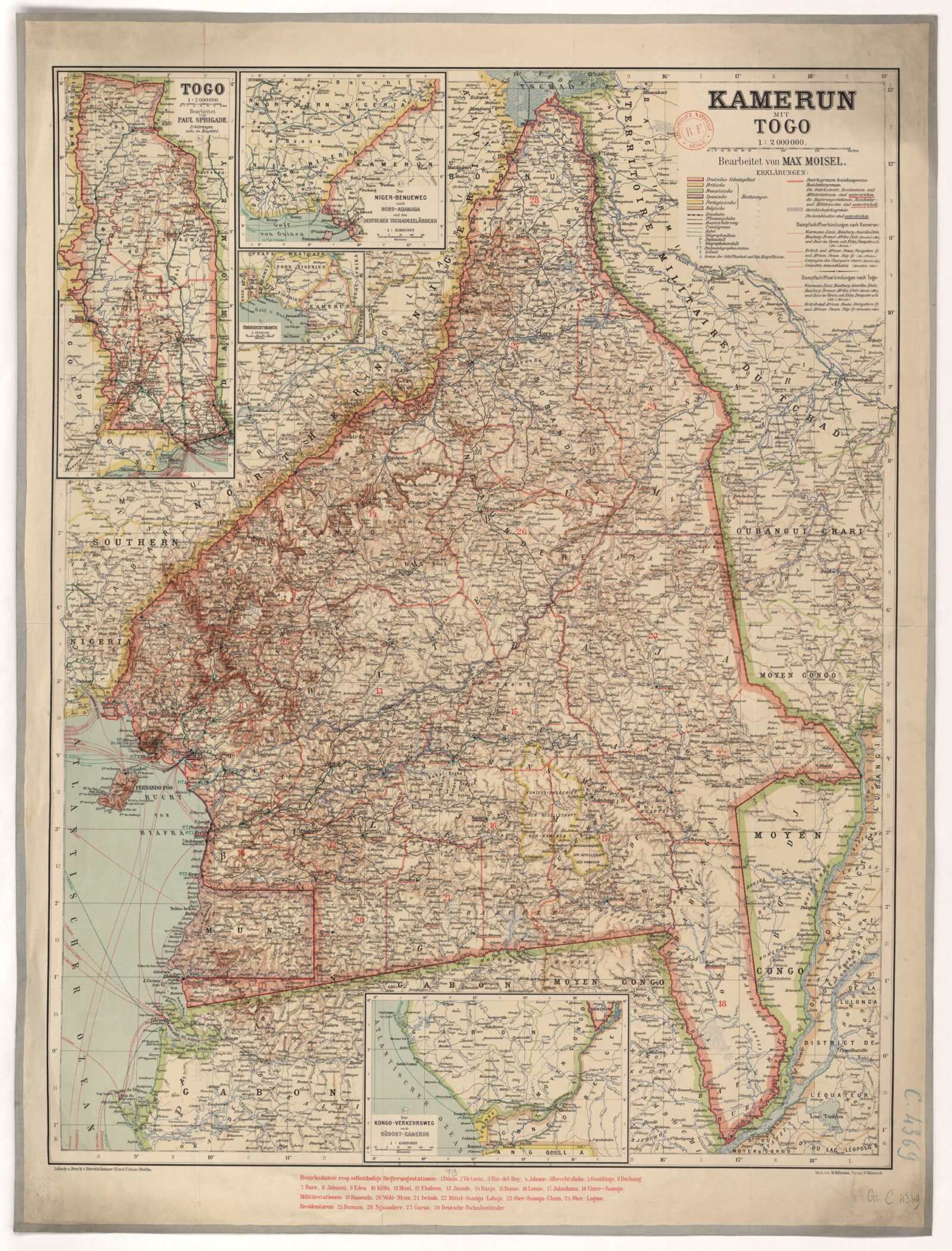
The German colony of Cameroon was located in western Central Africa and included the territory of present-day Cameroon and the eastern part of Nigeria. The inhabitants of Cameroon belonged to different ethnic groups, the most important being the Kingdom of Bafut and the Kingdom of Bali. (8) In 1884, Gustav Nachtigal, as Reich Commissioner for the West Coast of Africa, concluded a "protection treaty" with two leaders of the Duala and placed the country under German protectorate. At the "Congo Conference" of 1885, the borders of the colony were determined. (9) Economically, Cameroon was Germany's most important colony. Rubber for the electrical and automotive industries, palm oil and cocoa were among the products transported from the hinterland to the coast. (10) To this end, the DKEBBG built a railway line from Douala to Éséka from 1908 onwards and the Cameroon Railway Company built a railway line from Douala to Nkongsamba for the Northern Railway in 1906. (11) The railway was intended to make the transport of goods from the interior to the coast faster and cheaper, but also to bring German products quickly into the interior. (12) The establishment of the plantations was often based on forced labour and a ruthless land policy, which supposedly confiscated "ownerless" land and sold it to large corporations. (9) The plantation workers suffered from poor working conditions and a colonial legal system, which included corporal punishment. For Cameroon, an increase in corporal punishment and caning is documented between 1900 and 1913 from 315 to 4800. German colonial officials and jurists saw corporal punishment as an undisputed instrument of criminal policy, discipline and education within the framework of German colonial rule. (13) During the German colonial period, there were several military conflicts. Germany had set up a "Schutztruppe", which was also used to expand the German sphere of influence and whose main military burden was borne by local soldiers, so-called "askari". (14)
Neu-Tegel
In the west of the colony, near the town of Buea, there was a place called "Neu-Tegel". It was located on the grounds of the West African Plantation Society "Victoria". The name goes back to Margarethe Leuschner, daughter of the Tegel pharmacist Adalbert Lehmann. She had married the station manager of Buea, Franz Leuschner (1865-1933) in 1896 and had gone to Cameroon with him. (15)

Facts & Files
- LOCATION
- Industrial site between Berliner Straße and Kremmen railway line in Tegel
- TODAY
- Am Borsigturm, 13507 Berlin-Tegel
Citing the article
Facts & Files : Borsig: Locomotives for German Colonies – The Example of Cameroon. In: Kolonialismus begegnen. Decentralized Perspectives on Berlin's City History. URL: https://kolonialismus-begegnen.de/geschichten/lokomotiven-fuer-deutsche-kolonien-beispiel-kamerun/ (05.11.2024).
Literature & Sources
(1) Landesarchiv Berlin, A. Borsig Zentralverwaltung GmbH: Articles of Association of the General Partnership A.Borsig Berlin of 25 April 1894 and Amendments, A Rep. 226, No. 1155.
(2) Helmut Lindener and Jörg Schmalfuß: 150 Jahre Borsig, Berlin-Tegel, Berlin 1987, p. 15.
(3) Rudolf Martin: Jahrbuch des Vermögens und Einkommens der Millionäre in Preußen, Berlin 1912.
(4) Matthias Koch: Borsig – Lokomotiven für die Welt, Freiburg 1985, p. 6.
(5) Cf. Dietrich Kutschik: Lokomotiven von Borsig. "Eine Darstellung der Lokomotivgeschichte der Firma A. Borsig und der Nachfolgefirmen, Berlin 1985b, pp. 267-313.
(6) Landesarchiv Berlin, A Rep. 226, No. 364.
(7) Hannes Schneider: Die Eisenbahnen in den ehemaligen deutschen Schutzgebiete in Afrika, Museum deutsche Eisenbahnen – Balingen, p. 22.
(8) Jan Antosch: The German Colony of Cameroon, URL: https://www.dhm.de/lemo/kapitel/kaiserreich/aussenpolitik/die-deutsche-kolonie-kamerun.html, (last access: 2023-07-11).
(9) Sebastian Conrad: German Colonial History. C.H.Beck Wissen, Volume 2448, 4th, revised edition, original edition, Munich 2019, p. 35f.
(10) Sebastian Conrad: German Colonial History. C.H.Beck Wissen, Volume 2448, 4th, revised edition, original edition, Munich 2019, p. 36.
(11) Heinrich Schnee (ed.): Deutsches Kolonial-Lexikon, II. Band H-O, Leipzig 1920., vol. III, keyword Victoria-Pflanzungsbahn, p. 620.
(12) Francesca Schinzinger: Die Bedeutung der Eisenbahnen in den deutschen Kolonien für die deutsche Wirtschaft: Wirtschaft. Festschrift für Hans Pohl zum 60. Geburtstag, pp. 360–376.
(13) Winfried Speitkamp: German Colonial History. Reclam Non-Fiction, Updated and Expanded Edition, Ditzingen 2021, p.71f.
(14) Winfried Speitkamp: German Colonial History. Reclam Non-Fiction, Updated and Expanded Edition, Ditzingen 2021, p.73f.
(15) Bundesarchiv Berlin: Neu-Tegel, Höhenkulturstation. Exchange of a part of the botanical garden in Victoria for a plot of land belonging to the West African Planting Society "Victoria" in Moliko for experimental plantings, R 175-I/480; "Establishment of a high-altitude culture station in Neu-Tegel as a branch of the Research Institute for Regional Culture". In Bundesarchiv Berlin: Landwirtschaft und allgemeine landwirtschaftliche und botanische Versuche in den Bezirken > Buea, Bd. 3, R 175-I/783.
Tags
#Askari#Ausbeutung#Borsig#Burundi#German-East Africa#Duala#Eisenbahn#Eisenbahnschienen#Éséka#Gustav Nachtigal#Infrastruktur#Jiāozhōu#Kakao#Kamerun#Kautschuk#Kiautschou#Kolonialrecht#Kongokonferenz#Landwirtschaft#Lokomotive#Mobilität#Neu-Tegel#Nkongsamba#Palmöl#Plantagen#Ruanda#Tansania#Tegel#Togo#Zwangsarbeit