Mtoro Bakari in Kreuzberg
Mtoro Bakari came to Berlin from the colony of German East Africa in June 1900 to teach Swahili at the Seminar for Oriental Languages. Until the end of 1901, he lived with his superior Carl Velten at Markgrafenstraße 78 in Kreuzberg. As a native speaker, he made a significant contribution to his scholarly study of Swahili. After his release in 1905, Mtoro Bakari earned his living by teaching languages and lecturing at the Protestant Mission in Berlin. In the summer semester of 1909, he was the first language teacher to teach an African language at the recently founded Hamburg Colonial Institute. When he was dismissed again at the end of 1913, he returned to Berlin. From there, he traveled to various places to give lectures on East Africa. Until his death in November 1927, he lived at Lichtenrader Straße 40 in Neukölln. As a Muslim, he was probably buried in the Turkish Cemetery (Şehitlik Friedhof) on today's Columbiadamm. [1]
Swahili was the most important of the African languages taught at the Seminar for Oriental Languages. As early as the 19th century, it had reached far inland from the East African coast. From the 1880s onwards, it served as a means of communication at the lower and middle levels of the German colonial regime and was thus systematically spread throughout the colony. German colonial rule thus laid the foundation for the development of Swahili, which was written in Latin script. During the British colonial period, the language was further standardised and eventually adopted as the national language in Tanzania.
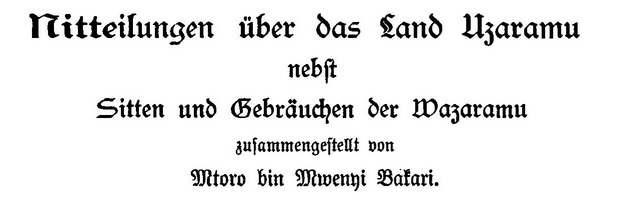
Mtoro Bakari became known above all as the main author of the "Customs and Customs of the Swahili". Previously, he had written two articles for a collection of Swahili-language travel accounts in which he reported on the history and culture of the Doe and Zaramo. These works were published under the name of his superior at the time, Carl Velten, who translated the texts he had collected from the Arabic into the Latin script, translated them into German and published them simultaneously in Swahili and German. [2] Only recently did an abridged and annotated English edition of the "Customs of the Swahili People" appear. [3] This text was subsequently interpreted as the first detailed account of Swahili culture in the 19th century by a local author. However, the degree of authenticity that was attributed to the text is put into perspective by the fact that it was written only immediately at the beginning of the 20th century, in Berlin, where Mtoro Bakari wrote it on behalf of his superior. For this reason, it is difficult to determine exactly the parts that both had in the original text and the German translation of the main part of the "Customs and Customs".
Velten's intention was to go beyond the descriptions of Swahili society written by European observers by drawing on authors who had themselves grown up on the East African coast and knew the conditions there from their own experience. He published their texts in the original language in order to authentically document both their linguistic expression and their thinking. This was not only of academic importance. The task of the lecturers at the Seminar for Oriental Languages was essentially to impart linguistic skills to German military personnel, colonial officials, private individuals and missionaries for their activities in the German colonies. Mtoro Bakari contributed to this through his teaching activities. In general, the German lecturers took over the main course in Swahili, which consisted mainly of the explanation of the grammatical structure and other general explanations. The actual language teaching took place mainly in the "exercises" of the local "lecturers" (in Berlin) or "language assistants" (in Hamburg).
In addition to his work as an author and lecturer, Mtoro Bakari made important contributions to the academic work of his German colleagues. In Hamburg, for example, he was available to the well-known Islamic scholar Carl Heinrich Becker as an informant in his research on Islam in East Africa. His work played a special role for Carl Meinhof, the founding director of the "Seminar for Colonial Languages" in Hamburg, who became known as the founder of the scientific research of African languages (African Studies). He wrote the conversations for his textbook "The Language of Swahili in German East Africa", whose orthography is apparently based on Mtoro Bakari's pronunciation, and also arranged for the "friendly review of the manuscript"[4], but without appearing as a co-author himself.
As early as 1904, he had drawn Meinhof's attention to the sounds in Swahili accompanied by a breathy sound, i.e. the aspirated phonemes th, ph, kh and tʃh. Europeans often did not perceive them, although they appeared as a signifying feature. Meinhof had also apparently missed this detail during his six-month stay in East Africa in 1902/03. Apparently, he took this as an opportunity to systematically investigate the phonetics of the African languages with the help of the technical recording facilities available at the time (kymograph, gramephone, etc.). Mtoro Bakari thus indirectly provided an impetus for the establishment of the Phonetic Laboratory. Meinhof was not able to establish this innovative idea in Berlin, but exactly one year after his move to Hamburg, the laboratory finally began its work in October 1910.
Meinhof was particularly grateful to Mtoro Bakari for his manifold work. When he left the Seminar for Oriental Languages in 1905, he attested to him, among other things: "Because of his good pronunciation, his teaching skills and his personal modesty, he was never a neutral collaborator, who provided me with any factual and linguistic information in the most willing way, even outside of his actual service."
In view of the systemic violence and systematic oppression that emanated from German colonial rule, the question arises as to how it came about that Mtoro Bakari made a small but not insignificant contribution to colonial knowledge production as well as to the teaching of African languages and cultures. In order to be able to give an answer to this question, it seems sensible to look at his behavior from the perspective of his experiences in East Africa and the German Reich.
He was born in Dunda, not far from the port city of Bagamoyo, which in the second half of the 19th century became the most important starting point for caravan traffic reaching as far as Central Africa. Both his grandfather and his father seem to have achieved some wealth through regional trade with the coast and gradually approached Islamic Swahili culture. However, the family apparently did not have any permanent wealth, such as a plantation. Nor was it likely to have played a decisive role in the long-distance trade, which, in addition to ivory, increasingly brought slaves to the East African coast, thus contributing to the expansion of the plantation economy there. Competition for direct access to this trade led to political rivalries and violent conflicts in many places.
The efforts of the German East African Society to take over the administration of the stretch of coast under his influence by means of a treaty with the Sultan of Zanzibar met with resistance. The numerically far inferior German troops often prevailed with ruthless brutality with the help of mercenaries, local forces and the superiority of their firepower. In September 1888, their guns destroyed part of the city of Bagamoyo – due to an imminent attack on their station. In the wider vicinity of the city, the violence perpetrated by both sides, from which the uninvolved population and, of course, Mtoro Bakari's family suffered, came to an end after a few months. At the beginning of 1891, the German Empire took over the administration of the entire colony of German East Africa and ensured the establishment of the colonial military. Until the turn of the century, the political priority of the colonial regime was to break the resistance throughout the interior by military means.
In the district of Bagamoyo, the subsidies of the German Empire in the 1890s made it possible to advance the construction of roads and bridges and to build buildings, fountains, etc. in the city itself. A large part of the population apparently perceived these investments positively. Mtoro Bakari himself expressed himself in this sense in the "Customs and Customs" and at the same time defended the so-called hut tax, which was levied by the Germans from April 1898. When it was introduced, he himself worked as a tax collector for a limited time. It is clear from his statements that many hated him for his work, as they perceived the tax as an unjustified coercive measure. This was all the more true because, for his own protection, at least in one case, as he himself reported, "my slave" and otherwise two African soldiers accompanied him.
However, the pressure exerted by the local tax collectors led to only small revenues. Another reason for this was the most severe and far-reaching famine during the German colonial period, which was caused by a drought that lasted until 1900. The colonial regime was only able to provide emergency aid selectively. Many people were in a precarious situation, probably including Mtoro Bakari, who had to provide for his wife and his still very young daughter. These difficult conditions seem to have been one reason why he accepted the offered job in Berlin, from where he paid them maintenance.
It soon became clear that neither Mtoro Bakari's positive assessment of colonial influence in East Africa nor his hopes for a permanently better life would become reality through his work in Germany. Apparently, he had mostly good experiences at first. Carl Velten appreciated his work and paid him respect. After Velten married, Bakari first moved to Zimmerstraße 9 and at the turn of the year 1903/04 to Kreuzbergstraße 21, where he met his future German wife, Berta Hilske. After the engagement in May, the couple married in October 1904. Regardless of this, Mtoro Bakari seems to have arranged for a divorce from his first wife as early as December 1903. Carl Velten, who considered the divorce to be incomplete and therefore accused him of bigamy, tried to prevent the marriage. The real reason for this, however, was that, in his view, marriages between light-skinned and dark-skinned "races" should be prohibited in principle.
The Bakaris openly defended themselves against the racism they experienced as a result. Berta and her mother personally approached the director of the seminary and complained about the attempts to prevent the marriage. Mtoro began to ignore Velten's instructions and no longer spoke to the director. However, the seminary did not dismiss him, not only because Carl Meinhof continued to employ him as a collaborator, but also because his return to East Africa was not desired. At the same time, they wanted to avoid a civil service dispute over the premature termination of the employment contract, which ran until May 1906. When the conflict with Velten escalated in May 1905, Mtoro asked for the termination of his contract on August 15, 1905.Six days later, the Bakaris embarked in Genoa and reached Dar es Salaam on September 13.
They were strictly denied entry there at the instigation of the governor of German East Africa, Gustav Adolf Graf von Götzen. At that time, there was neither a legal basis nor a corresponding ordinance for this. Götzen himself had forwarded the certificate required for the marriage to the colonial department in Berlin in September 1904. This was not the only reason why Mtoro Bakari could hardly expect an entry ban. Non-marital relationships between German men and local women were widespread in the colony until then. The entry of the married couple would have meant a complete reversal of these conditions and would therefore have called into question the asymmetrical social order on which the colonial regime was based. The harsh action against the Bakaris can also be explained by the fact that they arrived at the beginning of the Maji-Maji War, which put the colonial rule in severe distress. After nine days of forced stay on the ship, they returned to Berlin.
The aggressive racism expressed in reports in the German press in East Africa found its echo in some newspapers in the German Reich, but did not lead to any major public scandal there. Within the colonial administration, the marriage of the Bakaris seems to have been an important reason for increased measures against so-called "mixed marriages", i.e. in particular connections between German citizens and members of the German "protectorates". After the departure of the Bakaris from Dar es Salaam in September 1905, the first instruction in this regard was issued in German South West Africa (Namibia). Later, similar regulations followed in the other German colonies; in 1906 in German East Africa and in 1912 in Samoa. In the German Reich, on the other hand, "mixed marriages" continued to be recognized and possible until the beginning of the Nazi regime. [5] The story of the Bakari couple was known within the Reich Colonial Office; it became the internal reference for rejections of applications by "mixed" couples for marriage[6] and entry into German protectorates. As late as the 1920s, these couples were not allowed to enter the colonies.
After his forced return from East Africa, Mtoro Bakari tried in vain to persuade state authorities to acknowledge the injustice he had experienced and to help him to do an appropriate job. Carl Meinhof arranged for him to work at the Hamburg Colonial Institute in 1909. He consistently resisted the discrimination he experienced there. In 1911, the former colonial official Hans Zache tried, presumably with the support of Meinhof, to have him appear in his Swahili course in the role of a "native" in a mock court hearing. Mtoro Bakari defended himself against the associated attribution of the position of an intellectually limited subject with the help of his education and communication skills. In the end, Zache attested to him that he was not suitable for this as a "scholar" and instead brought in his own "boy" for this purpose.
A similar situation led to his immediate dismissal at the end of 1913. When the much younger Martin Heepe wanted to use the much experienced Mtoro Bakari as a "language assistant", the latter sat down in the teacher's place and refused to leave him. In this case, too, his behaviour was directed against institutional discrimination through the function intended for him in the system of "lectures" and "exercises". He was prepared to draw the final consequence from this. Meinhof refused to support him in this case. Although Meinhof was not very convinced of anthropological racial theories, from his point of view the subordination demanded in the colonies also applied to Germany. With the rise of younger German colleagues, this attitude was bound to lead to conflict.
Without the obstacles that were put in his way in Germany, Mtoro Bakari would have had an academic career open to him. After his release in Hamburg, he withdrew from colonial circles. Therefore, from 1914 onwards, only scant information about his life can be found. One source of income was lectures in various places about which little is known. Due to the rampant racism in connection with the campaigns against the occupation of the Rhineland, in which soldiers from the French colonies were involved, he obtained a certificate in 1922 that identified him as a citizen of the former German colonies in order to be able to ward off hostility. A letter he wrote in November 1926 to the above-mentioned Islamic scholar C.H. Becker is a possible indication of serious health or material problems. The last surviving documents concerning Mtoro Bakari are the death announcement by his wife on November 14, 1927 and his residents' registration card, on which July 14 was incorrectly entered as the date of death. In January 2022, the Historical Advisory Council to the Senator for Culture and Europe decided to install a Berlin porcelain memorial plaque at his last place of residence in Neukölln, which will commemorate him.
Ludger Wimmelbücker
- LOCATION
- Markgrafenstr. 78
- TODAY
- Markgrafenstr. 64
Citing the article
Ludger Wimmelbücker: Mtoro Bakari in Kreuzberg. In: Kolonialismus begegnen. Decentralised perspectives on Berlin's urban history. URL: https://kolonialismus-begegnen.de/geschichten/mtoro-bakari-in-kreuzberg/ (03.03.2025).
Literature & Sources
[1] Cf. Wimmelbücker, Ludger, Mtoro bin Mwinyi Bakari (c.1869-1927) – Swahili lecturer and author in Germany, Dar es Salaam 2009.
[2] Velten, Carl, Sitten und Gebräuche der Swahili nebst einem Annex über Rechtsgewohnheiten der Suaheli, Göttingen 1903; Velten, Carl, Desturi za Wasuahili na khabari za desturi za sheri'a za Wasuaheli, Göttingen 1903.
Velten, Carl, Schilderungen der Suahil von Expeditionen v. Wißmann, Dr. Bumillers, Graf v. Götzens, und Anderer, Göttingen 1901; Velten, Carl, Safari za Waswaheli, Göttingen 1901.
[3] Allen, J.W.T. (eds.), The Customs of the Swahili People: The Desturi za Waswahili of Mtoro bin Mwinyi Bakari and Other Swahili Persons, Berkeley et al. 1981.
[4] Meinhof, Carl, Die Sprache der Suahil in German-Ostafrika, Berlin 1910.
[5] Cf. Sippel, Harald, "In the Interest of Germanism and the White Race: Treatment and Legal Effects of "Mixed Races" in the Colonies of German East Africa and German South West Africa", in: Jahrbuch für afrikanisches Recht, 9 (1995), pp. 123-159; Wildenthal, Lora, German Women for Empire, 1884-1945, Durham, London 2001.
[6] In 1916, for example, the Colonial Office rejected Max Bebe Same's application to marry a German woman due to a lack of documents from Cameroon, thus preventing an attempt to enter the colonial territory. Two file notes refer to the "case of the East African Negro Mtoro", which is "very instructive". Cf. BArch R1001/4457f, pages 118-123.
Tags