W.E.B. DuBois in der Oranienstraße
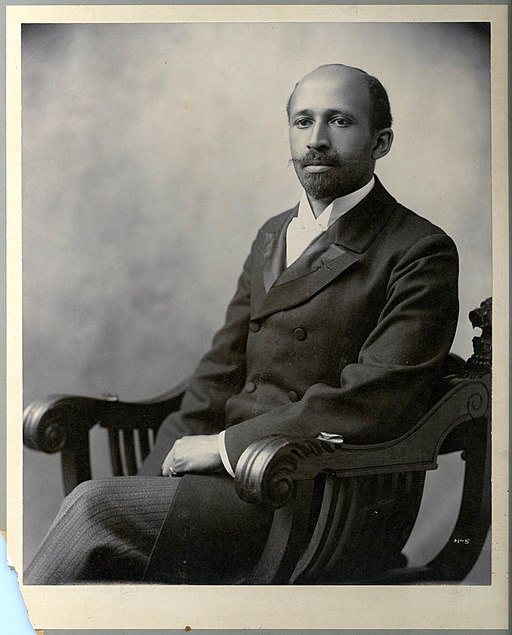
William Edward Burghardt Du Bois (1868–1963) left a monumental legacy as an African-American philosopher, sociologist, lecturer, journalist, and pioneer of the U.S. civil rights movement. However, in his long life and glorious career, the two years from 1892 to 1894 are often overlooked, during which W. E. B. Du Bois studied in Berlin at Friedrich-Wilhelms-Universität, now Humboldt University, and lived in an apartment on Oranienstraße in Kreuzberg. For the young Du Bois, this time was very formative; it had a great influence on his understanding of racism and on his later career as an activist in the U.S. civil rights movement.
Du Bois was born in Great Barrington, Massachusetts (USA), five years after the Emancipation Proclamation. He received his first bachelor's degree from Fisk University in Nashville, Tennessee, and his second bachelor's degree from Harvard University, where he became the first Black person to successfully earn a doctorate in 1895. Du Bois began to take an interest in Germany while still a student at Fisk University. In his bachelor's degree, he had learned German and dedicated his farewell speech to Otto von Bismarck, whom he admired for "forming a nation out of a mass of squabbling peoples"[1] – a view from which he later distanced himself. But for the young Du Bois, Bismarck's success story was seen as proof of the unifying power of a strong idea and was a model example for Black Americans. [2]
Doctoral degrees obtained in Germany were considered extremely prestigious in Du Bois's time, which is why he set himself the goal of achieving this academic "gold standard"[3]. It was not uncommon for American scholars in his time to travel to Europe to study at English, French, or the ever-popular German universities. [4] However, there were very few opportunities for Black students. Du Bois's studies in Germany were made possible by his successful application for a scholarship from the John F. Slater Fund for the Education of Freedmen, a foundation whose goal was to promote the education of African-Americans in the southern United States. [5]
So Du Bois was able to travel to Germany in 1892. Before moving to Berlin, he spent the summer of 1892 in Eisenach, where he lived with a pastor and his family, practicing his German and preparing for his studies. In his writings, Du Bois writes very positively about his first experiences in Germany. He emphasizes how surprised he was that there seemed to be significantly less racist prejudice against him compared to his experiences in the United States. In his autobiography he recalls: "I spent happy days in good old Eisenach at the foot of the Wartburg with a family in which academic education and German hospitality did not allow the racial prejudices common in America to arise at all." [6] In the fall, Du Bois enrolled at the Friedrich-Wilhelms-Universität in Berlin and moved into his quarters with a German family, at Oranienstraße 130A in today's Kreuzberg. Du Bois got used to the new life and adopted the habits of his peers and fellow students. For example, he wore the elegant outfit of wool suit, silk tie, gloves and walking stick characteristic of men of the bourgeois upper class. [7] Even though he had previously studied philosophy and history, Du Bois attended seminars and lectures in Berlin almost exclusively by professors of political economy. [8] The professors he considered most influential were Adolf Wagner, Gustav Schmoller and Heinrich von Treitschke, but he also studied with Max Weber and Wilhelm Dilthey. [9]
The economists Wagner, Schmoller, and von Treitschke were very conservative in their political views. Von Treitschke, in particular, was considered an extreme nationalist and was notorious for his pronounced anti-Semitism. [10] His inflammatory lectures were xenophobic, critical of democracy, celebrated imperialism – and they were extremely popular. It is surprising that Du Bois apparently deliberately failed to recognize these aspects and continued to study with von Treitschke. Despite the controversial views of his professors, his time as a student in Berlin had a profound impact on Du Bois, shaping his understanding of "race" constructions and representing a turning point in his analysis of the situation faced by African-Americans in the United States. Instead of the widespread idea of "race" characteristics, Du Bois now approached the definition in a more global perspective and in a socio-historical context:[11] "I began to look at the racial problem in America, the problem of the peoples of Africa and Asia, and the political development of Europe as a whole and to interweave my understanding of economics and politics [...]." [12] His studies in political economy in Berlin stimulated him to gradually question all ideas and assumptions about the economic structures of society and led him to the realization that they are historically constructed. [13] In his later, decidedly sociological treatises on African-American communities, such as "The Philadelphia Negro" (1896), the influence of the precise, rigorous methodology of the social sciences as practiced in Germany at the time[14] is clearly visible.
The approach of Wagner, Schmoller and von Treitschke, who dealt with contemporary social issues and referred directly to German society in their work, also had a lasting influence on Du Bois. All three were former members of the Reichstag and actively expressed their views in public lectures and print media. [15] Together, they had founded the Verein für Sozialpolitik, a forum in which scholars who advocated social and economic reforms exchanged ideas with each other and sought to influence the development of social policy in Germany. [16] Du Bois joined the association and thus became part of a socially engaged circle of intellectuals – and experienced first-hand the intertwining of science and political action. [17] He implemented this later in his career, when his work had taken on more activist features.
Perhaps most formative for him was that his time in Berlin was a respite from the relentless racism and prejudice of the South of the United States. [18] In "The Souls of Black Folk" (1903), Du Bois notes that his time in Europe, along with his childhood in Great Barrington, was one of the only phases in his life in which he did not experience blackness as a problem factor. [19] While Germany was by no means free of racism at the time, Du Bois felt freer in Europe than in the United States. He noted that for him, being black in Europe – unlike in the United States – did not necessarily mean social exclusion and exclusion from social participation. He also noticed that people in Europe seemed to pay more attention to signs of his class than to the color of his skin: he was an impeccably dressed gentleman with an elegant walking stick and was treated with respect. In his autobiography, he writes: "They [the whites] did not regard me as an abnormality or a subhuman. I was just a slightly more privileged student, whom they were happy to meet and with whom they could talk about God and the world, especially about the world I came from." [20] Having social contact with whites, which was generally forbidden in the segregated South, "shook my own ideas. The eternal walls between the races did not seem so strict and exclusive." [21]. Du Bois would remember this feeling of freedom for the rest of his life. And it may also explain why Du Bois sang such a hymn of praise to imperialist Germany, while he seemed to lack sensitivity to militarism, anti-Semitism, and right-wing populist movements that were openly expressed in public life at the time. [22] Du Bois was impressed by militarist patriotism and, like many of his contemporaries, thought that discrimination against the Jewish people in the German Reich would subside over time. [23] He did not recognize it as a frightening omen of horror.
After completing his first two years of study, Du Bois hoped to extend his scholarship for another year in order to be able to take the remaining semesters of study required for the doctorate. However, his application for an extension was rejected by the Slater Fund; and his many appeals to then-U.S. President Rutherford B. Hayes, the chairman of the fund, were also unsuccessful. [24] Thus, in 1894, Du Bois had to reluctantly travel back to the U.S., where deep divisions prevailed over questions of "race" constructions. Two years later, the Supreme Court upheld legal segregation in the U.S. with its ruling in Plessy vs. Ferguson, ushering in the Jim Crow era.
In the USA, Du Bois earned his doctorate at Harvard University, took on various teaching assignments, wrote and published his theories. He finally became known with his important work "The Souls of Black Folk" (1903). [25] This began a new chapter in his career, in which he devoted himself fully to the US civil rights movement. In 1905 he co-founded the Niagara Movement, and in 1909 the National Association for the Advancement of Colored People (NAACP), still one of the most influential Black civil rights organizations in the USA today. Both organizations were dedicated to resisting racial segregation and fighting for social justice for Black Americans. Until 1934, Du Bois was editor of "The Crisis", the very successful official magazine of the NAACP. During this period of his life, Du Bois wrote more about socialism, always emphasizing that the greatest challenge to socialism in the US, in his view, was not to be satisfied with a revolution of the white working class, but rather to set as its goal civil and economic rights for Black Americans. [26] Although he was only a member of the US Socialist Party from 1911 to 1913, his self-image as a socialist and his lifelong interest in socialist politics extended far beyond that. [27]
Beginning in 1919, Du Bois organized pan-African congresses whose core concerns were decolonization and an end to racial discrimination on the African continent. At the fifth Pan-African Congress in 1945, he met Kwame Nkrumah, a radical anti-colonialist under whose leadership Ghana gained independence from colonial rule and who later became the first president of the new state. President Nkrumah invited Du Bois to spend his last days in Ghana – an invitation that Du Bois accepted in 1961. Previously, in November 1958, he visited his alma mater, now Berlin's Humboldt University, where he was awarded an honorary doctorate in economics. [28] In Accra, he was celebrated as the father of pan-Africanism. Until his death in 1963 at the age of 95, Du Bois remained President Nkrumah's guest of honor. [29] Du Bois died just one day before hundreds of thousands of people in the U.S. took to the streets in Washington, D.C. for the civil rights of African-American people, where Martin Luther King Jr. gave his historic "I Have a Dream" speech. A year later, the Civil Rights Act was passed by the U.S. government, making discrimination on the basis of "race" illegal.
In Berlin's public space, there are only a few traces that bear witness to the time when Du Bois lived in Berlin. It was not until 2019 that a memorial plaque was dedicated to him at Oranienstraße 130A in Kreuzberg, where he lived during his stay in Berlin. [30] The memorial makes a small contribution to making Du Bois' legacy visible in Berlin's cityscape and to raising awareness of the transatlantic exchange that Du Bois's time in Berlin illustrates. Since 1998, two lecture series have been held in his honor at Berlin's Humboldt University, the "W. E. B. Du Bois Lectures" and the "Distinguished W. E. B. Du Bois Lectures". Until recently, these were the only public punctuations of the historical connection to Du Bois. [31] But this is set to change in the future: On the initiative of the Institute of English and American Studies at Humboldt-Universität Berlin, a memorial to Du Bois is being developed in the central university building on Unter den Linden. This is the first time that Humboldt-Universität has honored a Black person or person of color with a memorial. [32] This is being developed by the university in collaboration with Haitian artist Jean-Ulrick Désert and is intended to address Du Bois' time in Berlin as well as honor his legacy beyond that. [33] The timing of completion is still unclear due to the ongoing Covid-19 pandemic. It is hoped that the memorial will contribute to making the history of Black scholars visible and also to raise awareness of the relationships between Berlin and one of the most influential intellectuals of the 20th century.
Flavia Cahn
- LOCATION
- Oranienstr. 130
- TODAY
- Oranienstr. 130
Citing the article
Flavia Cahn: W.E.B. DuBois in der Oranienstraße. In: Kolonialismus begegnen. Decentralised perspectives on Berlin's urban history. URL: https://kolonialismus-begegnen.de/geschichten/w-e-b-dubois-findet-eine-wohnung-in-der-oranienstrasse/ (03.03.2025).
Literature & Sources
[1] Du Bois, W. E. B., Dusk of Dawn. An Essay Toward an Autobiography of a Race Concept (New York 2007), p. 16.
[2] Berman, Russell A., "Du Bois and Wagner: Race, Nation, and Culture Between the United States and Germany", in: The German Quarterly, 70.2. (1997), p. 123.
[3] Cf. Lewis, David Levering: W. E. B. Du Bois in Germany and Germany in W. E. B. Du Bois. 16th Distinguished W. E. B. Du Bois Lecture, 15.04.2008. Available online at: www.angl.hu-berlin.de/department/duboismemorial/ inberlin/1890s/lewis-david-l-dist-du-bois-lecture-2008.pdf [accessed 21.03.2022].
[4] Schäfer, Axel R., "W. E. B. Du Bois, German Social Thought, and the Racial Divide in American Progressivism, 1892–1909", in: The Journal of American History 88.3 (2001), p. 929.
[5] Johnson, Brian, "The Role of Higher Education in the Religious Transformation of W. E. B. Du Bois" in: The Journal of Blacks in Higher Education 59 (2008), p. 79.
[6] Du Bois, W. E. B., The Autobiography of W. E. B. Du Bois. A Soliloquy on Viewing My Life from the Last Decade of Its First Century, New York 1988 (10th edition), p. 160, "I spent a happy holiday in a home where university training and German home-making left no room for American color prejudice." (Translation)
[7] Cf. Barkin, Kenneth D., "W. E. B. Du Bois' Love Affair with Imperial Germany", in: German Studies Review (28.2.2005), pp. 285–302, here 294.
[8] Cf. Barkin, Kenneth D., "Berlin Days", 1892–1894: W. E. B. Du Bois and German Political Economy", in: boundary 2 (27.3.2000), pp. 79–101, here p. 92.
[9] Berman, Du Bois and Wagner: Race, Nation, and Culture Between the United States and Germany, 7p. 125.
[10] Barkin, W. E. B. Du Bois' Love Affair with Imperial Germany, p.: 84.
[11] Lee, Christopher J., "Du Bois in Berlin", in: Africa is a Country, 12.03.2020 https://africasacountry.com/2020/03/du-bois-in-berlin .
[12] Du Bois, Dusk of Dawn. An Essay Toward an Autobiography of a Race Concept, 23-24 "I began to see the race problem in America, the problem of the peoples of Africa and Asia, and the political development of Europe as one. I began to unite my economics and politics..."
[13] Schäfer, W. E. B. Du Bois, German Social Thought, and the Racial Divide in American Progressivism, 1892–1909, p. 934.
[14] Johnson, The Role of Higher Education in the Religious Transformation of W. E. B. Du Bois, p. 79.
[15] Barkin, W. E. B. Du Bois' Love Affair with Imperial Germany, 92.
[16] Ibid., p. 93.
[17] Cf. Lee, Du Bois in Berlin.
[18] Appiah, Kwame Anthony, Lines of Descent. W. E. B. Du Bois and the Emergence of Identity, Cambridge, MA 2014, p. 28.
[19] Barkin, W. E. B. Du Bois' Love Affair with Imperial Germany, p. 83.
[20] Du Bois, The Autobiography of W. E. B. Du Bois. A Soliloquy on Viewing My Life from the Last Decade of Its First Century, p. 157, "They [white folk] did not always pause to regard me as a curiosity, or something sub-human; I was just a man of the somewhat privileged student rank, with whom they were glad to meet and talk over the world".
[21] Du Bois, Dusk of Dawn. An Essay Toward an Autobiography of a Race Concept, p. 51, Translated from the original "... made my own ideas waver. The eternal walls between races did not seem so stern and exclusive."
[22] Barkin, Kenneth D.: W. E. B. Du Bois' Love Affair with Imperial Germany. In: German Studies Review, 28.2.2005, pp. 285–302.
[23] Ibid., p. 290.
[24] Johnson, The Role of Higher Education in the Religious Transformation of W. E. B. Du Bois, p. 79.
[25] Berman, Du Bois and Wagner: Race, Nation, and Culture Between the United States and Germany, p. 126.
[26] Lewis, David Levering, W. E. B. Du Bois, 1868–1919. Biography of a Race, New York 1993, p. 688.
[27] Horne, Gerald, W. E. B. Du Bois. A Biography, Santa Barbara 2010, p. 170.
[28] Cf. Lewis, David Levering: W. E. B. Du Bois in Germany and Germany in W. E. B. Du Bois. 16th Distinguished W. E. B. Du Bois Lecture. 15 April 2008. https://www.angl.hu-berlin.de/department/duboismemorial/ inberlin/1890s/lewis-david-l-dist-du-bois-lecture-2008.pdf.
[29] Cf. Horne, W. E. B. Du Bois. A Biography, pp. 188f.
[30] Conrad, Andreas: Memorial plaque for the US sociologist W. E. B. Du Bois. Der Tagesspiegel. 27 August 2019. https://www.tagesspiegel.de/berlin/24944188.html.
[31] Zocco, Gianna, "A "modest monument" is waiting for its completion. Gianna Zocco in conversation with Jean-Ulrick Désert and Dorothea Löbbermann", in: Blog of the Leibniz Centre for Literary and Cultural Research, Berlin (16 July 2020). Available online at: https://www.zflprojekte.de/zfl-blog/2020/07/16 [last access: 15.02.2021].
[32] Humboldt-Universität zu Berlin, W. E. B. Du Bois Memorial at Humboldt-Universität zu Berlin (22 July 2020). Available online at: https://www.angl.hu-berlin.de/department/duboismemorial [last accessed: 15.02.2021].
[33] Désert, Jean-Ulrick, "W. E. B. Du Bois", Humboldt-Universität zu Berlin (2019). Available online at: https://vimeo.com/368316978 [last access: 15.02.2021].
Tags
#1892#Adolf Wagner#Amerika#Antikolonialismus#Bürgerrechtsbewegung#Dekolonisierung#Eisenach#Friedrich-Wilhelms-Universität#Gedenktafel#Ghana#Gustav Schmoller#Harvard Universität#Heinrich von Trieschke#Humboldt-Universität#Jean-Ulrick Désert#Kreuzberg#Kwame Nkrumah#Max Weber#NAACP#National Association for the Advancement of Colored People#Niagara Movement#Niagara Movement#Oranienstraße#Pan-African Congress#Panafrikanismus#Sozialismus#Sozialwissenschaft#Stipendium#Studium#The Crisis#Verein for Social Policy#W. E. B. Du Bois#Wilhelm Dilthey#Willian Edward Burghardt Du Bois