AMAG: Postcards for German Colonies – The Example of Kiautschou
The contributions of the Reinickendorf Museum, which are presented on the page "Kolonialismus begegnung", have been carefully curated in the context of the special exhibition "Colonial Traces in Reinickendorf's Industrial History". The contributions have been thoroughly reviewed and revised for digital presentation. We recommend reading the comprehensive introductory text on Reinickendorf's colonial past (link) in advance.
Postcards for the colonies
Company: Albrecht & Meister AG (AMAG)
Founded: 1904 in Berlin by Paul Meister and others
Reinickendorf: from 1908 production at Holländerstraße 31/34
Production: Luxury Paper, Flashcards
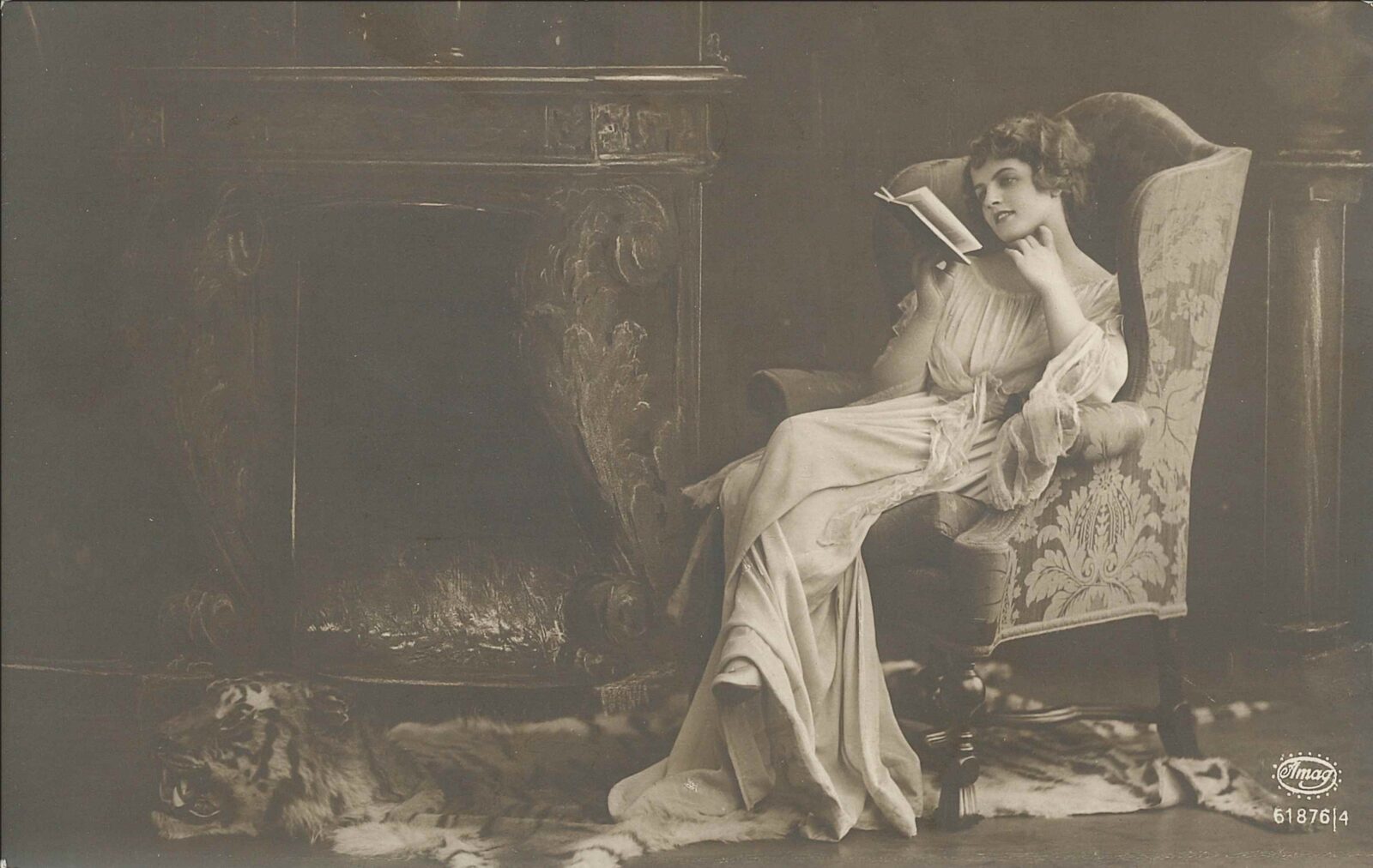
At the beginning of the 20th century, picture postcards became a mass medium and collector's item. They were used worldwide, including in the colonies, to correspond with those who stayed at home. From 1908 onwards, the company Albrecht & Meister AG (AMAG) produced picture postcards in Reinickendorf, which were sold to the colonies and sent back to the German Reich. They became a symbol of globalisation and colonial expansion.
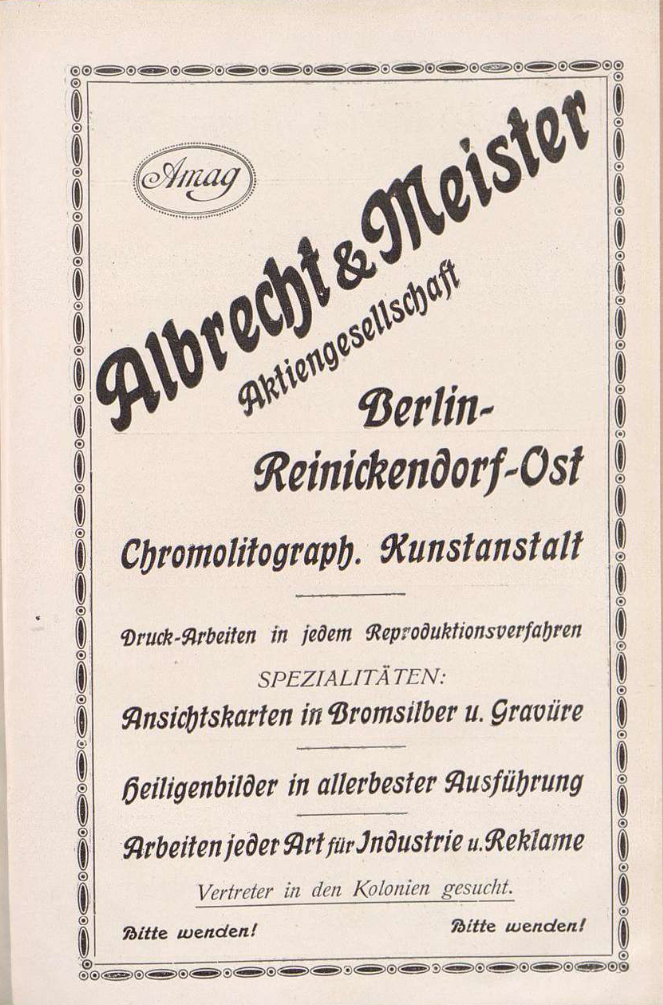
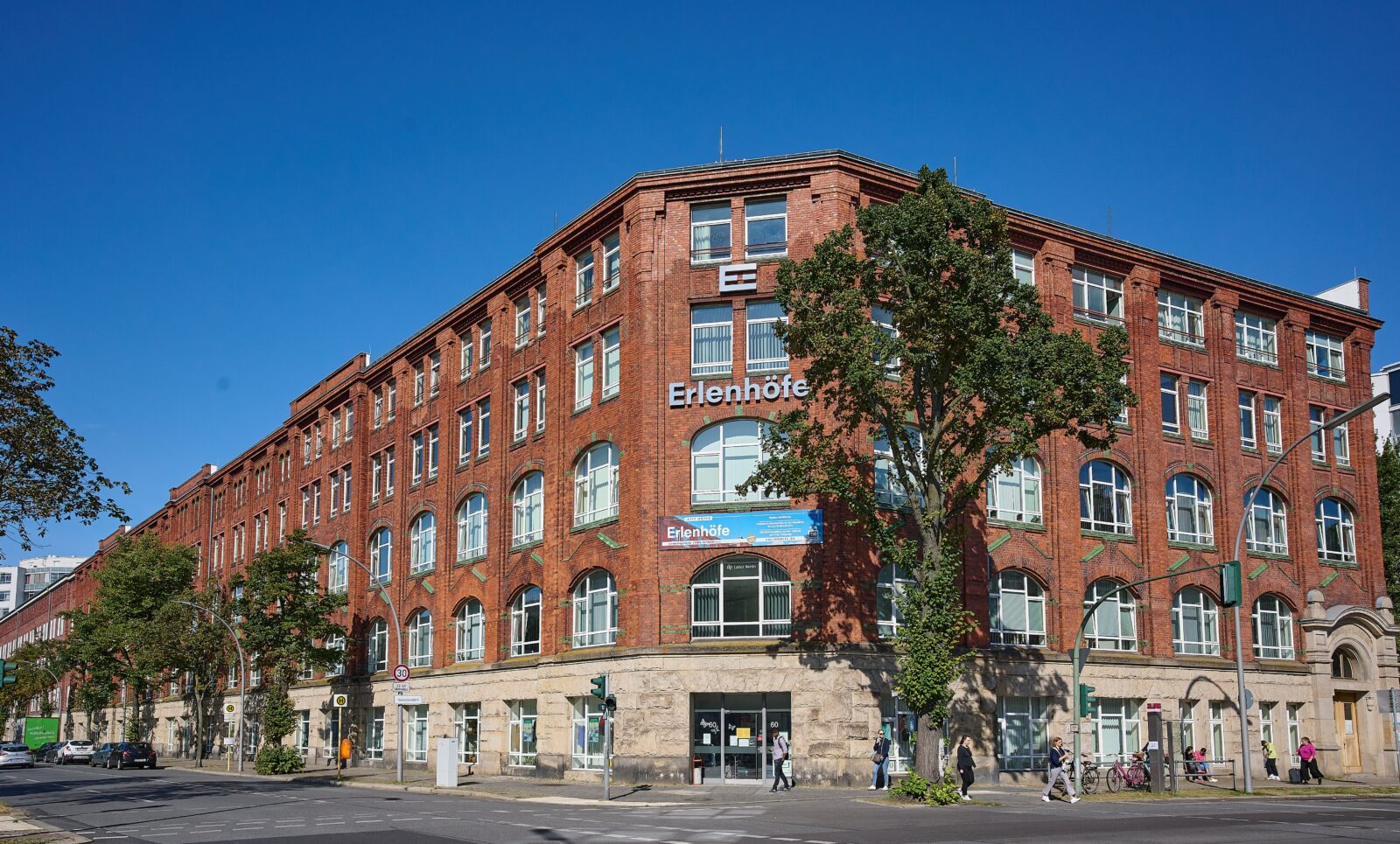
AMAG was founded in 1904 to take over and continue Albrecht & Meister GmbH in Berlin. In 1908, the corporation moved to a new building in Reinickendorf-Ost, Holländerstraße 31/34. (1) Postcards and congratulatory postcards were an important product for AMAG. In 1912, AMAG, which specialised in the production of luxury papers, calendars, celluloid articles, advertising articles and picture postcards, placed a double-page advertisement in the "Address Book for German New Guinea, Samoa, Kiautschou". (2) In it, it advertised its products, but above all it was looking for representatives for the colonies. These were presumably intended to sell picture postcards and other products to members of the colonial administration and the "Schutztruppen". (3) In 1914, the shares of AMAG were taken over by Berlin-Neuroder Kunstanstalten AG, but the company continued to run independently, but the land in Reinickendorf was abandoned. (4) The building in Holländerstraße was occupied by AEG in 1927. It is now a listed building.
The Kiautschou Colony
German colony: 1898–1914
Area: 551.7 km2, in the south of the Shandong Peninsula in the northern area of China's east coast
Population: 190,000 inhabitants, of which 2,401 were German soldiers, 1,855 civilian Germans (1913)
Economy: Trade, base of the Imperial Navy in East Asia
Military: 2,401 soldiers (1913)
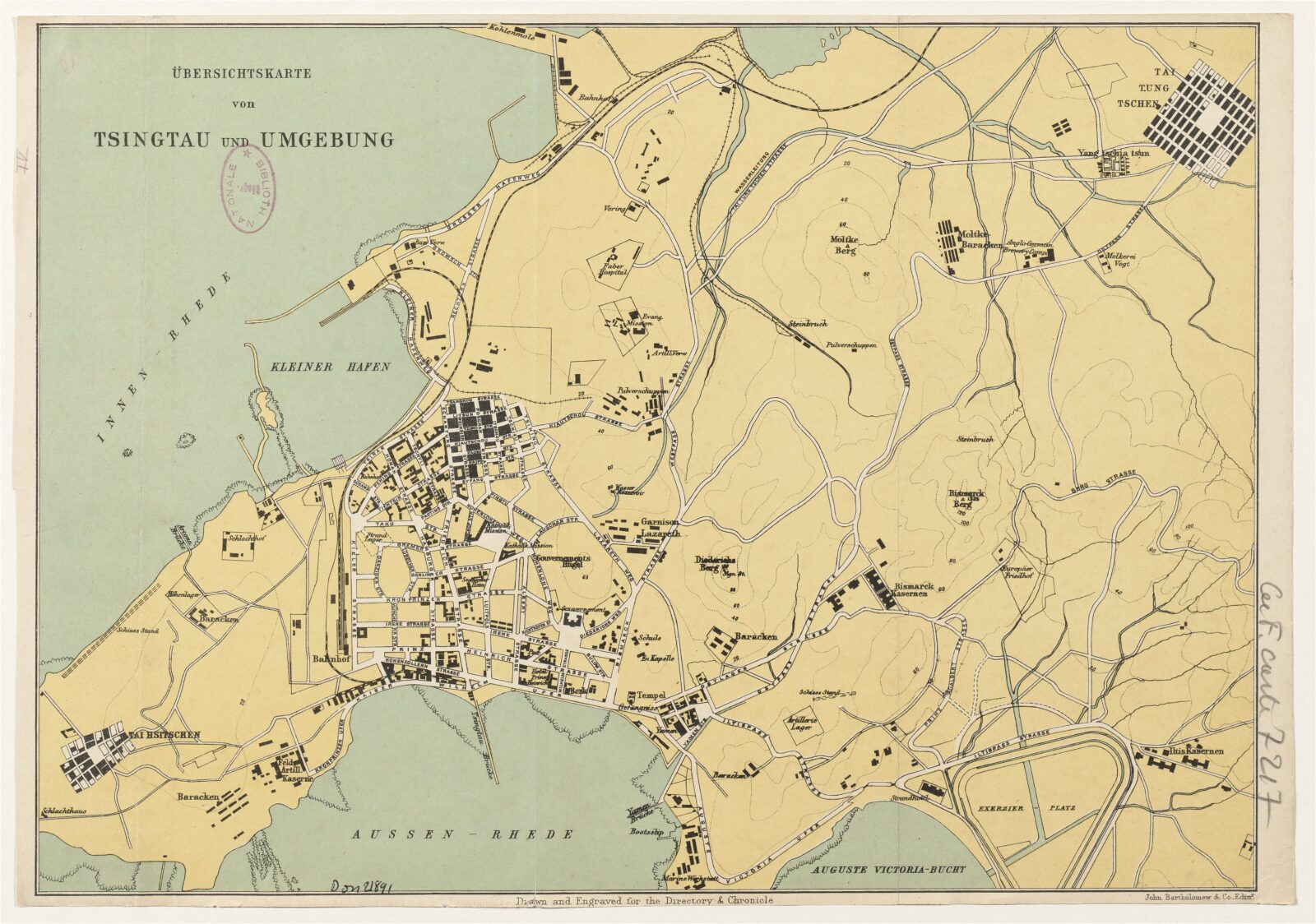
The area leased by China to the German Empire in the bay of Jiāozhōu (German: "Kiautschou") was located in the south of the Shandong Peninsula, in the northern area of the Chinese east coast. Unlike the other German colonies, Kiautschou had been established purely as a trading colony and naval base. (5)
Since the middle of the 19th century, Great Britain and other European powers had forced the Chinese government to open up China as a sales market. As a result, so-called "leased areas" were occupied at the end of the 19th century. As a result, the German Empire also acted as a major political power in China in order to expand its own influence. The Prussian East Asia Expedition led by Friedrich Graf zu Eulenburg from 1859 to 1862, whose aim was to conclude treaties with Japan and China, reached China in March 1861. In September 1861, Eulenburg was able to sign a treaty of friendship, trade and shipping with China, which also included permission to establish a diplomatic mission in Beijing. However, the establishment of a German military base was prevented by the Chinese government. Despite this, a few years later, after extensive travels through China, the geographer Ferdinand Freiherr von Richthofen recommended the Shandong Peninsula for the establishment of a German naval base in a memorandum addressed to Otto von Bismarck. After the occupation of Tsingtau in the Bay of Kiautschou by German naval troops in November 1897, China forcibly leased the area to the German Reich on March 6, 1898, and at the same time granted mining rights and the right to build a railway line in Shandong Province. (6)
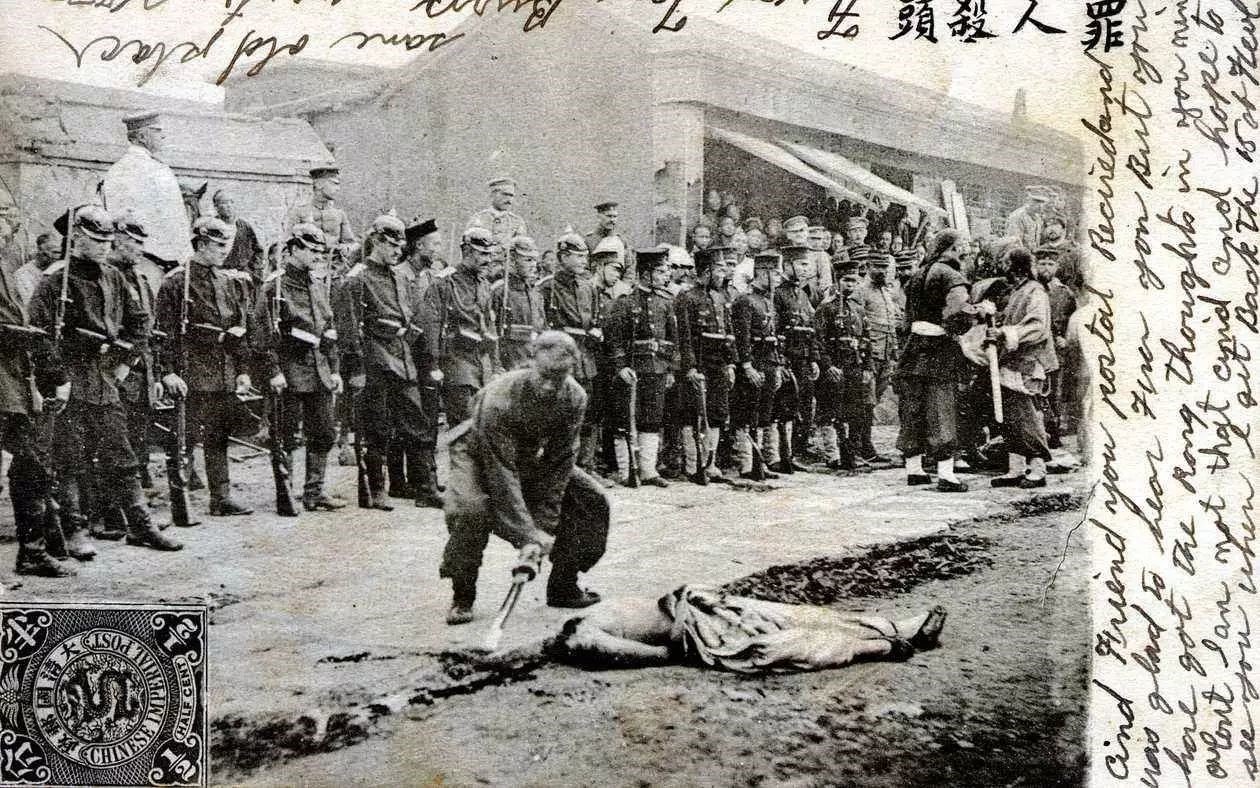
Everyday life in Tsingtau was characterized by ethnic segregation. There were separate legal systems and neighborhoods. Parts of the Chinese population worked as "coolies" (unskilled low-wage workers), who were also employed in German East Africa, Samoa and New Guinea. (7) The spatial and social division between the Chinese population on the one hand and Europeans, Americans and Japanese on the other was continued in the legal system. Thus, from 14 July 1900, rules were laid down for the local inhabitants of Tsingtau in the so-called "Chinese Order", whose violations were rigorously punished. As early as July 1, 1898, the "Ordinance on Violations of Service by Chinese Workers and Servants," signed by Imperial Governor Rosendahl on July 1, 1898, stated: "Chinese who are in an employment relationship or employment relationship may, at the request of the service and employers, be punished with a fine of up to half the amount of the monthly wage, with corporal punishment up to 50 blows and, in connection with these punishments or alone, with prison sentences, not exceeding 21 days, for continued breach of duty and indolence, for insubordination or unjustified leaving their places of service and employment, as well as for other significant violations of the service and employment relationship and inducing others to do so." Disputes and repression determined everyday life in the region. "Punitive expeditions", which meant the destruction of villages and the murder of their inhabitants in 1899 and 1900 with the aim of enforcing the contractually concessioned construction of railway lines, were led by Governor Paul Jaeschke in 1899 and 1900: In April 1899, German soldiers burned down the village of Hanjiakran, in June soldiers of the III Naval Battalion stormed the villages of Tidong and Liuge, 25 people died, and in the autumn of 1900, during the war against the Yihetuan, three more villages were attacked, killing 450 people. These "punitive expeditions" of the III Naval Battalion, as well as the aggressive appearance of German Catholic missionaries in the area around Jiaozhou, contributed significantly to the emergence of the resistance movement of the "Boxers" (Yihetuan or "Fighters for Justice and Harmony"), which was directed against European dominance and above all against the activities of the missions. (8)
An essential basis for the economic development of the colony was the construction of the Schantung railway, in which the Reinickendorf company August Borsig GmbH was also involved with smaller blocks of shares. (9)
Towards the end of the colonial period, imports in Kiautschou exceeded exports by 20 percent. This made Kiautschou one of the most expensive colonies of the German Reich, along with German South West Africa. (10)
Facts & Files
- LOCATION
- Holländerstraße 31-34, 13407 Berlin
- TODAY
- Holländerstraße 31-34, 13407 Berlin
Citing the article
Facts & Files : AMAG: Postcards for German Colonies – The Example of Kiautschou. In: Kolonialismus begegnen. Decentralized Perspectives on Berlin's City History. URL: https://kolonialismus-begegnen.de/geschichten/amag-postkarten-fuer-deutsche-kolonien-beispiel-kiautschou/ (05.11.2024).
Literature & Sources
(1) Albrecht & Meister AG: Handbuch der Deutschen Aktiengesellschaften 1914, pp.1135–1136f.
(2) Address Book for German New Guinea, Samoa, Kiautschou, Volume 12, Berlin 1912, p.68f.
(3) Felix Axster: " . . . will try to send you the best views from here": Postcards from the Colonial War in Namibia (1904–1908), Volker M. Langbehn (ed.), German Colonialism, Visual Culture, and Modern Memory, pp. 55–70.
(4) Ibid.; Berliner Börsen-Zeitung: Announcement on Albrecht & Meister, p. 3.
(5) Sebastian Conrad: German Colonial History. C.H.Beck Wissen, Volume 2448, 4th, revised edition, original edition, Munich 2019, p. 39.
(6) Winfried Speitkamp: German Colonial History. Reclam Non-Fiction, Updated and Expanded Edition, Ditzingen 2021, p.37. Bezirksamt Steglitz-Zehlendorf von Berlin (ed.): Spuren des Kolonialismus, Der private Nachlass des Wandervogels Karl Fischer, 1st edition, Berlin 2021, p. 19.
(7) Sebastian Conrad: German Colonial History. C.H.Beck Wissen, Volume 2448, 4th, revised edition, original edition, Munich 2019, p. 65.
(8) Winfried Speitkamp: German Colonial History. Reclam Non-Fiction, Updated and Expanded Edition, Ditzingen 2021, p. 37.
(9) Participation of Borsig: Schantung 108,000 M, German-Chinese 20,000 M Landesarchiv Berlin (LAB), A. Borsig Zentralverwaltung GmbH: Establishment and Profit Matters of the German-Chinese Railway Company, A Rep. 226, No. 331.
(10) Sebastian Conrad: German Colonial History. C.H.Beck Wissen, Volume 2448, 4th, revised edition, original edition, Munich 2019, p. 39.