The Royal Museum of Ethnology
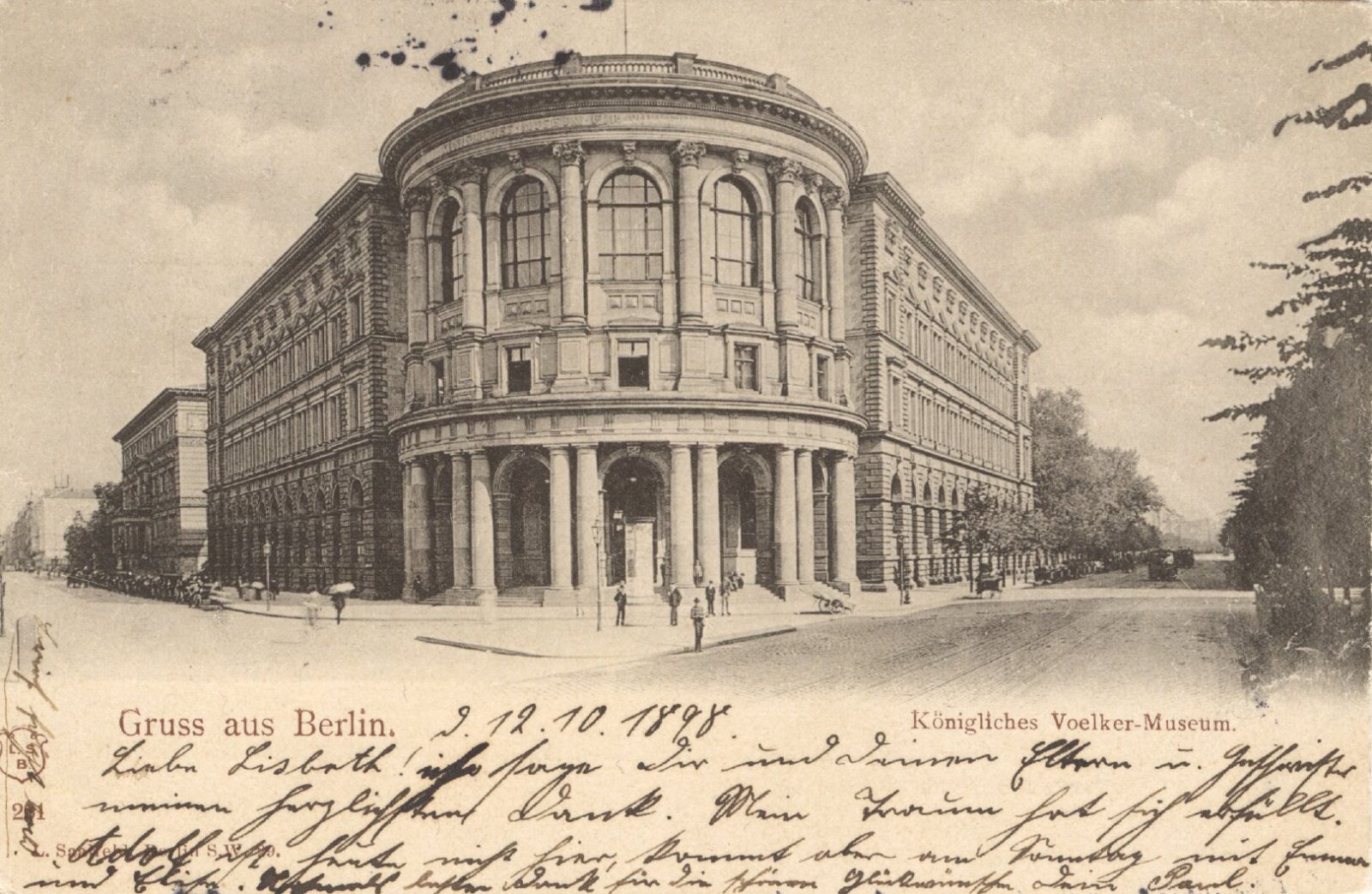
The Royal Museum of Ethnology opened its doors in 1886 at Königgrätzer Straße 120 (today Stresemannstraße, corner of Niederkirchnerstraße) – two years after the notorious Berlin "Africa Conference", at which the division of the African continent was sealed and the German Empire was established as a colonial power. The monumental building, designed by Hermann Ende (1829–1907), was only a few streets away from the conference venue. Together with the Museum of Decorative Arts (now the Gropius Bau), which was located directly next to it, another museum quarter was to be built here next to the Museum Island in Mitte. This new institution presented ethnology as a discipline and a showcase in the imperial interest, both in its physical presence of a Wilhelmine magnificent building and in its institutional form as a clearly royal institution.
The German Empire, which was founded in 1871 under Prussian aegis, was still at the beginning of its national aspirations. The German small-state mentality and provincialism were to be replaced by modern cosmopolitanism. As the capital of the Reich, Berlin stood for the German urge for recognition, and the museum was to exhibit this. [1] The collection had already been founded in 1873 under the leadership of the Berlin Society for Anthropology, Ethnology and Prehistory (BGAEU). The objects of the Royal Kunstkammer in the Berlin Palace were incorporated into the new collection. Today, around 500,000 objects are in the possession of the Ethnological Museum in the Humboldt Forum. The hundredfold growth of the collection of objects was undoubtedly due to the skilful museum policy and diligent work of the museum staff, above all the founding director Adolf Bastian (1826–1905).
In 1866, at the age of 40, the much-travelled ship's doctor Bastian came to the Friedrich-Wilhelms-Universität in Berlin as a lecturer, where he habilitated and was appointed associate professor of ethnology as early as 1869. From 1875 he also presided over the BGAEU, which he himself had co-founded in 1869; from 1876 Bastian finally became director of the Berlin Museum of Ethnology, a position he held for almost 30 years until his death. Bastian's meteoric career went hand in hand with the establishment of the scientific discipline of ethnology and the consolidation of the museum as its laboratory. [2] In contrast to British museum practice, which used technical progress as a measure of the hierarchization of world cultures, the new museum in Berlin was based on a model that arose from Humboldt's cosmopolitan views. But even Humboldt's cosmopolitanism, which is still much invoked in the present (for example in the "Humboldt Forum"), proves to be contradictory: the seemingly objective "discovery missions" used existing colonial contexts and promoted the universal claim to knowledge as a global narrative of superiority.
Ethnology as a science was to be based on the empirical-comparative method, and knowledge was to be gained through (world) travel and the collection of materials. Bastian's vision was to recognize one's own essence by capturing human creativity as completely as possible – humanity was assumed to be unified. The museum was to become an archive of this universality. [3] However, the method effectively contributed to a temporal and cultural hierarchy: the objects of ethnology were the so-called primitive peoples, who were supposedly supposed to represent the "prehistory" of the (European) "civilized peoples"; living people played no role in scientific research. [4]
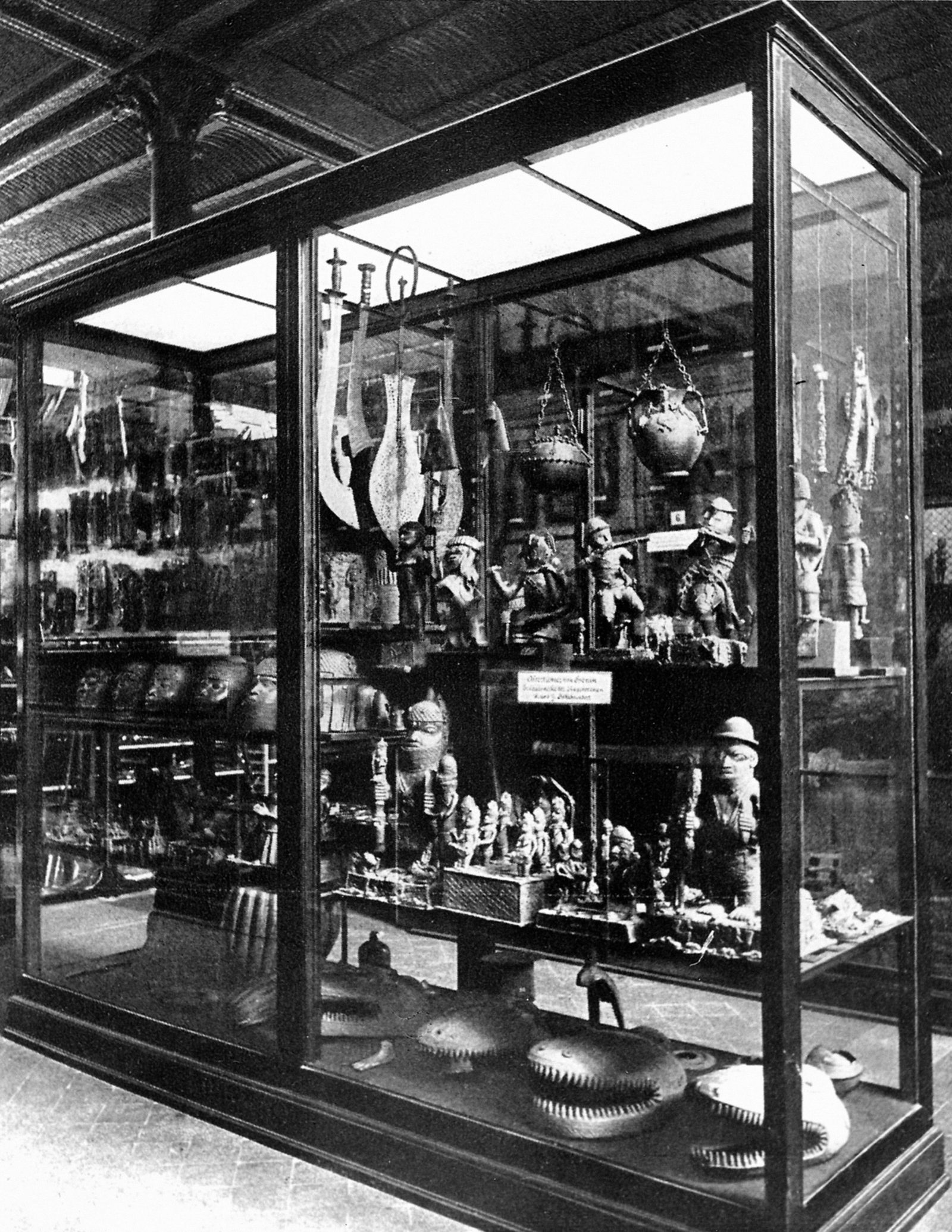
Franz Boas (1858–1942), the later founder of American anthropology, was strongly influenced by the ideas of his superior Adolf Bastian at the Berlin museum and summed up the collecting strategy of Bastian's scientific vision: "One must strike while the iron is hot!". [5] For the authenticity of the "historyless primitive peoples" was, not only in Bastian's view, threatened with annihilation by Western expansion. Therefore, the task of ethnology was to preserve as much (and exclusively) material culture as possible: "Save! Save! Before it's too late." The museum people fell into a veritable "frenzy of collecting". [6] They were not bothered by the fact that the "prehistoric" cultural assets were thus torn from their cultural context and disappeared into depots outside their social significance through "scientific appropriation". In fact, the wanton execution of the goods further accelerated the cultural extinction of the original cultures.
In 1881, Bastian even founded an aid committee for the increase of the ethnological collections in order to generate funds for collecting trips even more quickly. The two-year journey of Johan Adrian Jacobsen (1853–1947) through North America and Alaska in 1881/82 alone brought him about 7000 objects. In the mid-1880s, i.e. shortly before the opening of the new museum building, the collections already comprised 50,000 inventory numbers. [8] Director Bastian used a diverse network of contacts to achieve the "completion of the collections of the local museum". [9]
"In general, it is very difficult to obtain an object without using at least some force. I believe that half of your museum has been stolen." [10] In 1897, for example, Richard Kandt, who later became a "resident" in Rwanda, wrote to Felix von Luschan (1854–1924), assistant director and later head of the Africa Collection, from a trip to Africa. Bastian's collecting mania was thus also knowingly part of a violent history of appropriation. The fact that Bastian was clearly an actor and profiteer of colonial trade and exploitation is proved, among other things, by his involvement in the founding of the Society for the Study of Equatorial Africa in 1873, which aimed to scientifically explore the continent and thus open up new markets. Bastian spoke out openly in favor of "trade colonialism" and did not fail to emphasize the importance of scientific ethnology for world trade and "cosmopolitan-international trade". [12]
In addition, there was the privilege granted to the museum in 1889 "in the interest of science"[13] : it was granted pre-emption rights for all objects that were procured with Reich funds (including military actions) and thus developed into the central collection point for colonial acquisitions for the whole of Germany. [14] Bastian himself had previously corresponded with the Foreign Office for this purpose in order to highlight the "ethnological originalities" and to request that "these be preserved in a pure and untarnished manner in order to be preserved in museums for future studies"[15]
Ten years later, von Luschan enthusiastically noted that the collection was ten times as large as that of other institutions and that all objects from the colonies initially remained in the possession of the museum. [16] By the First World War, the Africa collection alone was to contain 55,000 objects. While the official museum guide of 1887 announced a separate colonial department[18] and a Federal Council resolution also envisaged the museum as a "replacement" for a colonial museum, Bastian himself finally recommended a separate museum for the "colonial acquisitions" in 1899 due to lack of space – the excess of objects arriving from certain regions began to disturb his scientific concept. [19] Nevertheless, Bastian saw a "natural and beneficial alliance" of ethnology and colonial policy, he even went so far as to describe the former as a "colonial teaching". [20]
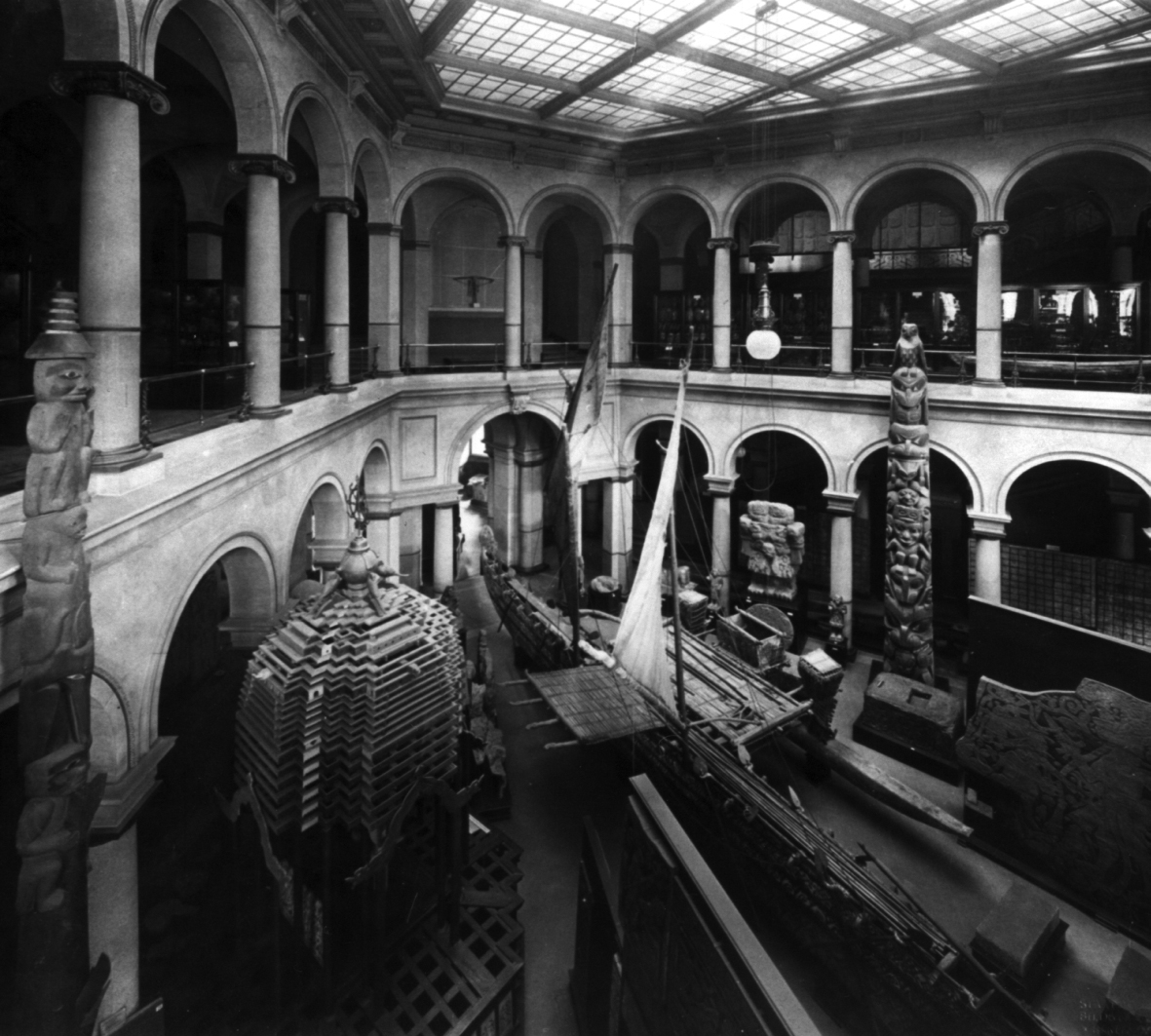
The magnificent Kreuzberg building, whose architecture with its many windows and wallless rooms did not necessarily meet the requirements of a museum, was not up to the massive increase in the collection. In view of the increasingly disorderly accumulation, the general director of the Berlin museums, Wilhelm von Bode (1845–1929), even spoke of the danger of a "monster universal museum", "unmistakable" and "unusable". [21] A "shed" on the Dahlem domain in southwestern Berlin was intended to remedy this. This location was finally considered for a new building, not least because Bode emphasised the emergency situation. [22] The architect Bruno Paul (1874–1968) designed a museum complex that provided a separate building for each of the four departments (Near East/India, East Asia, Africa/Oceania, America). Only one of the buildings was actually built before the First World War put an end to the entire project. [23]
Contrary to Adolf Bastian's vision of a purely scientific presentation of the collection, general popular education increasingly became a pillar of museum work. Thus, from the reopening in 1926, the claim of "visibility" prevailed – people were to look in Kreuzberg and study in Dahlem. Critical voices such as those of the art theorist Carl Einstein (1885–1940) criticized the object-related isolation and thus also the decontextualized aestheticization in the presentation. It was not scientific research, but ultimately the construction of an exoticized "other" that was offered. [24]
With the move of the permanent collection into today's Humboldt Forum in the rebuilt Berlin Palace – the Forum itself speaks of a return to the "origin"[25] – the continued location of Dahlem will once again become a "peripheral" study collection. It is unclear whether the exhibition of around 20,000 of the total of 500,000 objects in the centre of Berlin will provide transparent information about the acquisition history of the exhibits and the actors in the appropriation in order to do justice to the museum's responsibility. The potential discrepancy between ideas of the theory of science and scientific practice, which was shown using the example of Adolf Bastian, must be critically assessed again and perhaps again and again. [26]
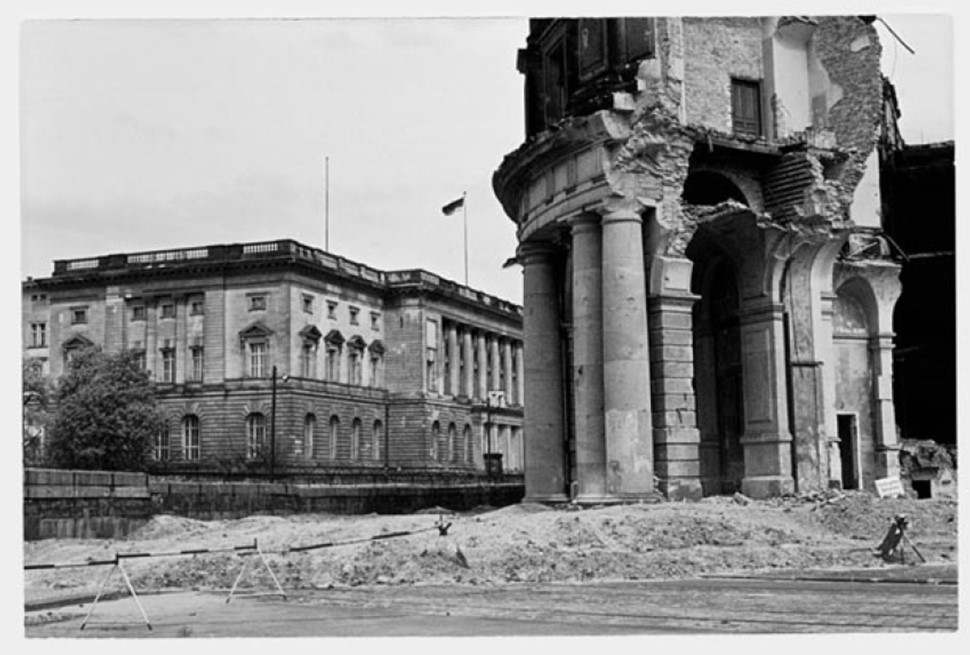
The museum in Kreuzberg, which was severely damaged in the Second World War, was demolished in 1961. Today there is a wasteland or a parking lot, only a barely perceptible, transparent memorial stele from 2009 (organized by the district of Friedrichshain-Kreuzberg) points to the history of the site. However, this does not make it clear that the museum played a central role in the colonial appropriation of objects throughout Germany, and that these collections are still located in Berlin and other places. Nor is it pointed out that the actors who worked in this museum encouraged this sometimes violent appropriation through their collecting activities. A clearly anti-colonial intervention would be necessary here, which critically classifies and reflects on this "collecting mania".
Clemens Wildt
- LOCATION
- Königgrätzer Straße 120
- TODAY
- Stresemannstraße 110, corner of Niederkirchnerstraße
Citing the article
Clemens Wildt: The Royal Museum of Ethnology. In: Kolonialismus begegnen. Decentralized Perspectives on Berlin's City History. URL: https://kolonialismus-begegnen.de/geschichten/das-koenigliche-museum-fuer-voelkerkunde/ (03.03.2025).
Literature & Sources
[1] Penny, H. Glenn, Objects of Culture – Ethnology and ethnographic museums in Imperial Germany. Chapel Hill / London 2002, p. 17f.
[2] Penny, H. Glenn, "Bastian's Museum. On the Limits of Empiricism and the Transformation of German Ethnology", in: Penny, H. Glenn / Bunzl, Matti (eds.), Worldly Provincialism. German Anthropology in the Age of Empire, Ann Arbor 2003, pp. 86–126, here p. 101.
[3] Bunzl, Matti, "Franz Boas and the Humboldtian tradition. From Volksgeist and Nationalcharakter to an anthropological concept of culture", in: Stocking, George W. (ed.), Volksgeist as Method and Ethic. Essays on Boasian Ethnography and the German Anthropological Tradition, Madison / London 1996, pp. 17–78, here pp. 48f.; Cf. Penny, Objects of Culture – Ethnology and ethnographic museums in Imperial Germany, pp. 19ff.; Cf. Penny, Bastian's Museum. On the Limits of Empiricism and the Transformation of German Ethnology, pp. 88ff.
[4] Cf. Penny, Objects of Culture – Ethnology and ethnographic museums in Imperial Germany, pp. 22f.; Weber, Kristin, "Objects as Mirrors of Colonial Relations. The Collecting of Ethnographica at the Time of German Colonial Expansion in East Africa (1884-1914)", in: Seifert, Marc/Egert, Markus/Heerbaart, Fabian (et al.) (eds.), Contributions to the 1st Cologne Conference on Young Researchers in African Studies, Cologne 2007, p.2f. Available online at: http://www.uni-koeln.de/phil-fak/afrikanistik/kant/data/WK1_kant1.pdf [last access: 07.03.21]; Ivanonv, Paoloa, "Appropriation. The Museum View as a Mirror of the European Encounter with Africa", in: Arndt, Susan (ed.), Images of Africa. Studies on Racism in Germany, Münster 2001, pp. 351-371, here p. 358.
[5] Liss, Julia E., "German culture and German science in the Bildung of Franz Boas", in: Stocking, George W. (eds.), Volksgeist as Method and Ethic. Essays on Boasian Ethnography and the German Anthropological Tradition, Madison / London 1996, pp. 155–184, here p. 165.
[6] Penny, H. Glenn, In the Shadow of Humboldt. A Tragic History of German Ethnology, Munich 2019, p. 121.
[7] Cf. Ivanonv, Appropriation. The Museum View as a Mirror of the European Encounter with Africa, p. 354.
[8] Bolz, Peter, "Historical Overview", in: König, Viola (ed.), Ethnologisches Museum Berlin, München / Berlin / London / New York 2003, pp. 13–20.
[9] Essner, Cornelia, "Berliner Völkerkunde-Museum in der Kolonialära", in: Reichhardt, Hans J. von (ed.), Berlin in Geschichte und Gegenwart. Jahrbuch des Landesarchives Berlin, Berlin 1986, pp. 65–94, here p. 72.
[10] König, Viola, "Adolf Bastian and the sequel. Five Companions and Successors as Collector for Berlin's Royal Museum of Ethnology", in: Fischer, Manuela/Bolz, Peter/Kamel, Susanne (eds.), Adolf Bastian and his universal archive of humanity, Hildesheim 2007, pp. 127–139, here p. 129.
[11] Cf. Ivanov, Paola, "'...to observe fresh life and save ethnic imprints of it.' Bastian and Collecting Activities in Africa During the 19th and Early 20th Centuries" in: Fischer, Manuela/Bolz, Peter/Kamel, Susanne (eds.), Adolf Bastian and his universal archive of humanity, Hildesheim 2007, pp. 238-250, here p. 239.
[12] Cf. Essner, Berliner Völkerkunde-Museum in der Kolonialära, p. 69.
[13] Cf. ibid., p. 72.
[14] Westphal-Hellbusch, Sigrid, "Zur Geschichte des Museums" in: Krieger, K. / Koch, G. (eds.), 100 Jahre Museum für Völkerkunde Berlin. Baessler-Archiv – Beiträge zur Völkerkunde, Neue Folge, Band XXI, Berlin 1973, pp. 1–99, here p. 16.
[15] Cf. Essner, Berliner Völkerkunde-Museum in der Kolonialära, p. 69.
[16] Tunis, Angelika, "I Consider it My Duty to Make Our Museum the Largest and Most Beautiful in the World", in: Fischer, Manuela / Bolz, Peter / Kamel, Susanne (eds.), Adolf Bastian and his universal archive of humanity, Hildesheim 2007, pp. 166–172, here p. 169.
[17] Cf. Ivanov, '...to observe fresh life and save ethnic imprints of it.' Bastian and Collecting Activities in Africa During the 19th and Early 20th Centuries, p. 240.
[18] Königliche Museen zu Berlin – Generalverwaltung (ed.), Führer durch die Sammlungen des Museums für Völkerkunde, Berlin 1887, p. 9.
[19] Cf. Tunis, I Consider it My Duty to Make Our Museum the Largest and Most Beautiful in the World, p. 169.
[20] Cf. Essner, Berliner Völkerkunde-Museum in der Kolonialära, p. 67.
[21] Cf. König, Adolf Bastian and the sequel. Five Companions and Successors as Collector for Berlin's Royal Museum of Ethnology, p. 128.
[22] Von Bode, Wilhelm, "Denkschrift betreffende Erweiterungs- und Neubauten bei den königlichen Museen Berlin" (1907), in: Von Bode, Wilhelm, Mein Leben. Berlin: 1930. Hermann Reckendorf GmbH, 2 vols., 2nd volume, pp. 239-240, here pp. 239f.
[23] Cf. Westphal-Hellbusch, Zur Geschichte des Museums, p. 29f.
[24] Saalmann, Timo, Kunstpolitik der Berliner Museen 1919–159, Berlin 2014, pp. 77f.
[25] Cf. Bolz, Historischer Übersicht, p. 20.
[26] Cf. Essner, Berliner Völkerkunde-Museum in der Kolonialära, pp. 92f.
Tags
#Adolf Bastian#Afrika Conference#Aneignung#Architektur#Ausbeutung#Berliner Society for Anthropology#Berliner Castle#Dahlem#Ethnologie#Ethnologie and Prehistory#Ethnologisches Museum#Felix of Luschan#Franz Boaz#Gedenkstele#Gesellschaft for research Equatorial Africa#Handelskolonialismus#Hilfscomité for the Propagation of the Ethnological Collections#Humboldt Forum#Johan Adrian Jacobsen#Kolonialhandel#königliche Kunstkammer#Königliches Museum of Ethnology#Kreuzberg#Mitte#Museum#Museumsquartier#Objekte#Repräsentation#Rettungsparadigma#Sammeln#Universalismus#Universalmuseum#Völkerkundemuseum#Weltreisen#Wilhelm von Bode#Wissensanspruch