The Muratti company in Kreuzberg
In the summer of 1906, B. Muratti Sons & Co. Limited opened a branch office in Berlin. Initially, the cigarette factory, which had headquarters in Manchester and London, was located at Dorotheenstraße 22, then at Universitätsstraße 3b, before moving in 1912 to the five-storey industrial park, the Victoriahof, at Köpenicker Straße 126, which is now in Kreuzberg. [1] In the course of industrialisation, many trading companies and factories settled in the street, which runs parallel to the Spree.[2]
Like tea, cocoa or coffee, tobacco was one of the typical colonial goods. Manufacturers of cigarettes, as well as other products from colonial contexts, tried to draw consumers' attention to their brands and assert themselves in the competitive market, especially by staging "foreignness" and "exoticism". [3]
With the knowledge of its use, the tobacco plant had come to Europe from America through Spanish colonizers from the end of the 15th century onwards and had spread as a tobacco in the 17th century via sailors, merchants and merchants and by military troops in the Thirty Years' War. Until the end of the 18th century, tobacco cultivation remained in European colonies (USA, Brazil, Caribbean) and was based almost entirely on slave labor, which continues globally to this day in exploitative labor structures. [4] In the following century, the cultivation of the tobacco plant expanded throughout the world. [5] Until the 20th century, most of the tobacco consumed in Germany came from overseas – North America, the Caribbean, Java and Sumatra – and was thus a colonial commodity whose trade was based on asymmetrical relationships between countries supplying raw materials on the one hand and countries processing and consuming raw materials on the other: "In the 19th and 20th centuries, the German market was also part of a worldwide colonial trade network – either indirectly through deliveries via colonial powers such as England, France, Spain and Portugal or directly in trade with the countries where it was grown." [6]
With the advent of cigarettes and the massively growing demand for tobacco, another region appeared on the scene as a cultivation area in the form of the so-called "Orient" tobacco growing area around the northeastern Mediterranean and the Black Sea. [7] In the 19th century, tobacco in Europe had begun to be smoked not only as chews, snorted or consumed as cigars or pipes, but also rolled into paper. [8] Around 1900, cigarettes increasingly developed into a modern mass consumer good and moved into everyday German urban culture. It became a "symbol of a modern attitude to time and life"[9] and prevailed over traditional tobacco products. In 1913, cigarette consumption in the German Reich amounted to around 13 billion cigarettes. [10]
For the German cigarette industry before the Second World War, and thus also for the Berlin branch of B. Muratti Sons & Co., the central point of reference was the Ottoman Empire, which under Kaiser Wilhelm II's imperialist colonial policy was increasingly penetrated economically and politically as a resource and sales market,[11] or the cultural area generally referred to by Europe as the "Orient": "Cigarettes in Germany at that time were oriental in almost every respect and of course." [12] More than ninety percent of the cigarettes produced in the German Reich consisted of so-called "Oriental tobacco" and thus of variants of the tobacco plant, which were largely grown by hand in the areas of today's Macedonia, Bulgaria and western Turkey in smallholder farms in labor-intensive cultivation. There, the leaves were pressed into bales for further processing and shipped to Germany and other parts of the world. In addition, numerous "Orient" references can be found on boxes, in advertisements and on posters, and interconnections with the Ottoman Empire shaped the company histories and entrepreneurs' biographies. [13]
Muratti was one of the many tobacco-processing companies in Berlin[14] and is thus part of the history of the early Berlin cigarette industry, which has so far been little researched – in contrast to Dresden, for example[15]. Like many large cigarette factories in the German capital before the First World War, such as the manufacturers Josetti, Manoli and Garbáty, Muratti has largely been forgotten. [16] In Muratti's case, the loss of the Berlin company archive and the lack of traces of the parent companies in London and Manchester make it difficult to remember. [17] Along with Dresden and Munich, Berlin was one of the main centres of the early German cigarette industry. [18] In contrast to neighboring countries such as Italy or Austria, the tobacco trade and the production of smoking products in the German Reich were not controlled by state monopolies. [19]
The beginnings of the Muratti company date back to 1821, when the Greek-Ottoman tobacco merchant Basil Mouratoglou founded a company in Constantinople (Istanbul) under the name B. Muratti. It had branches and plantations in almost all tobacco-growing regions of present-day Turkey and supplied numerous European governments with tobacco. [20]
After the Ottoman Empire monopolized the processing and sale of tobacco in 1883, he relocated his company to Western Europe in the 1880s. Muratti thus belonged to a large number of companies from the Ottoman Empire that were already present in various European cigarette markets before the First World War through branches and opened up new production and sales markets there. [21] In 1885, Demosthenes Basil Muratti (born 1853 in Constantinople), the son of the company's founder, opened a cigarette factory in Manchester. In 1890, the company was converted into a company under the name B. Muratti, Sons & Company. [22]
Even before the Berlin branch of B. Muratti Sons & Co. opened in 1906 under its director Sophocles Basil Muratti (died on September 6, 1918),[23] the company had been present in Berlin since the end of the 19th century through a representative office. [24]
Muratti's tobacco was probably no longer processed into cigarettes, as was still the case in the 19th century, exclusively by hand by tobacco rollers, but increasingly by machine, which allowed production capacity to be increased. [25]
Even if no evidence has survived that provides information about the composition of the workforce and the working conditions, it is likely that, as with all major manufacturers of "Orient" cigarettes, specialists from the tobacco-growing regions were employed in the production of the Muratti factory in Kreuzberg as buyers and tobacco mixers,[26] as well as increasingly migrant workers from the territory of present-day Turkey. Since the turn of the century, due to the steadily growing German-Ottoman economic relations, they lived in the city and were mainly active in the cigarette industry – in 1912, the metropolis of Berlin with its two million inhabitants had 1,320 Turkish inhabitants. [27]
While the majority of the workers employed by Muratti, like those of other Berlin cigarette factories, such as Manoli and Garbát, probably found accommodation in poorer areas of the city, such as the densely populated Scheunenviertel,[28] Sophocles Muratti lived in the upscale west of the city. [29]
In 1914, the company was renamed Cigarettenfabrik Muratti GmbH Berlin. A few years later, the businessman Annes Mihram Iplicjian (born 1889), born in Smyrna (now Izmir) in Asia Minor, who had spent his school days in Dresden, then worked for Muratti in the import business in his hometown and finally in Berlin since 1916, took over the management of the company as a co-shareholder and sole board member. In 1920, the company was converted into an independent stock corporation and now operated independently of the headquarters in Manchester. [30]
In order to stand out among the growing competition – before the First World War there were around 9,000 cigarette brands to buy in the German Empire[31] – the companies, including Muratti, tried to assert themselves on the market through new tobacco blends and refinements, but primarily through advertising. The advertising industry, which had already flourished before the First World War, expanded and professionalised in the interwar period and offered the cigarette industry, which had a particular affinity for advertising from the very beginning, opportunities to "raise the value of the mass product by combining it with the extraordinary" [32].
As with other colonial goods, such as coffee and chocolate, the origin of the raw material was also reflected in the advertising images in cigarette advertising at the beginning of the 20th century: "Against the background of the contemporary 'Orient' fascination, a rather closed cosmos of stereotypical images and diffuse references to the regions of origin of tobacco emerged." [33] The "Orient" represented here in the context of advertising stood for "exoticism, mystery, opulence and idleness"[34].
For example, the majority of cigarette brands bore names that could sound Egyptian, Arabic, Turkish, Greek, English or French. [35] The best-known cigarette brand of the Pankow factory Garbáty, for example, was called Queen of Sheba; the Hamburg company Sossidi Frères carried brands such as Fleur d'Orient, Archimedes and Noblesse. [36] In Dresden, brands bore the names Mohamed, Salem Aleikum and Flotte Türken. [37] On the often elaborately designed packaging, in advertisements or on advertising posters, stereotypical representations of the other were often found, as a counter-worlds to the European own: "Orientalizing" motifs, i.e. clichéd depictions – such as the dreamy "Oriental"[38] or the seductive "Oriental"; scenes from the Arabian Nights; bazaar or oasis scenes or views of "Oriental" cities or buildings (e.g. pyramids, minarets). [39] With them, the advertising industry linked up with Western constructions or fictions of the Orient.[40] A high point of this Orient mania is the Yenidze cigarette factory in Dresden, which opened in 1909 – and is still preserved today – in the form of a mosque as a "three-dimensional advertisement", which was also depicted on countless posters and in advertisements. Its architecture did not aim to correspond to an authentic replica of a mosque, but represented the "architectural realization of Western imaginary images"[41].
From the 18th century onwards, a "Turquerie" – "a European vision of the Ottoman Turkish world that was made manifest in a variety of forms"[42] – was reflected in the courtly and upper-middle-class context in Europe's music, architecture, painting and festive culture. In the 19th century, these European fantasies of the luxury of the "Orient" were continued, albeit now under new political and social auspices. [43] From the middle of the 19th century, North Africa and the Middle East came into focus as colonies, trading centres and travel destinations. [44]
After the First World War, producers began to "explore the aesthetic potential of the product [the cigarette] more strongly" and there was a "pluralization of motifs"[45] in advertising. Thus, despite their "exotic" name, brands were no longer only associated with oriental motifs, but also with sports motifs.
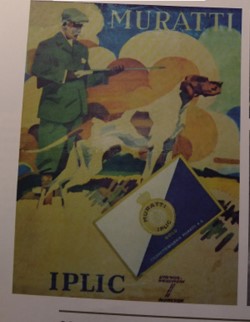
The Muratti cigarette factory also occasionally advertised with orientalist motifs, such as the advertisement for the Neb-Ka brand[46], which takes up the image of a smoking "Oriental" often reproduced in cigarette advertising – represented as such by the characteristic cone-shaped headgear, the fes. However, Muratti's marketing strategy, similar to that of the Berlin manufacturer Manoli, was primarily aimed at the cosmopolitan character of the product – another important topos in contemporary cigarette advertising. [47] Muratti's cigarette varieties bore names with "mystical, noble connotations" – such as Ariston, Ariston Luxe, Ariston Gold, Gentry, Iplic. The claim to be Germany's most distinguished cigarette was also reflected in the visual program of its advertisements, with which the company positioned itself in the luxury segment. For example, the advertisements from the 1920s showed hunting and riding scenes that referred to the leisure activities of the English upper class (for Muratti Iplic, Muratti Luxe, Muratti Ariston, among others), and showed men in tailcoats smoking Muratti cigarettes or ladies in fine fur, which were created by the renowned commercial artist Ludwig Hohlwein (1874 – 1949), among others, who produced designs for a large number of German companies, as well as for other cigarette manufacturers such as Jasmatzi & Söhne, Reemtsma and Suloma. [48] [Fig . 1]
The noble tins made of tin – still popular collector's items today – also gave the goods a special value. For example, they bore the golden inscription "Muratti Ariston – smoked by royality and nobility", were quite price-intensive and underlined the upscale image.
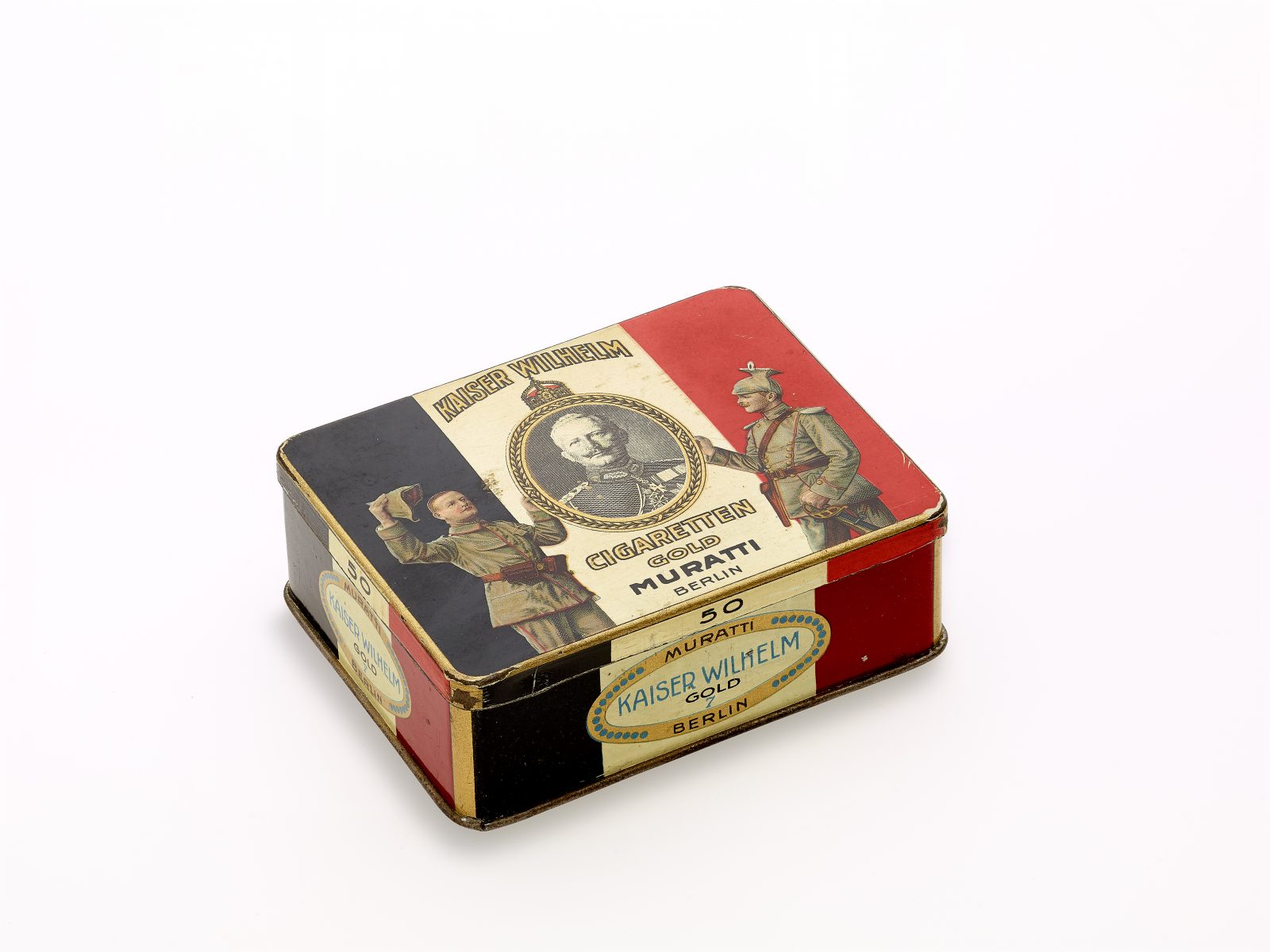
The category of patriotic advertising, which can be read as an aesthetic reaction to the increasing nationalization of society, included the cigarette cans with which Muratti advertised his brands "Kaiser Wilhelm Gold" and "Mutti". The portrait of Wilhelm II held by two soldiers (Manoli similarly advertised his brand "(The) Kaiser"), or images of other members of the royal family were depicted on these boxes. [Fig. 2] For the companies, it was apparently an effective means of pointing out the excellence and exclusivity of their product. [49]
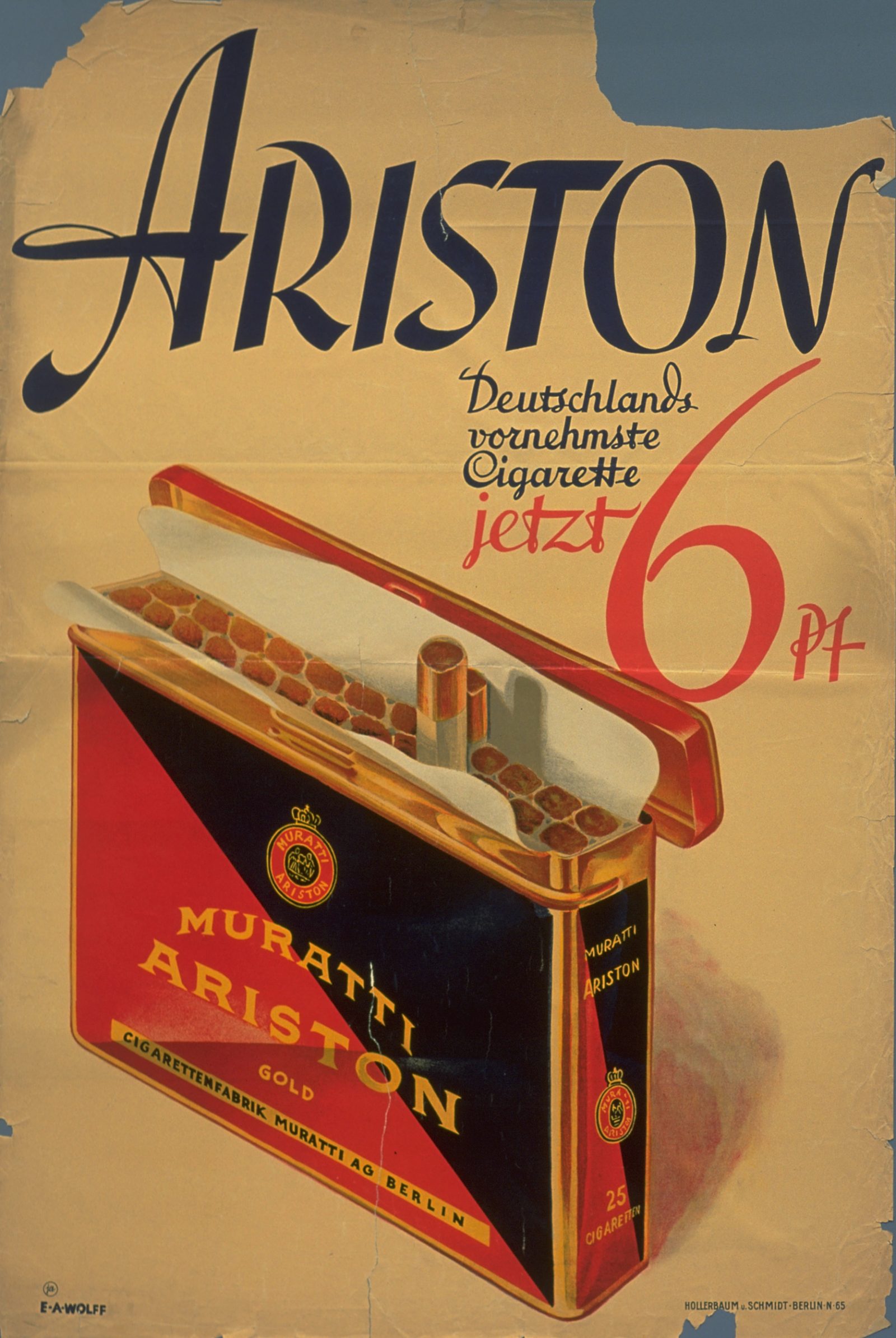
At the beginning of the 1930s, the company massively expanded its production and now tried to establish itself as a "people's cigarette" by launching a multi-year, strategically designed advertising campaign. It redesigned its packs and divided them diagonally from the bottom left to the top right into a bright red and a bright blue area. In gold, she placed the company emblem, a stylized crown and the respective name of the variety in the color areas. [50] [Fig. 3] Part of the strategy was also experimental advertising films, which attracted a lot of attention "because they boldly, confidently and cinematically very convincingly combined avant-garde means in film with the new techniques of sound film and color film"[51][51]. Although less explicit, the references to the "Orient" are not missing: the famous three-minute sound film "Muratti intervenes" (1934) by filmmaker Oskar Fischinger (1900–1967), in which animated cigarettes dance a ballet, is accompanied by Mozart's well-known rondo "Alla Turca", among other things.
At the beginning of the Second World War in 1939, the army administration confiscated the production facility in Köpenicker Straße, which was now moved to Kommandantenstraße 20, also in Kreuzberg. Three years later, the factory was shut down by the National Socialists. At the end of the war, the German cigarette industry had hardly any tobacco supplies left. [52]
The attempt by B. Muratti Sons & Co. to resume cigarette production in the largely undestroyed factory in Kommandantenstraße failed due to the resistance of the American occupying forces. They ensured that Muratti did not receive any raw tobacco quotas. After the Berliner Zeitung had publicly pointed out in 1948 that the functioning cigarette factory in Kommandantenstraße in the American sector was idle – "a loss for the national economy, a loss of taxes for Berlin, many empty jobs"[53] – and that the owners had tried in vain to obtain raw tobacco through the American occupation authorities, cigarette production was resumed in the same year, although initially only domestic tobacco was available. From 1945 onwards, the "Oriental tobaccos" were increasingly replaced in Germany and Europe by the American Blend blend, which consisted largely of Virginia tobacco. In the 1950s, this tobacco came largely from growing areas in the USA, Italy and Rhodesia (Zimbabwe/Zambia), which reorganized the world map of the tobacco trade. [54] Soon after the war, Muratti AG advanced to become the largest tobacco processing company in Berlin. [55]
In 1960, Brinkmann AG from Bremen (since 1992 part of the Rothmans Group London) took over the majority of the company's shares from the then Greek owners Adrian and Alexander Enfiezioglou. In the years that followed, Oriental cigarettes such as Muratti Privat or Muratti Cabinet receded into the background. The factory primarily produced cigarettes of the Lux Filter brand, up to 300 million cigarettes per month. In 1975, the Kreuzberg plant closed its doors after sales figures had fallen drastically. [56]
Both factory buildings, in which Muratti produced cigarettes, have been largely preserved in their original form today and house lofts and offices. In Kommandantenstraße, the name Muratti is still emblazoned in large letters at the entrance, but without further reference to the former function of the building.

Lisa Hackmann
- LOCATION
- Kommandantenstrasse 20 (today 22)
- TODAY
- Köpenicker Str. 126
Citing the article
Lisa Hackmann: Die Firma Muratti in Kreuzberg. In: Kolonialismus begegnen. Dezentrale Perspektiven auf die Berliner Stadtgeschichte. URL: https://kolonialismus-begegnen.de/geschichten/die-firma-muratti-in-kreuzberg/ (03.03.2025).
Literature & Sources
[1] See illustration of the Viktoriahof Köpenicker Straße 126 & 126A in: Landesdenkmalamt Berlin, Online. Available at: https://www.berlin.de/landesdenkmalamt/denkmale/liste-karte-datenbank/denkmaldatenbank/daobj.php?obj_dok_nr=09011039 (last access: 08.04.2022).
[2] Cf. Official Gazette of the Royal Government of Potsdam and the City of Berlin. Potsdam, 1912, p. 468; Lieser, Helga, "Der Mythos der Neuen Welt und das Gold des Orients", in: Kunstamt Kreuzberg (ed.), Made in Kreuzberg. Produkte aus Handwerk und Industrie, Berlin 1996, pp. 129–136, here p. 131; Landesdenkmalamt Berlin, Viktoriahof (Obj.-Doc.-Nr.: 09011039). Available online at: https://www.berlin.de/landesdenkmalamt/denkmale/liste-karte-datenbank/denkmaldatenbank/daobj.php?obj_dok_nr=09011039 [last access: 24.01.2021].
[3] Cf. Zeller, Joachim, Bilderschule der Herrenmenschen. Koloniale Reklamesammelbilder, Berlin 2008, p. 221.
[4] Cf. Zick, Tobias, "Das blutige geschäft mit den Tabak-Sklaven", in: Süddeutsche Zeitung. 18.06.2016. Available online at: www.sz.de/1.3038404 [last accessed 11.03.2021].
[5] Cf. Jacob, Frank / Dworok, Gerrit, "Tabak: Eine globalhistorische Einführung", in: Jacob, Frank / Steinberg, Swen (eds.), Tabak und Gesellschaft. Vom braunen Gold zum soziale Stigma, Baden-Baden 2015, pp. 9–32.
[6] Schürmann, Sandra / Alten, Christoph / Hirt, Gerulf et al., The World in a Cigarette Packet. Transnational Horizons of a German Product, Marburg 2017, p. 20.
[7] Cf. ibid.; Nacar, Can, Labor and power in the late Ottoman Empire. Tobacco workers, managers, and the state, 1872–1912, Basingstoke 2019, pp. 16–22.
[8] Cf. Schindelbeck, Dirk / Alten, Christoph / Hirt, Gerulf / Knopf, Stefan / Schürmann, Sandra, Zigaretten-Fronten. Die politische Kulturen des Rauchens in der Zeit des ersten Weltkriegs, Marburg 2014, p. 26.
[9] Ibid.
[10] Cf. Jacobs, Tina / Schürmann, Sandra, "Rauchsignale: Struktureller Wandel und visuelle Strategien auf dem deutschen Zigarettenmarkt im 20. Jahrhundert", in: WerkstattGeschichte, 45, Essen 2007, pp. 33–52, here p. 36.
[11] Cf. Fuhrmann, Malte, Der Traum vom deutschen Orient. Zwei deutsche Kolonien im Osmanischen Reich 1851-1918, Frankfurt am Main 2006; Köse, Yavuz (ed.), Osmanen in Hamburg – eine Beziehungsgeschichte zur Zeit des ersten Weltkrieges, Hamburg 2016, p. 190.
[12] Rahner, Stefan / Schürmann, Sandra, "Die 'deutsche Orientzigarette'" in: Köse, Osmanen in Hamburg – eine Beziehungsgeschichte zur Zeit des ersten Weltkrieges, pp. 135–154, here p. 136.
[13] Cf. ibid., pp. 136f.; Schürmann/Alten/Hirt, The World in a Cigarette Packet. Transnational Horizons of a German Product, p. 20.
[14] Cf. Berliner Adreßbuch 1906, Unter Nutzung amtlicher Quellen, Berlin 1906, vol. 1., pp. 418–420; Lieser, Der Mythos der Neuen Welt und das Gold des Orients, p. 131.
[15] See, among others, Bilgic, Leman / Fabian, Maike / Schwetasch, Corinna / Stock, Robert, "Dresdner Orientalismus", in: Lindner, Rolf / Moser, Johannes (eds.), Dresden. Ethnographic Explorations of a Residence, Leipzig 2006, pp. 207–236; Steinberg, Swen, "Mohammed aus Sachsen. Die Marketing von 'orientalischer Fremdheit'. Regionalität, Nationalismus und Ideologie in der Dresdner Zigarettenindustrie (1860–1960)", in: Tabak und Gesellschaft. Vom braunen Gold zum sozialen Stigma, Baden-Baden 2015, pp. 183–212.
[16] Cf. Schindelbeck/Alten/Hirt et al., Zigaretten-Fronten. The Political Cultures of Smoking in the Time of the First World War, pp. 28f.
[17] Cf. Agde, Günter, Flimmernde Versprechen. Geschichte des deutschen Werbefilms im Kino seit 1897, Berlin 1998, p. 98.
[18] Cf. Rahner/Schürmann, Die 'deutsche Orientzigarette', p. 139.
[19] Cf. Schürmann/Alten/Hirt et al., The World in a Cigarette Packet. Transnational Horizons of a German Product, p. 146.
[20] Cf. Tracy, W. Burnett / Pike, William Thomas, Manchester and Salford at the Close of the 19th Century. Contemporary Biographies, Brighton 1901; Balta, Evangelia, " History of, and Historiography on, Greek Tabacco ", in: Dies., Peuple et production. Pour une interprétation des sources ottomans, Istanbul 1999, pp. 247–257, here p. 252.
[21] Cf. Schürmann/Alten/Hirt et al., Die Welt in einer Zigarettenschachtel. Transnationale Horizonte eines deutschen Produkts, pp. 33, 53.
[22] Cf. Tracy/Pike, Manchester and Salford at the Close of the 19th Century. Contemporary Biographies.
[23] Cf. The London Gazette, 22.02.1924, p. 1653.
[24] Cf. inter alia Berliner Adreßbuch 1899, Unter Nutzung amtlicher Quellen, Berlin 1899, vol. 1, p. 46.
[25] Cf. Schürmann/Alten/Hirt et al., Die Welt in einer Zigarettenschachtel. Transnationale Horizonte eines deutschen Produkts, pp. 28-31.
[26] Cf. Steinberg, Mohammed aus Sachsen. Die Marketing von 'orientalischer Fremdheit'. Regionalität, Nationalismus und Ideologie in der Dresdner Zigarettenindustrie (1860–1960), p. 190.
[27] Cf. Lieser, The Myth of the New World and the Gold of the Orient, p. 131.; Westhafen, Werner von , "Muratti – a Legend from Kreuzberg", in: Kreuzberger Chronik, April 2005, issue 66. Available online at: https://www.kreuzberger-chronik.de/chroniken/2005/april/geschichte.html [last access: 24.01.2021]; Königseder, Angelika / Schulze, Birgit, "Turkish Minority in Germany", in: Information on Political Education. Issue 271, 13.01.2006. Available online at: https://www.bpb.de/izpb/9698/tuerkische-minderheit-in-deutschland?p=all [last accessed 24.01.2021] .
[28] Cf. Ingster, Oljean / Rätzke, Rüdiger, "Jews in Berlin. Life in the Scheunenviertel. Where the Jewish proletariat found a place to stay", in: Berliner Zeitung, 06.12.1988, p. 12.
[29] Cf. Berliner Adreßbuch 1907, Unter Nutzung amtlicher Quellen, Berlin 1907, vol. 1., p. 40; Lieser, Der Mythos der Neuen Welt und das Gold des Orients, p. 131.
[30] Cf. above: Entry on Iplicjian, in: Reichshandbuch der deutschen Gesellschaft. Das Handbuch der Persönlichkeiten in Wort und Bild. Bd. 1 (A–K), Berlin 1930, p. 398; n.d., "Cigarettenfabrik Muratti A. G. Berlin", in: Deutsches Wirtschafts-Archiv, Berlin / Düsseldorf 1951, p. 80.
[31] Cf. Schindelbeck/Alten/Hirt et al., Die Welt in einer Zigarettenschachtel. Transnationale Horizonte eines deutschen Produkts, p. 13.
[32] Zeller, Bilderschule der Herrenmenschen. Koloniale Reklamesammelbilder, p. 221; cf. also Wolter, Stefanie, Die Marketing des Fremden. Exotismus und die Anfänge des Massenkonsums, Frankfurt am Main 2005, pp. 61–81.
[33] Jacobs/Schürmann, Rauchsignale: Struktureller Wandel und visuelle Strategien auf dem deutschen Zigarettenmarkt im 20. Jahrhundert, p. 41.
[34] Schürmann/Alten/Hirt et al., The World in a Cigarette Packet. Transnational Horizons of a German Product, p. 55.
[35] Cf. Steinberg, Mohammed aus Sachsen. The Marketing of 'Oriental Foreignness'. Regionality, Nationalism and Ideology in the Dresden Cigarette Industry (1860-1960), p. 197; Schürmann/Alten/Hirt et al., The World in a Cigarette Packet. Transnational Horizons of a German Product, p. 35.
[36] Cf. Rahner / Schürmann, Die 'deutsche Orientzigarette', p. 140.
[37] Cf. Steinberg, Mohammed aus Sachsen. Die Marketing von 'orientalischer Fremdheit'. Regionalität, Nationalismus und Ideologie in der Dresdner Zigarettenindustrie (1860–1960), p. 199.
[38] Cf. image: "Orientale", poster design by Louis Oppenheim (1918). Available online at: https://sammlung.mak.at/sammlung_online?id=collect-60250. Cf. image 'oriental' scene: https://www.europeana.eu/de/item/15514/PI_3928 [last accessed 09.06.2021].
[39] Cf. Jacobs/Schürmann, Rauchsignale: Struktureller Wandel und visuelle Strategien auf dem deutschen Zigarettenmarkt im 20. Jahrhundert, p. 41.
[40] Cf. Bilgic / Fabian / Schwetasch / Stock, Dresdner Orientalismus; Chahine, Rima, Das orientalistische Plakat Westeuropas. 1880–1914, Oldenburg 2013, pp. 143–158.
[41] Bilgic / Fabian / Schwetasch / Stock, Dresdner Orientalismus, p. 221.
[42] Williams, Haydn, Turquerie. An eighteenth-century European fantasy, New York 2014, p. 7.
[43] Cf. Eldem, Edhem, Consuming the Orient. On the occasion of the Exhibition on Consuming the Orient, held at the Ottoman Bank Archive and Research Centre between November 15, 2007 and March 2, 2008, Istanbul 2007.
[44] Cf. Bilgic / Fabian / Schwetasch / Stock, Dresdner Orientalismus, p. 220.
[45] Jacobs / Schürmann, Rauchsignale: Struktureller Wandel und visuelle Strategien auf dem deutschen Zigarettenmarkt im 20. Jahrhundert, p. 42.
[46] Cf. picture: "Orientale", see note 38.
[47] Cf. Jacobs/Schürmann, Rauchsignale: Struktureller Wandel und visuelle Strategien auf dem deutschen Zigarettenmarkt im 20.
[48] Cf. Agde, Flimmernde Versprechen. Geschichte des deutschen Werbefilms im Kino seit 1897, p. 91.
[49] Cf. Jacobs/Schürmann, Rauchsignale: Struktureller Wandel und visuelle Strategien auf dem deutschen Zigarettenmarkt im 20. Jahrhundert, p. 42; Giloi, Eva, Monarchy, Myth, and Material Culture in Germany 1750–195, Cambridge 2011, p. 190.
[50] Cf. Agde, Flimmernde Versprechen. Geschichte des deutschen Werbefilms im Kino seit 1897, p. 91.
[51] Ibid., p. 97.
[52] Cf. Lieser, Der Mythos der Neuen Welt und das Gold des Orients , p. 132.
[53] n.d., "Sleeping Beauty Sleep in the USA Sector. A Cigarette Factory That Wants to Fabricate and Is Not Allowed," in: Berliner Zeitung, 13.5.1948, p. 3.
[54] Cf. Schürmann/Alten/Hirt et al., The World in a Cigarette Packet. Transnational Horizons of a German Product.
[55] Cf. Lieser, Der Mythos der Neuen Welt und das Gold des Orients, pp. 132–136; Hengartner, Thomas, "Tabak", in: ibid. / Merki, Christoph Maria (eds.), Genussmittel. Ein kulturgeschichtliches Handbuch, Frankfurt am Main 1999, pp. 169–193, here pp. 180f.; Rahner/Schürmann, Die 'deutsche Orientzigarette', p. 154.
[56] Cf. Lieser, Der Mythos der Neuen Welt und das Gold des Orients, 136.
Tags
#Adrian Enfiezioglou#Alexander Enfiezioglou#Anbau#Annes Mihram Iplicjian#Anzeigen#Arbeit#B. Muratti#Bilder#Cigarettenfabrik Muratti GmbH Berlin#Exklusivität#Fabriken#Garbáty#Handel#Kolonialware#Kommandantenstraße#Konsum#Krieg#London#Manchester#Manoli#Migration#Orientalismus#Osmanisches Reich#Plakate#Plantagen#Reklame#Rohstoffe#Schwarzes Meer#Sklaverei#Sons & Company#Sophokles Basil Muratti#Tabak#Vermarktung#Verpackungen#Victoriahof#Werbung#Zigrettenindustrie