The Schöneberg Munumé and Makembe
People from the colonies came to Berlin temporarily or permanently for various reasons. Some came as missionary students, for training or as servants of returning colonial soldiers and officials. Others stayed in the city after participating in a so-called 'Völkerschau'. After the turn of the century, some women from the oceanic colonies also accompanied their German husbands back to Germany. Most of the so-called 'Kolonialmigrant_innen', however, were men. They had to struggle with racial exclusion and many difficulties in finding housing and work. Although some were able to build up a petty-bourgeois existence as craftsmen or, like Martin Dibobe, as a subway conductor, many were dependent on precarious employment at fairs, in the hospitality industry or as Statist_innen in film. They were usually sought out and hired because of their supposedly 'exotic' skin colour.
The story of Wilhelm Munumé and Peter Makembe has been handed down from Schöneberg, at least in fragments. Both were born in the German colony of Cameroon at the beginning of the 1890s and belonged to a small group of Migrant_innen who built up a permanent existence in Germany. From the surviving fragments, it is also possible to guess at the everyday experience of the two between the personal desire for integration and social rejection and exclusion.
Wilhelm Edimo Munumé came to Hamburg before the First World War, initially in the role of a servant. After a stopover in Wiesbaden, he settled in Großgörschenstraße in the early 1920s. Along with Charlottenburg – both had only been part of Berlin since 1920 – Schöneberg was an important place of residence for Migrant_innen from African countries. It was often not the wealthy districts of the former suburbs, but the poorer areas, such as the entertainment district around Nollendorfplatz, where Black people could settle in the housing market, which was already competitive at the time.
Munumé repeatedly tried to find work in the expanding film industry. Advertisements in film magazines and even advertising postcards testify to his search for work, with which he skilfully responded to the expectations of the German majority society. In his case, it is said that he appeared in the films "Mistress of the World" (1919/20) and "I Had a Comrade" (1926). In many cases, however, it is difficult to identify Black actors and their roles because they were rarely listed by name as participants. Black actors were also sometimes in demand because there were only a limited number of Black people as Statist_innen and actors. Munumé's repeated courtship, however, also testifies to the fact that the film business was an uncertain one that could at most lead to an irregular income.
Munumé lived in Großgörschenstraße at the same address as the Cameroonian Peter Mukuri Makembe, a businessman who had come to Germany for an apprenticeship. Between 1912 and 1918, Makembe then worked at the University of Hamburg as a language assistant for Douala, a language spoken in Cameroon. In addition, he was involved in the African Relief Association, one of the first self-help organizations to support Kolonialmigrant_innen in Germany. Towards the end of the First World War, he finally founded an import company for tropical fruits.
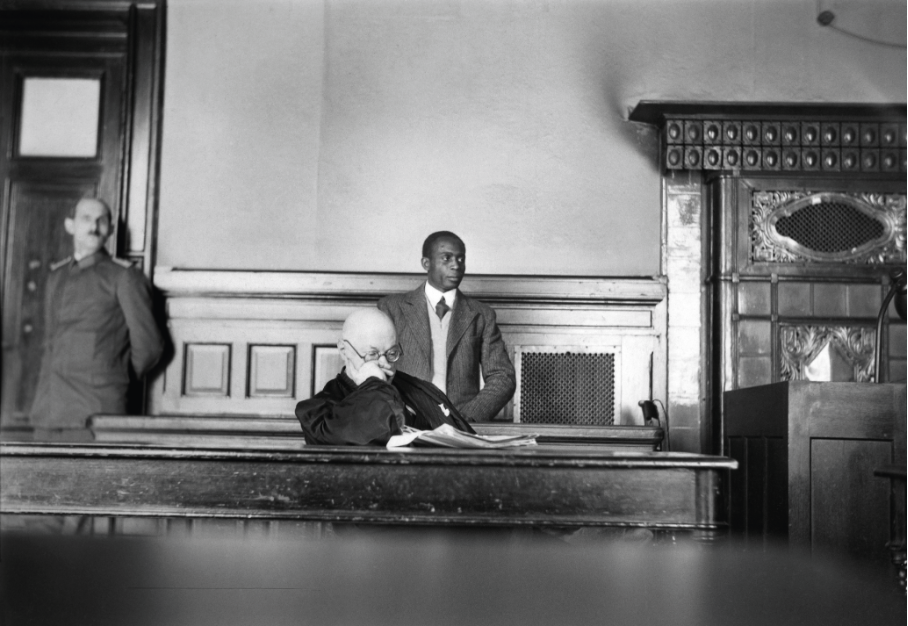
At the end of 1926 – as further sources of their shared history tell us – Munumé and Makembe were sentenced to several years in prison together for counterfeiting money before the Moabit criminal court. After several frustrating experiences on the Berlin job market, the two finally took advantage of the ignorance and clichés of the Berliner_innen to produce 5-pound notes in the name of a non-existent African kingdom. Their request was initially successful: with forged legitimation papers, they obtained the materials for printing the notes, but Munumé then attracted attention when exchanging such a note and was arrested a short time later. In their study of Black Germans, the Historiker_innen Robbie Aitken and Eve Rosenhaft assess this fraud as a survival strategy. Nevertheless, part of the Black community at the time expressed concern about the negative effects of the trial on the reputation of the Black minority. The German Society for Native Studies, which in some cases provided the black minority with at least a small financial support for their livelihood, also considered stopping it altogether after the arrest. According to contemporary Beobachter_innen, the prison sentence of the two was light – Munumé was sentenced to 37 months in prison and Makembe to 18 months. The judge justified his verdict in an allegedly racist manner by saying that he did not believe that the two had been able to assess the seriousness of their offense.
Munumé and Makembe were to be deported to Cameroon after serving their sentences. Makembe, however, managed to escape from the ship in Rotterdam and returned to Berlin. In 1935 he left Germany for France, founded a business in Strasbourg and married the German Erna Pusch a few years before his death (between 1939 and 1942), who bore the name Erna Makembe after the wedding.
In the case of Munumé's threatened deportation, the left-liberal League for Human Rights intervened in his favor, above all Joseph Bilé, who was also black and lived for a while at neighboring Bülowstraße 39. After his prevented deportation, Munumé became involved in anti-colonial organizations in the early 1930s. After emigrating from Nazi Germany and a stopover in Belgium, Munumé died in the Netherlands in February 1940, shortly before the occupation of the country.
This text is the revised version of a chapter from the exhibition "Research Workshop: Colonial History in Tempelhof and Schöneberg", which the Schöneberg Museum showed from 19.5. to 29.10.2017.
Stefan Zollhauser
Johanna Strunge
- LOCATION
- Place of residence of the two
- TODAY
- Großgörschenstraße 31
Citing the article
Stefan Zollhauser, Johanna Strunge: Die Schöneberger Munumé und Makembe. In: Kolonialismus begegnen. Dezentrale Perspektiven auf die Berliner Stadtgeschichte. URL: https://kolonialismus-begegnen.de/geschichten/die-schoeneberger-munume-und-makembe/ (12.06.2024).
Literature & Sources
Robert Aitken/Eve Rosenhaft: Black Germany. The making and unmaking of a diaspora community, 1884–1960, Cambridge 2013.
Tobias Nagl: The Uncanny Machine. Race and Representation in the Weimar Cinema, Munich 2009.
Tags
#Abschiebung#Afrikanischer Hilfsverein#Armut#Ausgrenzung#Die Mistress of the World#Duala#Erna Makembe#Exotisierung#Fälschung#Film#Gericht#Haft#Ich has a comrade#Joseph Bilé#Kamerun#Kaufmann#Klischee#Liga for Human Rights#Männer#Martin Dibobe#Migranten#Nationalsozialismus#Peter Makembe#Rassismus#Strafprozess#Wilhelm Munumé