Plans for the colonial monument
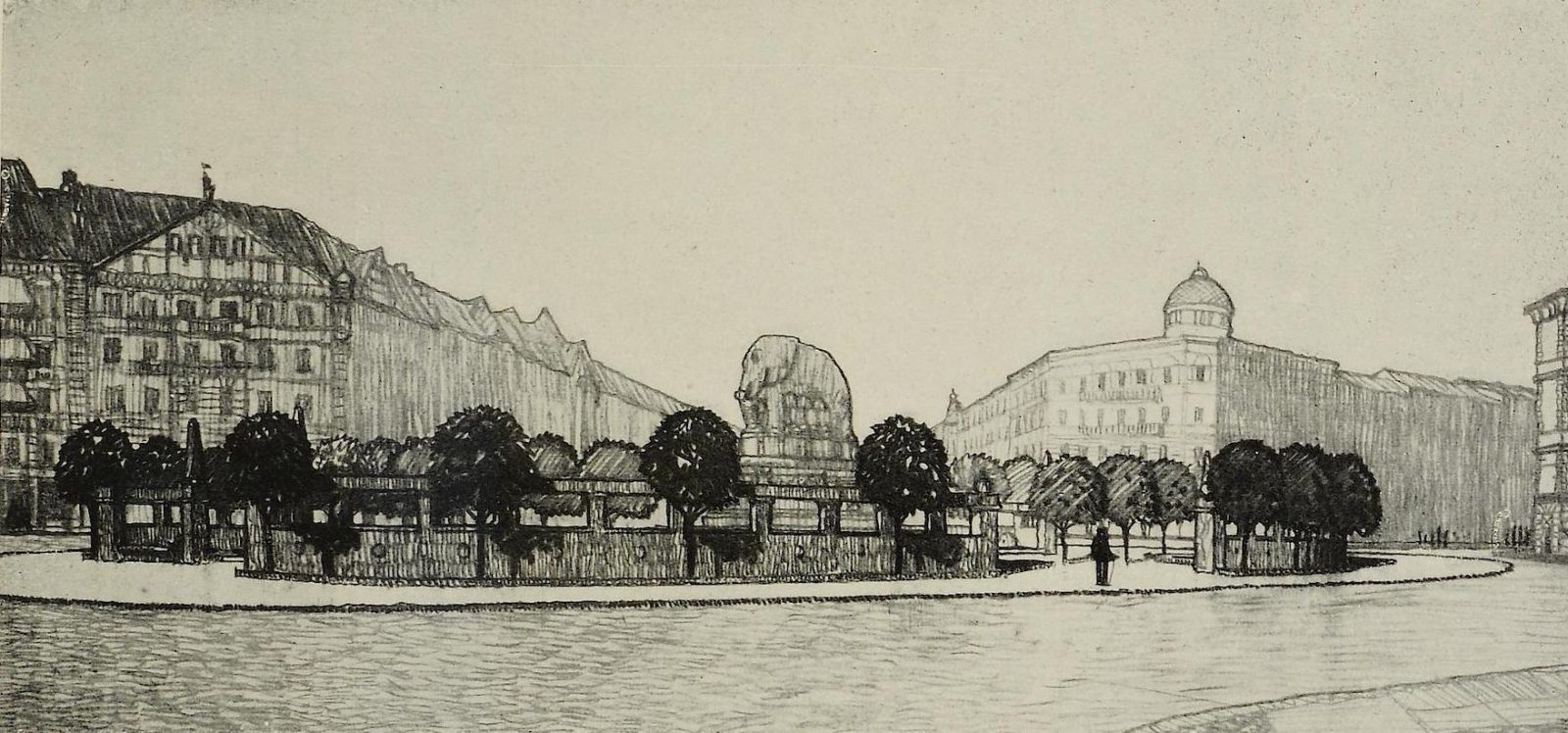
In Berlin, the traces of the former colonial metropolis are not obvious, but largely superimposed and hidden. The most visible are the streets named after former German colonies or people with colonial entanglements. But if the First World War had not intervened, an unmissable monument in honor of German colonialism would have been erected at the beginning of the 20th century on today's Bersarinplatz in Berlin-Friedrichshain. In the end, it was not built in Berlin, but in Bremen. The story of the planned colonial monument in Berlin refers to the city's handling of its own colonial history and also illustrates how flexible the function of monuments is.
Berlin was the center of the German Empire. This was where the colonial administrations were located, with the Reich Colonial Office, the headquarters of the German colonial army, and the offices of various colonial interest groups such as the German Colonial Society. In addition, mission agencies and other colonial scientific research centers for medicine, botany, and ethnology were also located in Berlin. In Berlin in the early 1900s, attitudes toward colonialism were ambivalent. For this reason, the procolonial lobby, which included members of the above-mentioned organizations as well as politicians in the upper echelons of the government, wanted to gain more public support for the colonial project and get the population to identify more strongly with the German overseas colonies. [1] Against this background, plans were developed in 1908 for a so-called colonial war memorial in Berlin. The project was led by the Reichstag, the Bundesrat and the Reich Chancellery (under Reich Chancellor Bernhard Fürst von Bülow); presumably, the German Colonial Society also played a decisive role as an initiator. [2] Instead of many smaller individual monuments for individual battles, this monument was intended to function as a central colonial monument in honor of all German soldiers who had fallen overseas in the struggle for the expansion of the German colonial empire. The monument was intended to arouse national pride in the colonial project and establish a collective consciousness in favor of colonialism. [3]
But there were not only supporters of this project. When the plans for the colonial war memorial were discussed in the Reichstag, the SPD in particular refused to support the project. SPD city councillor Pfannkuch argued that Berlin should "keep its hands off participating in the erection of a monument to the fallen, who had to divest the natives of their homeland and their ancestral possessions on command." [4] City councillor Reimann spoke out against Pfannkuch: "Anyone who has even a little German feeling in them"[5] should vote for the monument, he appealed to the council. He saw the construction as a patriotic duty. There were also strong differences of opinion regarding the location and design of the monument, even among those who were in favour of the monument. Faced with the difficulty of finding a suitable place for the monument in the city center, the choice of location fell on Baltenplatz, today's Bersarinplatz in Friedrichshain. For many supporters of the monument, however, Baltenplatz was far too far away from the Reichstag and the center of political life in Berlin. [6] In order to achieve the desired public impact, the monument should be seen by as many people as possible – how could that be possible in the remote east of the city? Even city councillor Pfannkuch saw this and suggested a location in Tiergarten instead.
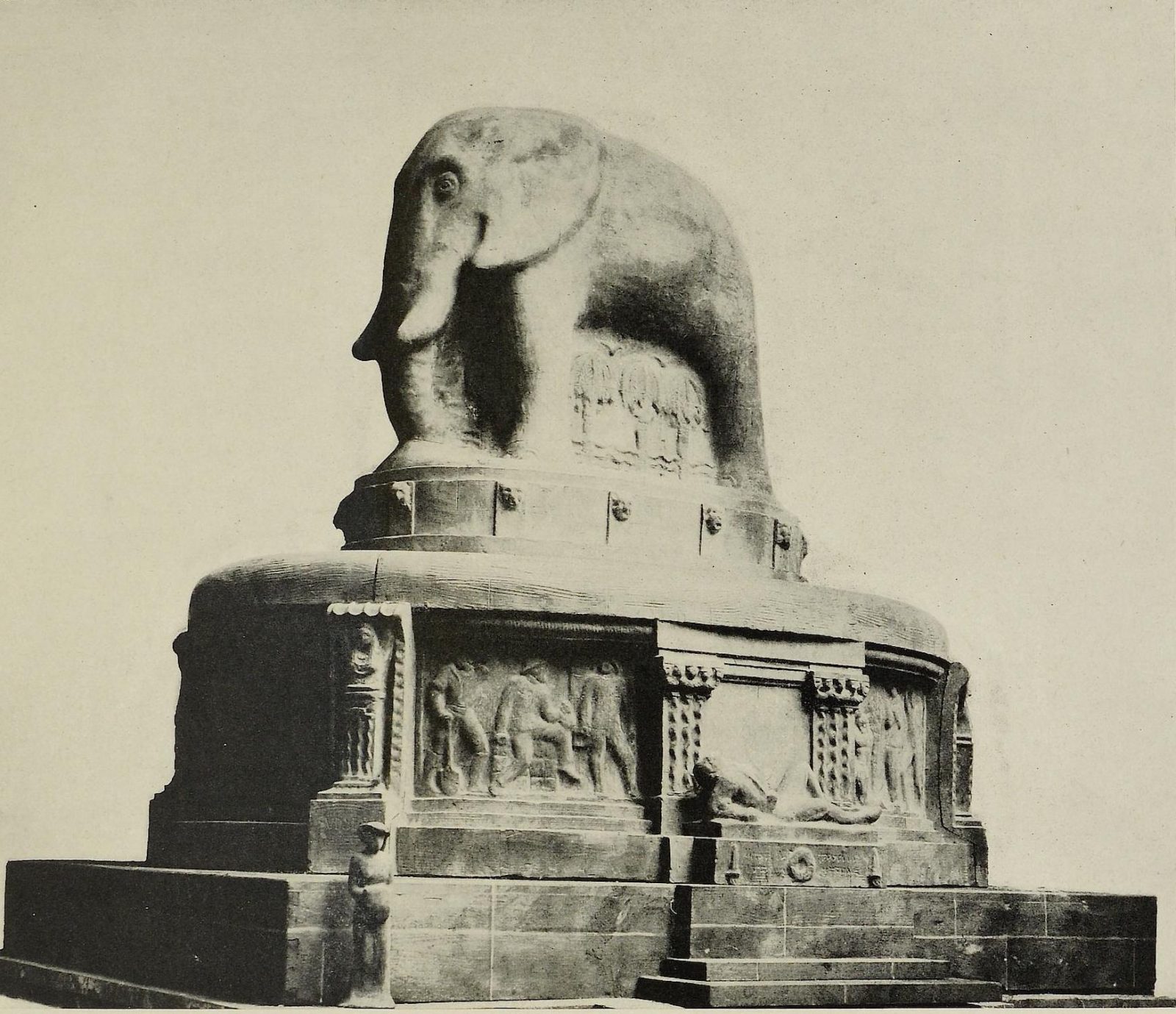
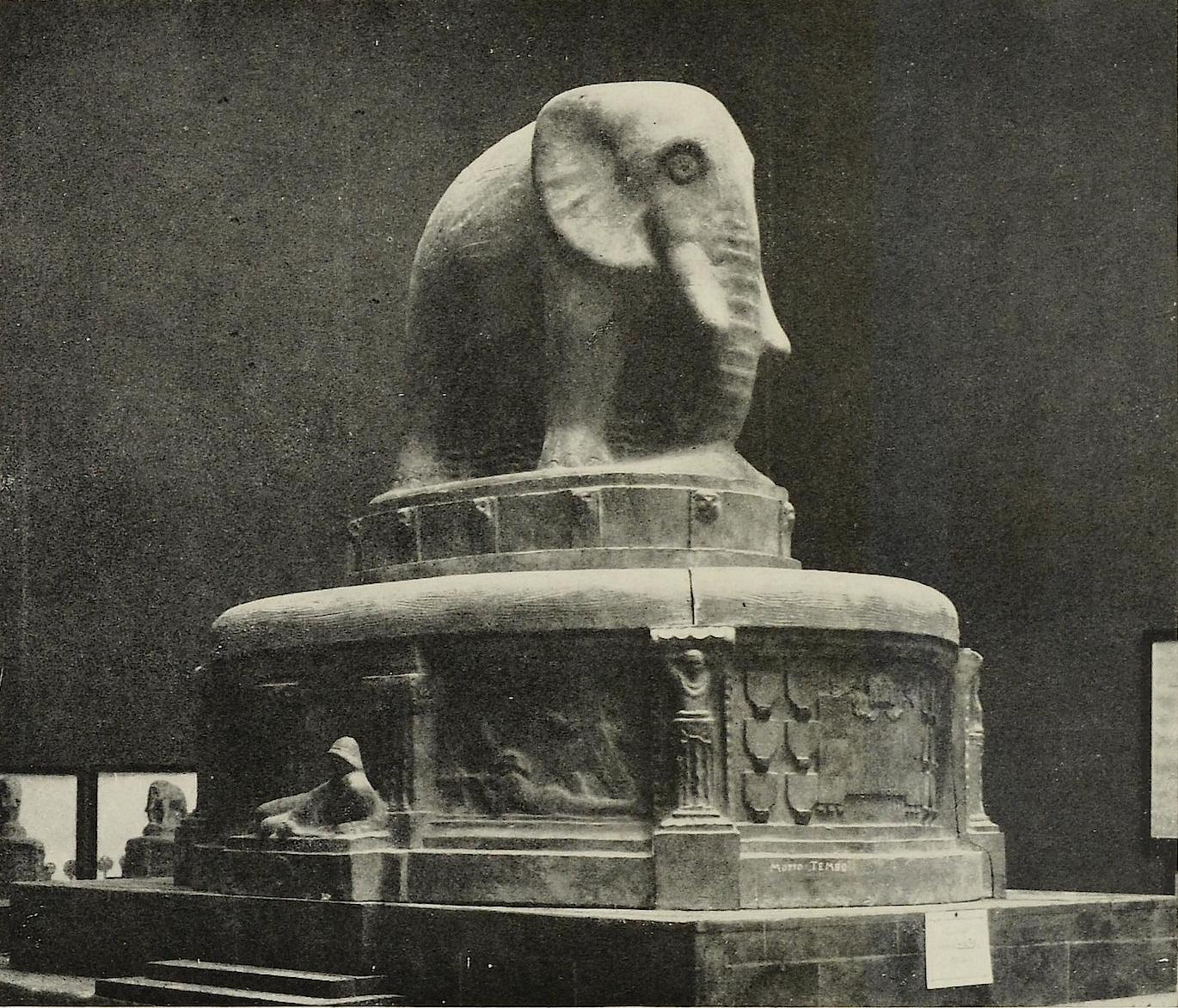
When the winner of the artistic competition for the design of the monument was announced in 1913, a debate flared up again. Some members of the Reichstag were against the winning design by Fritz Behn (1878–1970) for aesthetic reasons. Behn, who trained in Munich, enjoyed a solid reputation in Germany as a gifted animal sculptor. Behn's design for the monument, consistent with his usual style, envisaged a sculpture in the shape of a giant African elephant on a multi-storey pedestal, depicting various scenes from life in the colonies as well as the figure of a wounded soldier. [7] Critics criticized the elephant design as a central figure as inappropriate for the design of a military memorial. Other designs were submitted to the competition, based on more classical motifs such as a victory column or a fighting warrior figure. In Behn's design, on the other hand, honoring the dead did not seem to be a central concern, but rather embodied a fundamental monument to the colonial project, in which the elephant stood for the strength of German colonialism and pride in colonial conquests. Behn had joined the German Colonial Society in 1911. His support for leading figures of German colonialism and his writings about his travels to the German colonies in Africa clearly illustrate his pro-colonial attitude and a conviction of the superiority of white people. [8] In his book "Haizuru: A Sculptor in Africa," Behn writes: "Our white prestige alone enables us to hold our colonies." [9] This illustrates his view that the superiority ("prestige") of white Europeans confers a right to own colonies and dominate overseas populations.
For Behn, the German colonies were also of utmost importance for art, as he saw them as valuable sources of inspiration for German artists. [10] His travels to what was then "German East Africa" in 1907–1908 and 1909–1910 were opportunities for him to escape the supposed modern civilization and immerse himself in what he saw as wild, exotic, unspoiled, and primitive landscapes and cultures in order to draw new inspiration for his artistic work. He was not alone in this position. Many European artists drew material for their artistic work from their highly romanticized encounters with the "exotic other" from similar trips or colonial exhibitions. Paul Gauguin is one of the best-known of these artists who benefited from European colonialism for his art practice, as well as countless others such as Paul Klee, Henri Matisse and Emil Nolde.
Behn's works of art are thus highly political. His sculptures of gazelles, jaguars and elephants, even a bronze orangutan and a granite gorilla, which can still be seen today in the Berlin Zoo, were by no means merely neutral or harmless representations of the animal kingdom. Then as now, they were and are decisive for the understanding and the German regime of view of Africa and colonial subjects. [11] Even the Deutsche Kolonialzeitung saw Behn's work as "art in the service of the colonial idea". [12]
Despite his unequivocally pro-colonial stance, Behn's choice of an elephant as a symbol to honour fallen soldiers was perceived by many as inappropriate, stylish and even disrespectful. [13] The artistic competition was therefore relaunched by Kaiser Wilhelm II in 1914. [14] Behn was given a second chance to submit a design, as were the runners-up of the previous competition, Hermann Hahn and Carl Sattler, Louis Tuaillon and the sculptor August Gaul, who also specialised in sculptures of animals. [15] However, the outbreak of the First World War thwarted the undertaking of the colonial monument. In the 1920s, it was to be taken up again, but plans for a colonial warrior memorial in Berlin were postponed indefinitely.
But the story of the elephant does not end here – it continues in Bremen. For the port city, the colonial trade had been very profitable. Therefore, the loss of the German colonies after the First World War was more present for Bremen than for most other German cities; many Bremen merchants, trading companies and former members of colonial troops longed for the "glorious" times of German imperialism, campaigned for a reconquest of the colonies and were part of a strong neocolonial lobby in Bremen. [16] In 1926 , the Bremen local group of the German Colonial Society submitted an application for permission to erect a colonial memorial. This public monument was intended to be an expression of the neocolonial hope to "regain" the "lost" colonies and to rise again to colonial power. [17] Thus, the planned Berlin project for the Colonial Memorial was resumed and updated to better represent Bremen's position. The Bremen Colonial Memorial was created on the basis of Behn's original elephant design. In the Bremen version, the 7-meter-high African elephant also stands on a 12-sided pedestal, which in turn rests on a rectangular pedestal. The panels on the sides of the pedestal bear the names of former German colonies and show portraits of important personalities of German colonialism such as Franz Adolf Lüderitz and Paul von Lettow-Vorbeck, both of whom were from Bremen. Beneath the monument is also an underground crypt dedicated to the German soldiers who died in the colonies, which houses an altar dedicated to "Our Dead" and a Book of the Dead in memory of the fallen soldiers[18 ]. As with the original plans in Berlin, the Bremen Colonial Monument honors the German dead of colonialism, but in a more sacred and heroic way. Thus, the monument mourns not only the lives of the soldiers, but also the loss of the colonies. The inscription "Our Colonies" on the front of the monument expresses the belief that Germany has an inalienable claim to the territories overseas. Likewise, the elephant seems to symbolize Germany's stubborn determination to continue to insist on its status as an influential European colonial power. The colonial monument was inaugurated in July 1932. The Nazis called Bremen the "City of Colonies"; throughout the Nazi era, the colonial monument was one of the most important meeting places for the neocolonial movement in Germany. [19]
Towards the end of the Second World War, almost all colonial monuments in East Germany had been destroyed, but some remained in West Germany. One of these is the Colonial Memorial in Bremen. All inscriptions and dedications on the monument were removed in 1945, which gave the monument a kind of neutralization because it seemed to be separated from its context of origin. [20] When a general amnesia of remembrance and discursion around the colonial era began after the Second World War, the significance of the giant stone elephant in the middle of Bremen was also forgotten. It was not until the late 1980s that the elephant sculpture became part of the public consciousness again, when activists of the anti-apartheid movement in Bremen took the initiative to rededicate the monument and declare it an anti-colonial monument. [21] On 18 May 1990 – the year of Namibia's independence – the elephant was officially renamed the "Anti-Colonial Memorial". As part of the renaming ceremony, a plaque was placed next to the monument explaining its history, its role in National Socialism and its new meaning; it also addresses the violence of colonialism and denounces neocolonial oppression. The plaque explicitly sets a sign of solidarity with the African resistance struggle against persistent neocolonial conditions. [22] In this way, the monument became a symbol of responsibility and a strong statement against neocolonialism.
On the occasion of Namibian President Sam Nujoma's visit to Bremen in 1996, an additional commemorative plaque was installed to commemorate the Namibian victims of German colonialism. In 2009, another memorial was erected next to it commemorating the genocide of the Herero and Nama in Namibia between 1904 and 1908. The site of the former colonial memorial has thus become a place of remembrance of Germany's role as a colonial aggressor. The stone elephant has thus taken on many roles: it was intended to honour dead soldiers, cheer on colonial pride and serve neo-colonial propaganda after 1919; it fell into oblivion and was eventually transformed into a symbol of anti-colonial attitude. It testifies to the political dimension of art in public space. The history of the elephant – from its originally planned role as a colonial monument in Berlin-Friedrichshain to its current role in Bremen's cityscape – shows that the meanings of monuments can change dynamically and even become the opposite of their original intention and meaning. However, monuments always remain a political statement, as they shape the public's relationship to history and its understanding of history; with every change in meaning, their influence is also actualized. [23] The recoding of the Colonial Memorial, one of the few remaining colonial monuments in Germany, is an example of how historical monuments in Europe whose original function is incompatible with the values of the present could be dealt with.
There is a lot of traffic around Bersarinplatz in Berlin today. Just a few steps away are anti-fascist and queer feminist occupied houses and housing projects that are repeatedly observed by state organs and are threatened with eviction. In the immediate vicinity of Bersarinplatz, protests and solidarity for this struggle take place again and again; there is no trace of the colonial monument that was not built. Flowers and a well-kept lawn grow on Bersarinplatz, just as city councillor Pfannkuch would probably have once wanted.
Flavia Cahn
- LOCATION
- Baltenplatz
- TODAY
- Bersarinplatz
Citing the article
Flavia Cahn: Plans for the Colonial Monument. In: Kolonialismus begegnen. Decentralised Perspectives on Berlin's City History. URL: https://kolonialismus-begegnen.de/geschichten/planungen-fuer-das-kolonialdenkmal/ (03.03.2025).
Literature & Sources
[1] Cf. Zeller, Joachim, "Die Leiche im Keller Eine Entdeckungsreise ins Innerste der Kolonialmetropole Berlin", in: Bechhaus-Gerst, Marianne / Klein-Arendt, Reinhard (eds.), AfrikanerInnen in Deutschland und schwarze Deutsche – Geschichte und Gegenwart. Contributions to the conference of the same name from 13 to 15 June 2003 at the NS-Dokumentationszentrum (EL-DE-Haus) Cologne, Münster, 2004, pp. 89-108, here pp. 90-92.
[2] Zeller, Joachim, "Colonial Monuments in Berlin", in: ibid. / van der Heyden, Ulrich (eds .), Kolonialmetropole Berlin. Eine Spurensuche, Berlin 2002, pp. 168-181, here p. 169.
[3] Zeller, Joachim, Colonial Monuments and Historical Consciousness. An Investigation of the Colonial German Culture of Remembrance, Frankfurt a. Main 2000, p. 87.
[4] Stenographic Reports on the Public Sessions of the City Council of the Capital and Residential City of Berlin. Meeting on 08.05.1913, p. 259.
[5] Ibid.
[6] Zeller, The Corpse in the Cellar A Journey of Discovery into the Innermost of the Colonial Metropolis Berlin, p. 85.
[7] Cf. Schneidewind, Ernst, "Glossen zum Wettbewerb um das Kolonialkrieger-Denkmal oder die neueste Berliner Denkmals-Katastrophe", in: Die Kunstwelt: Deutsche Zeitschrift für die bildende Kunst, 19/20 (1914), pp. 653-654 https://digi.ub.uni-heidelberg.de/diglit/kunstwelt1913_1914 .
[8] Zeller, Joachim, Wilde Moderne: Der Bildhauer Fritz Behn (1878-1970), Berlin 2016, p. 53.
[9] Behn, Fritz, Haizuru: Ein Bildhauer in Afrika, Munich 1917, p. 48.
[10] Zeller, Wilde Moderne: Der Bildhauer Fritz Behn (1878-1970), p. 27.
[11] Wilke, Sabine, "Romantic Images of Africa. Paradigms of German Colonial Paintings", in: German Studies Review, 29.2 (2006), pp. 285–298, here p. 297.
[12] Zeller, Wilde Moderne: Der Bildhauer Fritz Behn (1878-1970), p. 58.
[13] Schneidewind, Glosses on the Competition for the Colonial Warrior Monument or the Latest Berlin Monument Catastrophe, :p. 653f.
[14] Zeller, The Corpse in the Cellar: A Journey of Discovery into the Innermost of the Colonial Metropolis of Berlin, p. 97.
[15] Zeller, Kolonialdenkmäler in Berlin, p. 170.
[16] Eickelberg, Gudrun, The History of the Bremen AntiColonial Monument. February 2012. Available online at: http://www.der-elefant-bremen.de/pdf/AntiKolonialDenkmal.pdf [last access: 14.02.2021].
[17] Zeller, Colonial Monuments and Historical Consciousness. An Investigation of the Colonial German Culture of Remembrance, p. 153.
[18] State Office for the Preservation of Monuments Bremen, Colonial Memorial & Anti-Colonial Memorial, Obj doc no.: 00001771.
[19] Zeller, Joachim, "Münchner Kolonialkunst: Der Bildhauer Fritz Behn", 18.12.2019, in: münchen postkolonial. Available online at: http://muc.postkolonial.net/files/2011/07/BehnMUC2010-1.pdf [last access: 14.02.2021].
[20] Zeller, Joachim, review by Rudolph Bauer / Inge Buck / Michael Weisser et al., "DerElefant! Bilder, Gedichte, Dokumente zum Anti-Kolonialdenkmal in Bremen", in: freiburg postkolonial, 15.03.2012. Available online at: https://www.freiburg-postkolonial.de/Seiten/Rez-2012-DerElefant-Bremen.htm [last access: 14.02.2021].
[21] Cf. ibid.
[22] Cf. Zeller, Colonial Monuments and Historical Consciousness. An Investigation of the Colonial German Culture of Remembrance, p. 224.
[23] Ibid., p. 370.
Tags
#1932 #Anti-Kolonial-Denk-Mal #Baltenplatz #Bedeutungsveränderungen #Berliner Zoo #Bersarinplatz #Bremen #Bundesrat #Debatte #Deutsche Kolonialgesellschaft #Elefant #Erster Weltkrieg #Franz Adolf Lüderitz #Friedrichshain #Fritz Behn #Herero #Kaiser Willhelm II #Kolonial Memorial #Kolonialdenkmal #Kolonialkriegerdenkmal #Kolonialmetropole Berlin #Kolonialrevanchismus #Kolonialsoldaten #Kploniallobby #Kunst #Nama #Namibia #Nationalsozialismus #Paul von Lettow-Vorbeck #Reichskanzler #Reichstag #Reise #SPD #Tierbildhauer #Umwidmung #Unabhängigkeit #Wettbewerb