The Oranien-Apotheke
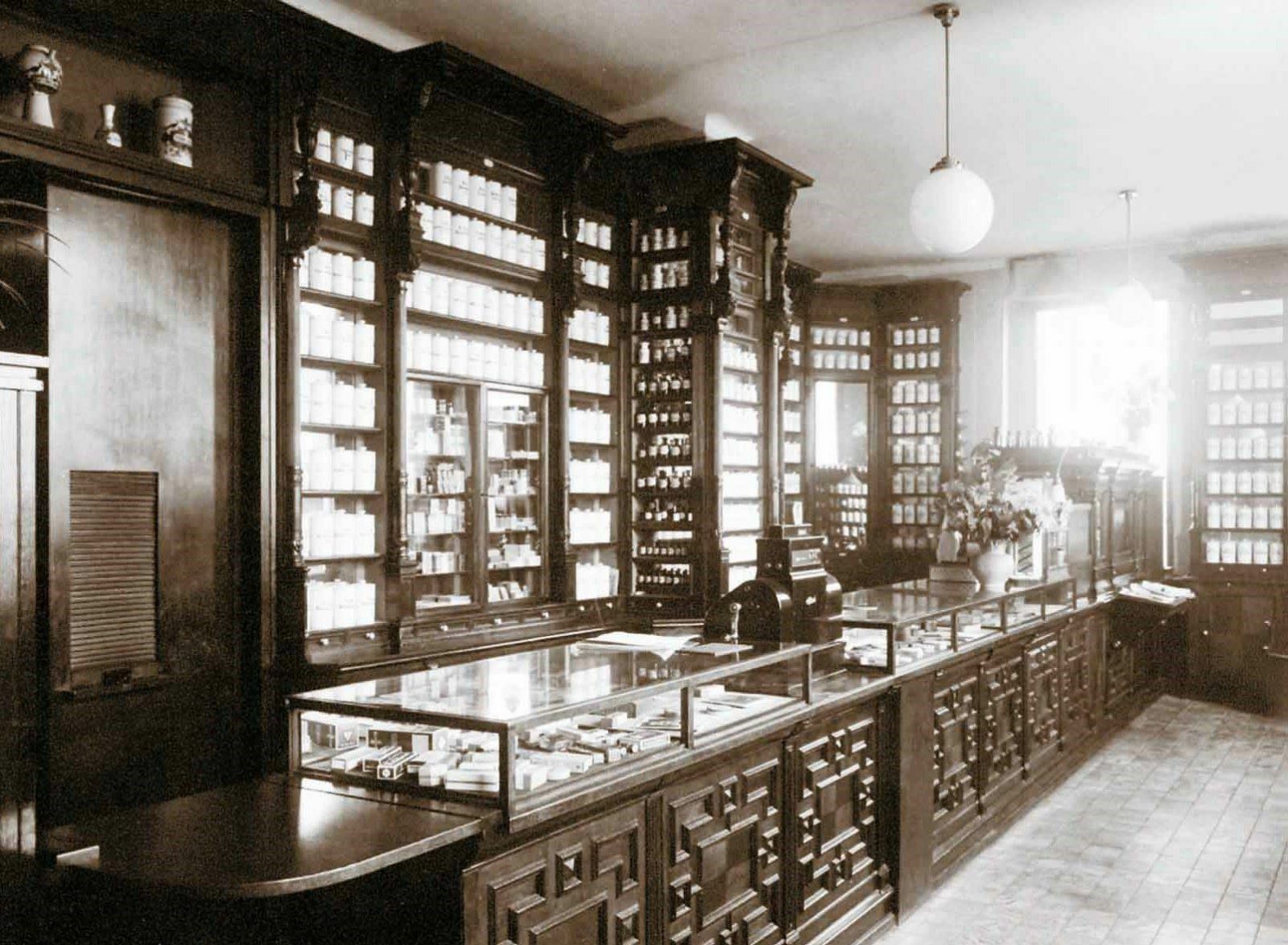
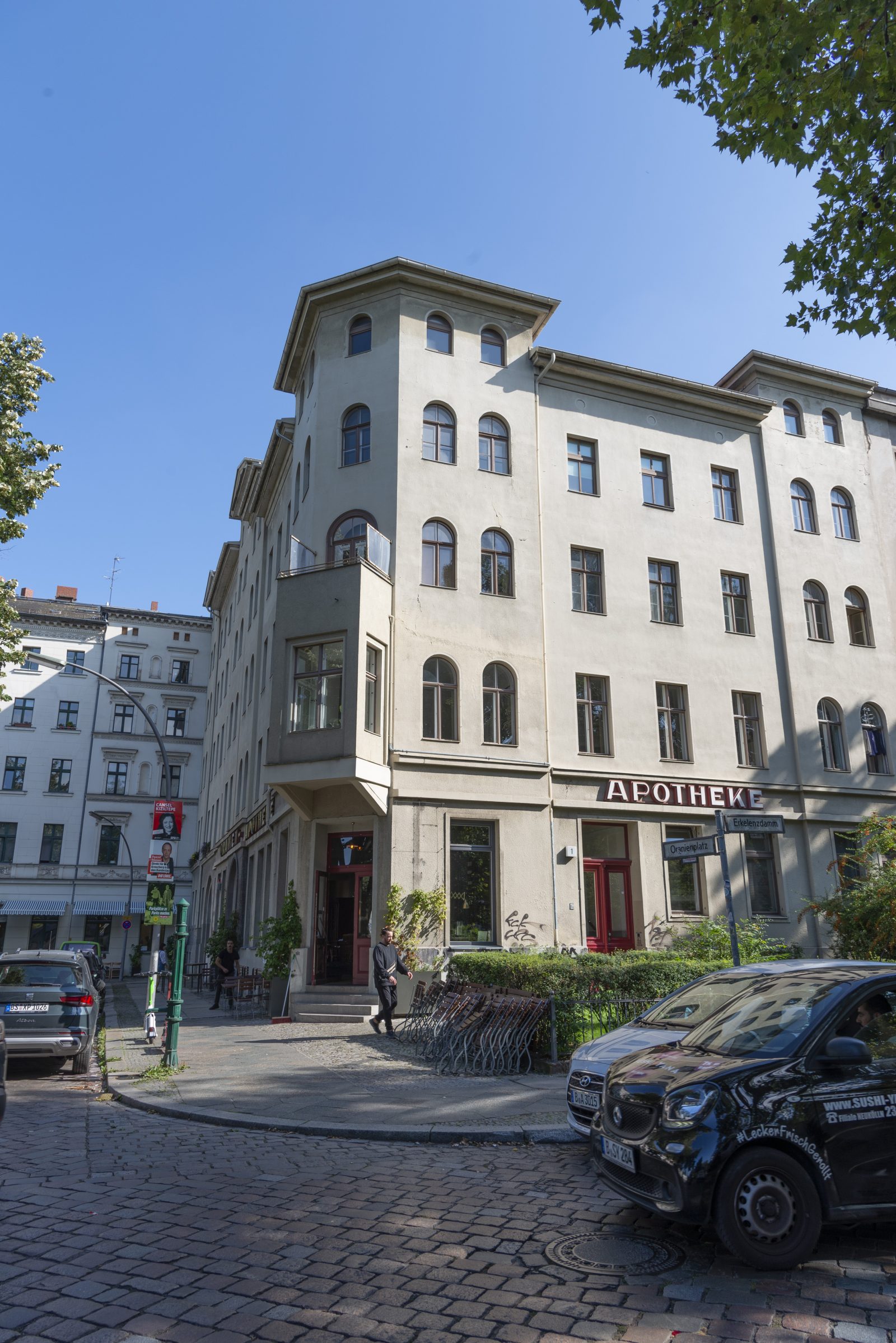
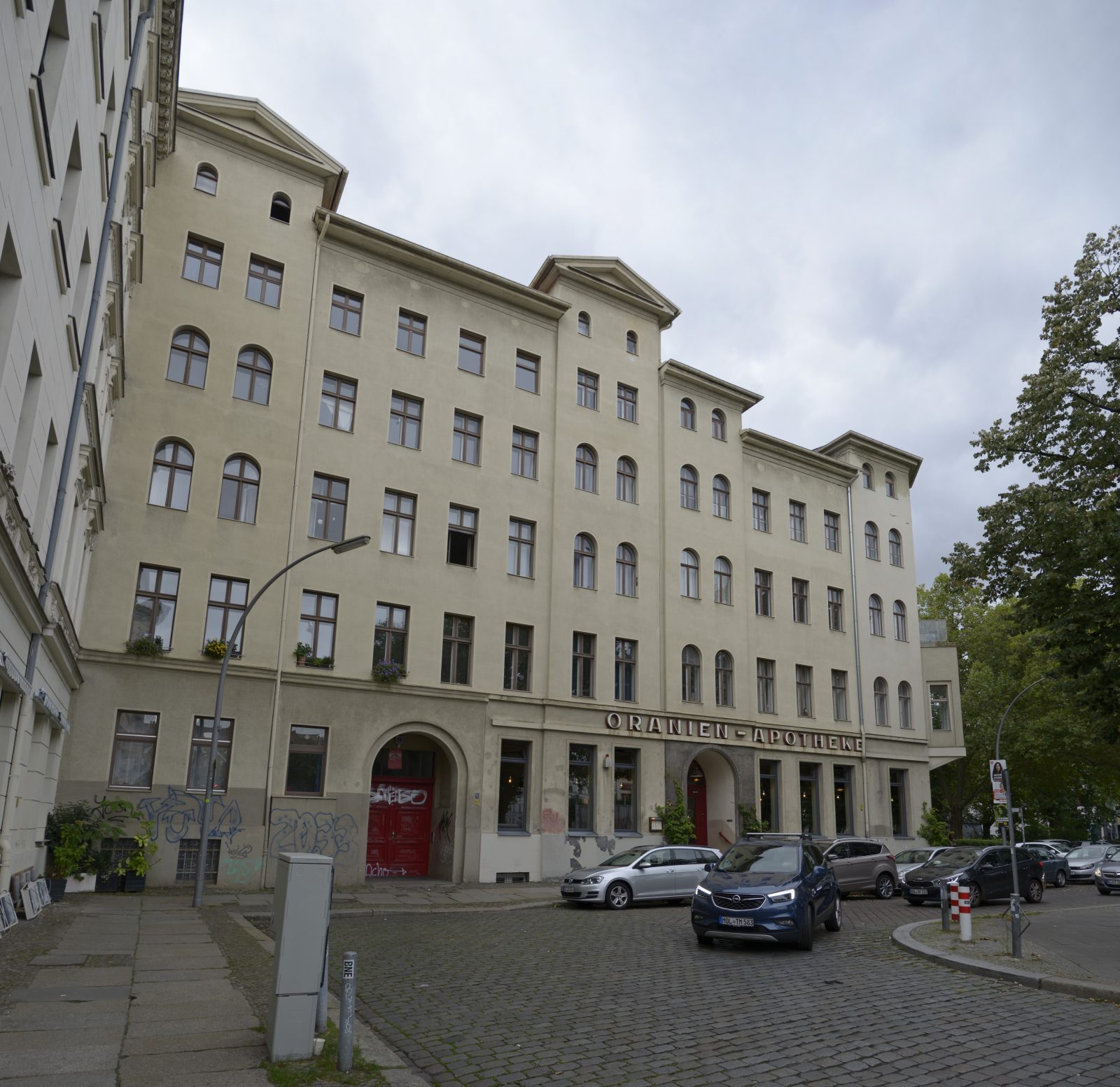
On the sand-colored building on Oranienplatz, the name Oranien-Apotheke is written in neon letters - today it is the Brasserie Ora, a chic bar-restaurant. The former pharmacy is located on Erkelenzdamm not far from the lively Kottbusser Tor, between Oranienstraße and the leafy Luisenstadt Canal. The building was completed in 1860; since then, the Oranien-Apotheke has been located on the ground floor. Under the management of the Lutze family, the pharmacy grew into the pharmaceutical production company Dr. Kade Pharmazeutische Fabrik, based in Kreuzberg, which continues to exist today under the name Dr. Kade Health Care. In the early 1900s, the pharmaceutical factory and pharmacy established itself as the official medical supplier for Europeans traveling to the colonies. This text shows how closely Dr. Kade was intertwined with German colonial interests in Africa – a chapter of the company's history that remains unmentioned in its official chronicle. [1]
In April 1860, the Pharmazeutische Zeitung published an advertisement: they were looking for a pharmacist to take over the management of a new pharmacy on Oranienplatz, Elisabethufer 19 (today Erkelenzdamm 1), which had not yet been opened. [2] On June 7, 1860, Dr. Rudolph Ernst Emil Kade was granted the official license to operate the pharmacy. For seventeen years, Dr. Kade and his son Richard Heinrich Kade ran the Oranien-Apotheke until their son sold it in 1877. The pharmacy was then owned by Friedrich Ernst John before it passed into the possession of Dr. Franz Albert Lutze in 1886. Despite the changing owners, the name Kade established itself as a kind of trademark, which is why Lutze gave his business the name Dr. Kade's Oranien-Apotheke. From this time on, the Oranien-Apotheke seems to have made a name for itself as a manufacturer and distributor of medicines. It was expanded to include a laboratory in which medicines were produced and delivered to other pharmacies and hospitals as well as to a clientele from the upper class of the population and, if necessary, exported. This was also about status and prestige: Lutze prided himself on his position as the official supplier of medicines to the passengers of the imperial yacht Hohenzollern, and both the Prussian and Saxon courts awarded him state medals for special services to the economy. [3] In an advertising brochure from 1904, Lutze calls himself "Purveyor to the Court of His Majesty the Emperor and King" and boasts of his services to the Prussian royal family. [4]
Dr. Kade's Oranien-Apotheke sold medicines for private medicine boxes, veterinary practices and ships. However, it primarily specialised in travelling to the "tropics", i.e. to the German colonial territories in Africa. The target clientele were "laymen" on expeditions, missionaries, researchers and entrepreneurs who were active in the colonies, as well as so-called Schutztruppen, who fought for German colonial expansion in and control of Africa. They were sold bandages, chemicals, medical instruments and other pharmaceutical equipment as well as a wide range of medicines. Tablets, gelatin capsules, sterilised products for injections, ointments and medicinal teas were offered. Larger goods such as microscopes, photo and X-ray machines were also available. In the heyday of German colonialism around 1900, there was a lively demand for these products. With its offer, the Oranien-Apotheke made great profits.
In order to provide enough space for the steady increase in production, Lutze later bought the building at Elisabethufer 35 (today Erkelenzdamm 3), which was located directly next to the pharmacy, and opened a separate production facility there in 1908. The laboratory became a factory, which Lutze gave the name Dr. Kade's Pharmaceutical Factory.
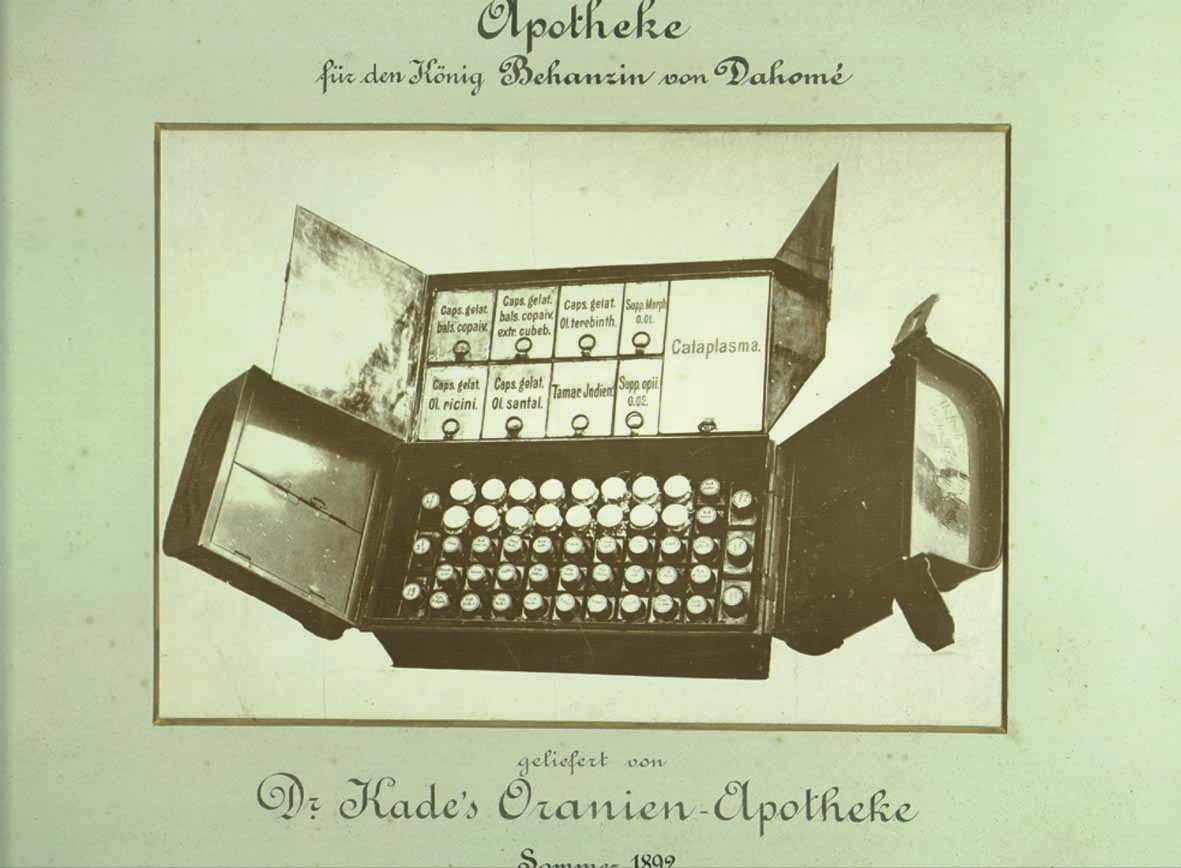
Travellers to the colonies could obtain individually compiled first-aid kits from Dr. Kade's Oranien-Apotheke. These contained medicines for the treatment of the travel illnesses and complaints typical of Europeans on expeditions. The first-aid kits, which were also advertised as tropical pharmacies, were based on the guide of Dr. Kohlstock, staff physician at the Medical-Surgical Friedrich Wilhelm Institute in Berlin and assistant to the chief physician of the Imperial Schutztruppe for German East Africa – in the sense of actively supporting the Schutztruppe. During this time, he had dealt with the medical needs of Europeans in East Africa and other "tropical malaria areas"[5] and advocated the standardisation of medical advice. In 1891, Kohlstock published his recommendations in the "Medical Guide for East Africa and Tropical Malaria Areas", a medical volume of over 300 pages that supported the compilation of the first-aid kits of Dr. Kade's Oranien-Apotheke. [6] These included bandages, gauze and iodine antiseptic to treat injuries, quinine tablets for malaria, valerian root tincture for the nervous system, insect powder, calomel and other medicines for dysentery and other diseases of the digestive tract. The equipment varied in size depending on the length of the expedition and the distance to so-called "civilized places". [7] They were made of durable materials such as canvas, tin or wood. The No. 1 Tropical Pharmacy, as the advertising brochure explained, could simply be attached to a belt loop, while the larger kits were intended for transport by "carriers". This presumably meant people living locally in African countries who served wealthy Europeans on their "adventures" in the colonies. [8] The advertisement for the first-aid kits for personal use emphasizes that they fit perfectly into the so-called tropical case, which was made especially for this clientele by European colonial travelers. The offer included not only first-aid kits, but also cooling systems and water treatment devices, which, according to Kohlstock, could be used to protect against cholera, typhoid fever and other water-borne diseases. Lutze's advertising strategies and Kohlstock's recommendations, which were described as "hygiene recommendations"[9], are run by the subliminal racist message that the "tropics" are dirty and dangerous.
Documents from the Berlin Missionary Archive indicate that it was also in correspondence with Dr. Kade's Oranien-Apotheke in the early 1900s. The letters contain orders for medicines for missions and dispensaries in German East Africa, in places such as Ilembula, Kidugala, Lupembe and Emmaberg (all in present-day Tanzania), some of which are still in operation today. In a letter dated 28 March 1907 from the Oranien-Apotheke to the missionary society – it still exists today under the name Berliner Missionswerk and is still based in the same red brick building at Georgenkirchstraße 70 in Friedrichshain – questions about Dr. Kade's Tropenapotheke No. 17 are answered, suggesting a possible imminent purchase. [10] A letter sent shortly before this kindly reminds the Missionswerk that he, like Lutze's entire missionary clientele, is entitled to a discount of 5% on the sales price. [11] The Oranien-Apotheke's offer was aimed not only at missionaries, but also at researchers and businessmen with economic interests in the colonies. Here, the scientific staff who dealt with biology or diseases in the colonies could obtain microscopes. Dr. Kade's water filters, which enjoyed highly positive reviews,[12] were also used and highly praised by the Shandong Railway Company in Kiautschou, the so-called "protected area" of Germany in eastern China, during the construction of the railway from 1900 to 1902.
Lutze's biggest customer, however, was undoubtedly the German colonial military. Even more remarkable than the small personal first-aid kits, however, are the comprehensive sets of medical equipment for field hospitals, as well as the medicine cabinets for hospitals and Red Cross stations. Some were so large that they would have taken up an entire wall in a real pharmacy. One of the sets on offer had been specially designed to fit into the "officer's case" designed by Hermann von Wissmann. Wissmann was a colonial researcher, governor of the colony of German East Africa from 1885 to 1886, and notorious for his brutal military tactics. [13] In his officer's trunk, Dr. Kade's medical products shared space with cartridges, cigarettes, and writing utensils. [14] Lutze deliberately marketed his products to a military clientele: his sets were for sale at the Officers' Club in Berlin-Mitte, where soldiers could also buy clothing and weapons. [15] As an official "supplier to the colonial department of the Foreign Office", Dr. Kade's Oranien-Apotheke promised to cover any medical needs of the German Schutztruppen. They were obviously very well equipped for war. [16]
According to the reports of the 1905 Colonial Congress in Berlin, Dr. Kade's Oranien Pharmacy supplied the Schutztruppe sent to put down the Herero and Nama uprising of 1904–1907 in German South West Africa with medical equipment, medicines and water treatment equipment. [17] This conflict ended in genocide. Many of the Herero who were fleeing died an agonizing death: they died of thirst because the few water points had been poisoned by German troops. [18]
Lutze's participation in the colonial congresses in Berlin in 1902 and 1905 and the fact that he presented his products there at the "Tropical Medicine Exhibition" are further evidence of the close involvement of the Orange Pharmacy in business in colonized states and thus in the exploitation of these countries.[19][20] So it is not surprising that with the end of World War I and the redivision of the German colonies to other European colonial powers, Dr. Kade also had to accept a sharp decline in income. The company had lost its economic niche and its regular clientele and had to reinvent itself. Under a new English name, Dr. Kade Pharmaceuticals, the company instead focused on new markets in Japan. The company survived World War II; another name change followed. In the 2000s, the company, which had renamed itself Dr. Kade Health Company and was already in its fourth generation of family ownership at the time, continued to expand with the distribution of over-the-counter drugs. [21] Dr. Kade has established itself as a successful pharmaceutical company that manufactures and distributes well-known drugs such as Riopan or Hexal. Although the company's headquarters are no longer in Kreuzberg, pride in the "Made in Germany" identity remains. Advertisements for various Dr. Kade products can be seen in many pharmacy shop windows in Berlin, but the company's involvement in German colonialism is hardly known. This chapter is not deepened in Dr. Kade's version of the company's history: the company's activities in the years 1886–1908 are summarized only with the short sentence "The pharmacy supplies, among other things, the on-board pharmacy of the imperial yacht 'Hohenzollern'". The expansion of the production facility, prompted by the lucrative profits from the colonial market, is attributed to a "pleasing [...] business development"[22]. These omissions in Dr. Kade's self-portrayal illustrate the general lack of confrontation with colonialism in Germany.
What became of the Oranien-Apotheke? When the last pharmacy tenant, Klaus Dallmann, retired in 2013, some Kreuzberg residents wondered what would happen next. [23] Was this the end of the history of the pharmacy on Oranienplatz, after 133 years of uninterrupted operation? Yes and no. The new tenants are not pharmacists; they converted the pharmacy into a bar and restaurant. The historic furniture was renovated, while pharmacy equipment and utensils such as scales, wooden drawers, glasses and ladders were converted into decorative elements. Rows of cocktail glasses now stand on the pharmacy shelves; the shop counter has become a bar. The Oranien-Apotheke seems to live on in Brasserie Ora, at least aesthetically. Some people see Brasserie Ora as a positive example of gentrification,[24] because a piece of Kreuzberg's past is preserved there in the present. But only a fraction of the history of the Oranien-Apotheke can be seen here. In Ora's nostalgic aesthetic concept, there are no references to what the old pharmacy had to do with travel, imperialism, war and genocide in the German colonies, including Africa.
Flavia Cahn
- LOCATION
- Elisabeth-Ufer 19, Berlin
- TODAY
- Erkelenzdamm 1, 10999 Berlin
Citing the article
Flavia Cahn: Die Oranien-Apotheke. In: Kolonialismus begegnen. Decentralised perspectives on Berlin's city history. URL: https://kolonialismus-begegnen.de/geschichten/die-oranien-apotheke/ (03.03.2025).
Literature & Sources
[1] Cf. Dr. Kade Health Care, History of Dr. Kade Health Care. Available online at: https://www.kade.de/unternehmen/historie/ [last accessed: 25.10.2021].
[2] Cf. (Voigt is the publisher!)., Pharmazeutische Zeitung, 5th year, No. 16, 18 April 1860 http://www.digibib.tu-bs.de/?docid=00035907.
[3] Acta of the Society for the Promotion of Protestant Missions among the Gentiles. Concerning: pharmacies, medicines, instruments, etc. "The Advantages of the Sucro-Filter", Landesarchiv Berlin, Sig. bmw 1/784.
[4] Cf. Dr. Kade, "Liste Nr. 7. Dr. Kades gebrauchsfertige Sanitätsausstattungen für die Tropen", Berlin.1904, pp. 1-15, in: Acta der Gesellschaft zur Beförderung der evangelischen Missionen unter den Heiden. Concerning: Pharmacies, Medicines, Instruments, etc. 1887-1930, Landesarchiv Berlin, Sig. bmw 1/784, p. 1.
[5] After his return to Germany in 1890, Kohlstock was promoted to the position of medical officer of the Schutztruppen in German East Africa and other German "protectorates" in West Africa and South West Africa at the Foreign Office. Cf. Kohlstock, Paul, Ärztlicher Ratgeber für Ostafrika und Trope Malariagebiete, Berlin 1891, p. 4.
[6] The travel equipment was also influenced by other publications, such as: Dr. F. Plehns Tropen-Hygiene, Jena 1902; Dr. C. Menses Tropischer Gesundheitslehre und Heilkunde, Berlin 1902; Dr. Falkensteins Ärztlicher Ratgeber für Seeute, Kolonisten etc. 2nd edition, Berlin 1883.
[7] Kohlstock 1891, p. 284.
[8] Cf. Dr. Kade, List No. 7. Dr. Kade's ready-to-use medical equipment for the tropics, p. 7.
[9] Cf. Pfuhl, A. (first name is everywhere given only as A, unfortunately): "Ueber das Schumburg'sche Verfahren zur Wasserreinigung", Zeitschrift für Hygiene und Infektionskrankheiten, 33. 1900, pp. 53-88.
[10] Acta of the Society for the Promotion of the Protestant Missions among the Gentiles. Concerning: pharmacies, medicines, instruments, etc. Letter from Dr. Kade's medical pharmaceut. Manufacturing and export business to the company for the promotion of the Protestant missions and the pagans. 28.03.1907. Landesarchiv Berlin, Sig. bmw 1/784
[11] Acta of the Society for the Promotion of the Protestant Missions among the Gentiles. Concerning: Pharmacies, medicines, instruments, etc. Letter from Dr. Kade's medical pharmaceut. Manufacturing and export business to the Society for the Promotion of the Protestant Missions and the Gentiles. 18.03.1907. Landesarchiv Berlin, Sig. bmw 1/784
[12] Cf. Acta of the Society for the Promotion of Protestant Missions among the Gentiles. Concerning: pharmacies, medicines, instruments, etc. "The advantages of the Sucro-Filter", no date. Landesarchiv Berlin, Sig. bmw 1/784
[13] Kohlstock, Medical Guide for East Africa and Tropical Malaria Areas, p. 286
[14] Cf. ibid.
[15] Cf. ibid., p. 285.
[16] Cf. Dr. Kade, List No. 7. Dr. Kade's ready-to-use medical equipment for the tropics, p. 1.
[17] Deutscher Kolonialkongress 1905, Verhandlungen des Deutschen Kolonialkongresses 1905 zu Berlin am 5., 6. und 7. Oktober 1905, Berlin 1906, p. 21 and p. 205.
[18] Cf. Sarkin, Jeremy, Colonial Genocide and Reparations Claims in the 21st Century, Westport, CT 2009.
[19] Cf. German Colonial Congress 1902, Negotiations of the German Colonial Congress 1902 in Berlin on 10 and 11 October 1902, Berlin 1903.
[20] Cf. German Colonial Congress 1905, pp. 30-31.
[21] Deutsche Apotheker Zeitung, "Don't be afraid of taboo topics." Deutsche Apotheker Zeitung, 5 August 2016.
[22] Dr. Kade Health Care, Story of Dr. Kade Health Care. Available online at: https://www.kade.de/unternehmen/historie/ [last access: 25.10.2021].
[23] Cf. Röhrig, Lutz, Die Oranien-Apotheke und die Brasserie Ora. Available online at: https://www.zeit-fuer-berlin.de/aus-den-bezirken/friedrichshain-kreuzberg/oranien-apotheke [last access: 01.05.2021].
[24] Cf. ibid.
Tags
#Afrika#Auswärtiges Office#Berliner Missionary Society#Cholera#Dr. Franz Albert Lutze#DR. KADE Pharmaceutical Factory#Dr. Kohlstock#Dr. Rudolph Ernst Emil Kade#Expedition#Forscher#Friedrich Ernst John#Geschäftsleute#Hermann von Wissmann#Hoflieferant His Majesty the Emperor and King#Hygienevorstellungen#Instrumente#Kolonialabteilung#Kolonialkongress#Malaria#Medizin#Militär#Missionare#Ostafrika#Pharmazeutische Products#Reiseapotheke#Salben#Schutztruppen#Tabletten#Tropenapotheke#Typhus#Verbandmaterial