Colonial film entertainment at Nollendorfplatz
In the first decade of the 20th century, the still young medium of film developed into an integral part of Berlin's entertainment culture. In the big city, a relatively high density of retail cinemas and cinemas quickly emerged, in which films from and about the German colonies could also be seen. The possibility of travelling safely to the far-flung colonies in a cinema seat was met with enthusiasm by the audience. Above all, shots of exotic animals and big game hunts were popular subjects. However, the selection of programmes in the cinemas was not limited exclusively to nature shots. Numerous colonial propaganda films were shown, which were intended to confirm the prefabricated worldview of the audience. The majority of colonial films reinforced existing racist stereotypes and glorified the cultural and economic achievements of the Germans in the overseas territories.
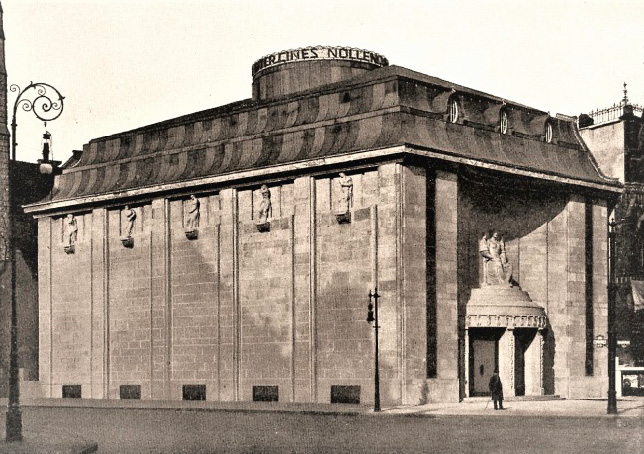
In 1911, the Mozart Hall in the Schöneberg New Schauspielhaus on Nollendorfplatz was converted into a cinema and colonial films were also shown here from then on. Robert Schumann's colonial films were presented here several times. After the screenings in the Mozart Hall, Schumann also showed his films in 1914 at the Cines, also located on Nollendorfplatz, and thus in the first independent cinema building in Berlin, which had opened its doors a year earlier.
Schumann had travelled to German South West Africa (DSWA, now Namibia) for the first time with his camera in 1904 to accompany an expedition on film. When the war against the Herero and Nama broke out shortly afterwards, Schumann changed his plans without further ado and joined the so-called 'Schutztruppen' on the side of the Germans. A year later, he returned to Germany wounded and at the same time militarily excellent. In his luggage he also had film material showing army life in DSWA and thus completely new images and impressions for the audience in the German Empire. From 1907 Schumann worked as a projectionist for the German Colonial Society and presented his film material together with his first-hand stories. These live performances authenticated the film material and were probably also so popular because Schumann spoke simply and understandably. With his performances, Schumann can be placed in the context of popular presentations about the war against the Herero.
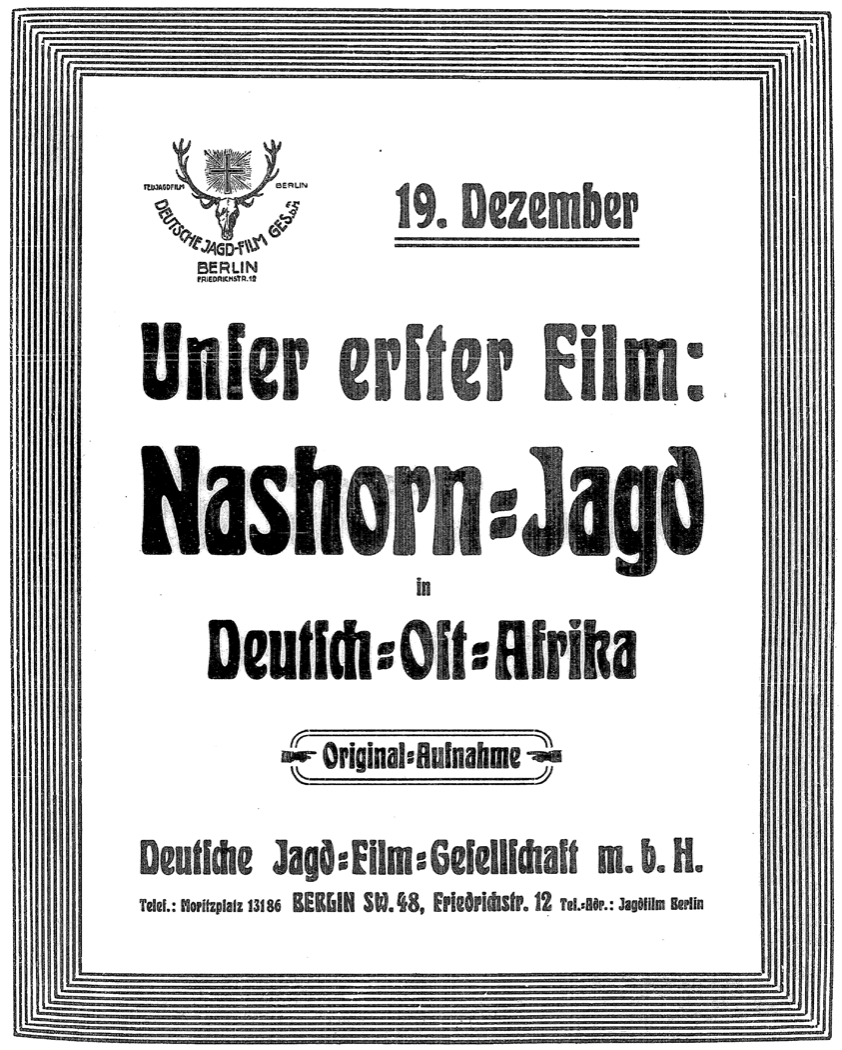
In the course of further trips to the colonies, Schumann specialized in hunting films, for which he gained even greater fame. In his films – such as "Rhinoceros Hunting in German East Africa" (1913) – Schumann staged himself as a masterful hunter. In addition, he portrayed himself as an Africa expert in the films, for example by showing in front of the camera how to cut off the skin of the rhinoceros. Schumann brought back his hunting experiences from his travels on several thousand meters of film strips. He also showed his shots, which were spectacular by the standards of the time, in the Reich Chancellor's Palace. In order to market his films profitably, he founded the German Hunting Film Society in 1913. In total, his company published three hunting films and one feature film from the German colonies.
The colonial film enjoyment in Schöneberg was repeatedly offered free of charge in order to be accessible to the widest possible public. The organiser of these cinema experiences was the Cinematographic Study Society, founded in 1913, for which Schumann also repeatedly offered film screenings. The aim of the Study Society was to distribute educational, documentary and expedition films. About twice a month, the Study Society invited people to the Mozart Hall of the New Theatre with free admission. The Cinematographic Study Society became a gathering place for all those interested in colonial films.
Schumann was one of the first filmmakers to provide the German public, including the Schöneberg Bürger_innen, with images from the colonies. He established a new style of colonial film, which did not show the colonies as an up-and-coming and attractive place for Investor_innen like many others, but in his films the colonies became the scene of dramatic adventures. He appealed to the emotions of the audience and by placing himself as a person at the center, he also offered the audience the opportunity to identify with him and his adventures.
At the beginning of the First World War, Schumann euphorically joined the army and was already missing in combat in September 1914. His melodramatic films continued to endure. For the German Colonial Society, Schuhmann's films were also a means of reviving colonial sentiment in Germany in the 1920s.
This text is the revised version of a chapter from the exhibition "Research Workshop: Colonial History in Tempelhof and Schöneberg", which the Schöneberg Museum showed from 19.5. to 29.10.2017.
Malin Winter
Johanna Strunge
- LOCATION
- Cines
- TODAY
- Nollendorfplatz 4
Citing the article
Malin Winter, Johanna Strunge: Colonial Film Entertainment at Nollendorfplatz. In: Kolonialismus begegnen. Decentralised Perspectives on Berlin's City History. URL: https://kolonialismus-begegnen.de/geschichten/kolonialfilmunterhaltung-am-nollendorfplatz/ (12.06.2024).
Literature & Sources
Wolfgang Fuhrmann: Imperial Projections. Screening the German Colonies, New York/Oxford 2015.
Tobias Nagl: The Uncanny Machine. Race and Representation in the Weimar Cinema, Munich 2009.