Artistic Explorations of the Colonial Gaze
Accompanying the exhibition "Colonial Traces of Reinickendorf's Industrial History" in the GalerieETAGE, selected objects were also examined for their colonial traces and contexts in the rooms of the permanent exhibition in the Reinickendorf Museum.
With the participation of a focus group of students from the Thomas-Mann-Gymnasium (Johanna Grace Ampofo, Amanda Calista Williams, Ibrahim Sow, John Kossi Gbeassor), digital interventions for visitors were developed (Link) that open up multi-perspective views of the exhibits.
The contributions have been thoroughly reviewed and revised for digital presentation. We recommend the introductory text on Reinickendorf's colonial past (Link) to get started.
Hannah Höch – Artistic Explorations of the Colonial Gaze
Hannah Höch
The internationally renowned artist Hannah Höch came to Berlin as a young woman to attend the School of Arts and Crafts. In Berlin, she met her partner at the time, Raoul Hausmann. Together with him, she invented the principle of photomontage. Through Hausmann, Hannah Höch was introduced to the Dada artist circles. Dada was an artists' movement that positioned itself against conventional political and social norms and used photomontage and collage techniques as one of its stylistic devices. From 1939 until her death in 1978, Hannah Höch lived in her house in Heiligensee.
Biography
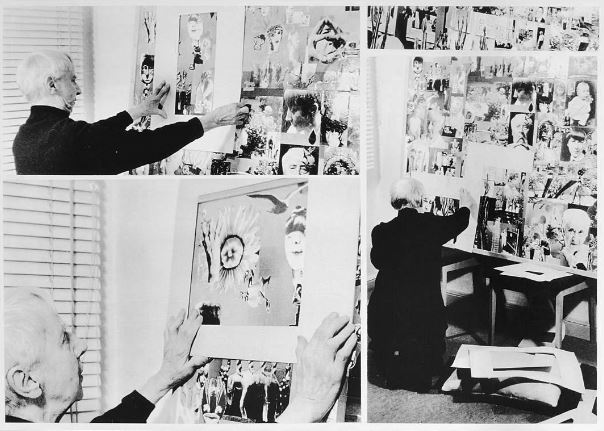
With her work "Lebensbild" (Life Picture), Hannah Höch collaged a review of her own life from 1972 to 1973. The Orgel-Köhne couple accompanied the artist photographically. The large photograph of the collage "Lebensbild" is presented in the Hannah Höch Room in the Reinickendorf Museum. In addition to personal motifs, the "Lebensbild" also includes excerpts from her artistic work.
In the upper left corner, she quoted fragmentarily three of her own works that stand in a colonial context: two collages from her series "From an Ethnographic Museum" (1922 – 1931) and the work "Angst" (1970). Höch positioned herself against the colonial gaze early on. In these works, she critically questioned the stereotypical viewing habits of the "foreign" and "primitive".
Kidnapping
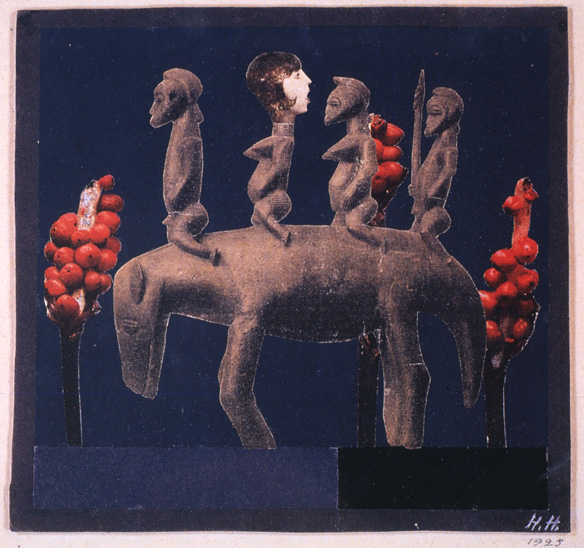
The main motif of the collage "Abduction" is a wooden sculpture from the Congo, which Hannah Höch had cut out of the "Berliner Illustrierte Zeitung". Four stylized people sit on a horse, male in the front and back and female in the middle. A white woman's head is mounted on the left female figure, which is directed backwards towards the male figure with the spear.
In contrast to the quiet, closed heads of the other characters, the gaping mouth of the modern white woman's head looks like an indignant cry with which the white woman rebels against her abduction. Here the defenseless white woman is shown as threatened by the black man.
With this collage, Höch critically alludes to the high-profile racist campaign "Black Shame". During the Allied occupation of the Rhineland with the deployment of French colonial troops (1920-1923), black soldiers were accused of mass acts of violence against German women and children.
The Sweetness
In this photomontage, Hannah Höch addresses the stereotypical view of the foreign. In the center of the picture, an oversized head dominates the much smaller rest of the body. It is a mask from French Congo, which was depicted in "The Cross-Section" in 1924. The artist creates the facial expressions by closing the left eye and inserting a huge female eye on the right, looking upwards at an angle. The mouth is replaced by the made-up mouth of a white woman. The body ends at the bottom with the posing legs of a white woman.
With the title "The Sweetness", Höch subverts the viewer's viewing habits. The graceful, elegant posture of the figure, which is actually so ungracefully deformed, reflects the representation of the female body in the contemporary media. These were linked to the encounters with the foreign at the "Völkerschauen" of the colonial era.
Anxiety
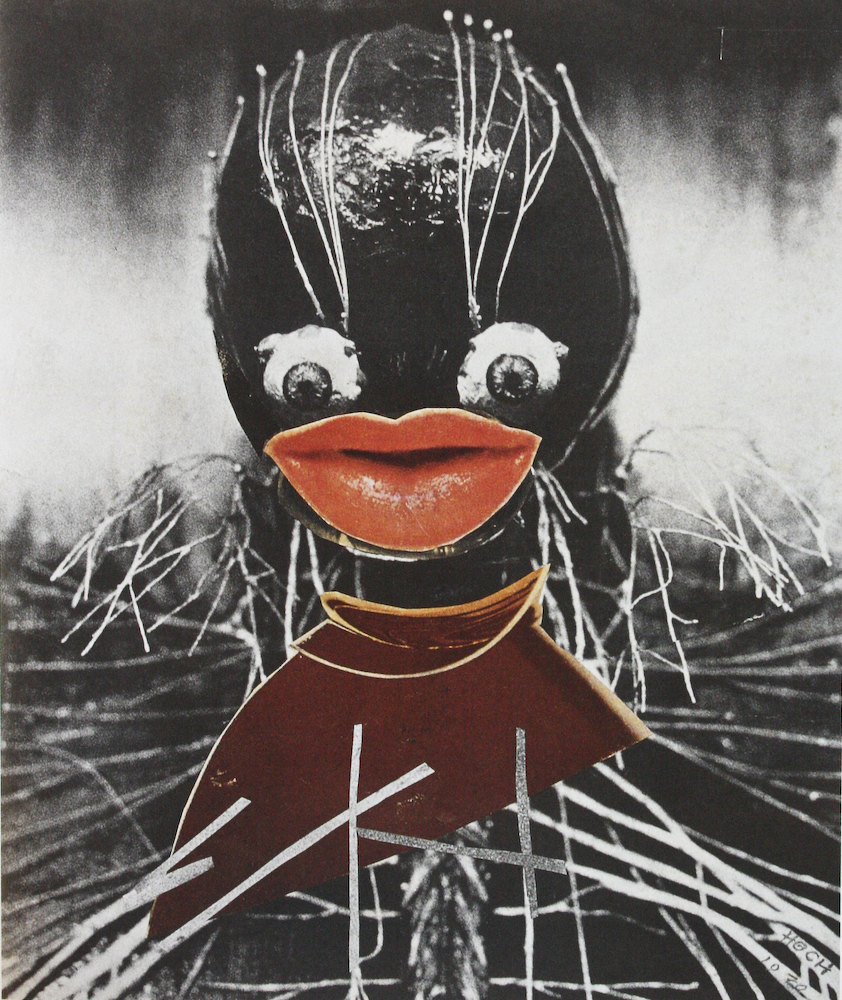
In 1970, Hannah Höch once again expressed her ironic commentary on the exotic view of the foreign. In choosing the excerpts for this collage, the artist does not fall back on quotations from "primitive" art, but uses the photograph of a scientific model, which she combines with an oversized woman's mouth painted red and two staring eyes. A grotesquely stylized black woman is recognizable against a picture background full of undergrowth.
The figure's wide-open eyes convey a naïve shyness, which in turn is reflected in the viewer's strange fear. The title "Angst" plays with the ambivalent dialogue between the depicted figure and the viewer.


Claudia Wasow-Kania
Imke Küster
- LOCATION
- TODAY
Citing the article
Claudia Wasow-Kania, Imke Küster: Artistic Examinations of the Colonial Gaze. In: Kolonialismus begegnen. Decentralised Perspectives on Berlin's Urban History. URL: https://kolonialismus-begegnen.de/geschichten/kuenstlerische-auseinandersetzungen-mit-dem-kolonialen-blick/ (23.11.2024).
Literature & Sources
Denise Toussaint: Encountering the Colonial View. Identity, Alterity and Postcoloniality in the Photomontages of Hannah Höch. Bielefeld 2015