Quane e ("Martin") Dibobe becomes train driver of the U1
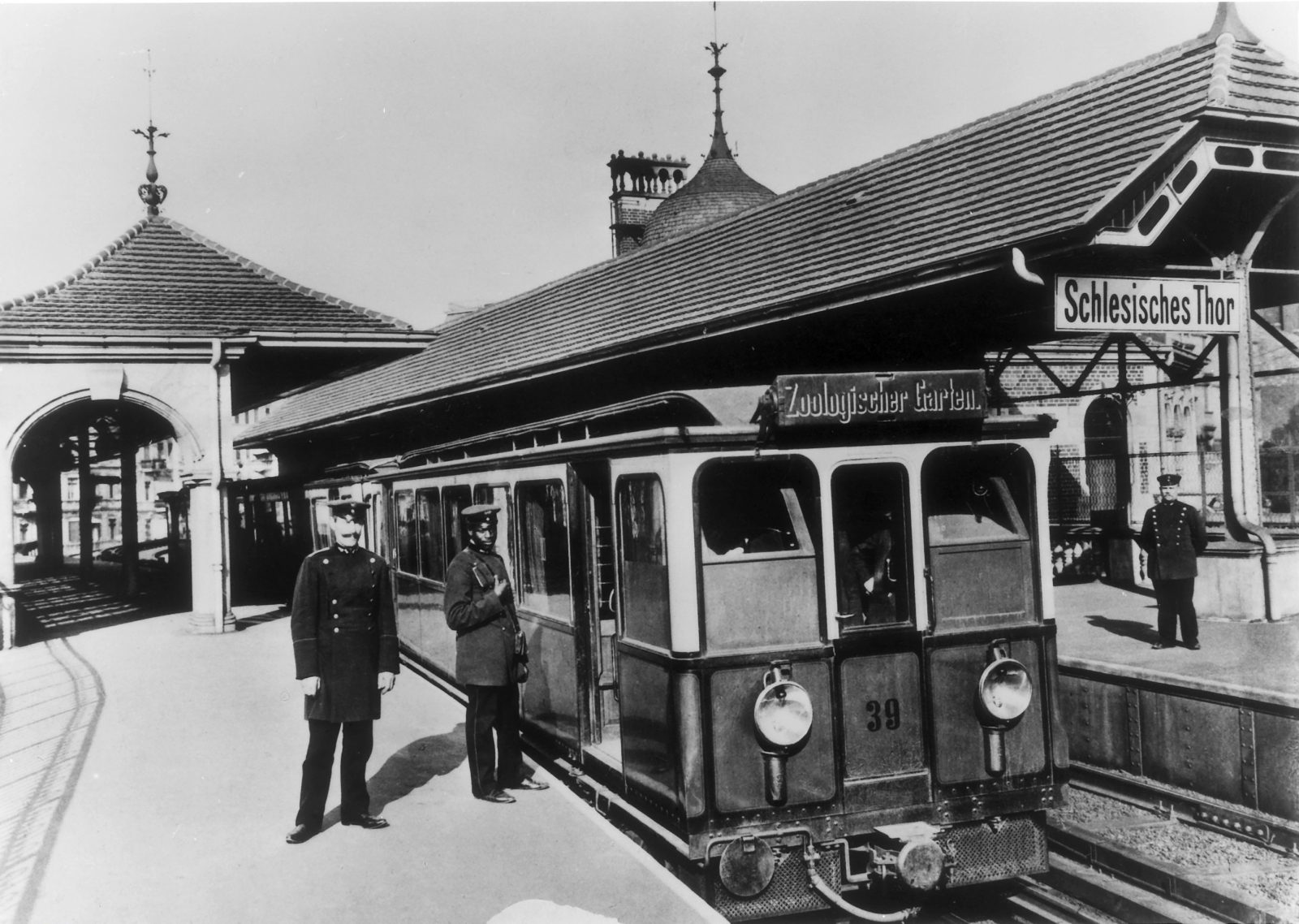
Quane e Dibobe was born on October 31, 1876 in Bonapriso, now Duala, in the former German colony of Cameroon, the son of an important local leader. At the mission school, he was baptized with the name "Martin Dibobe", under which he is remembered today. Dibobe was one of 103 people from the African continent who came to Berlin in 1896 to work at the German Colonial Exhibition. This was part of the Berlin Trade Exhibition, which took place from May to October 1896 in Berlin-Treptow in today's Treptower Park. [1] Like several others, Dibobe then stayed in Berlin and did an apprenticeship as a mechanic. He found a job with the Berlin Transport Company and became Berlin's first black train driver. Dibobe ran trains on line BII on the elevated railway, which ran across the city from Warschauer Straße in the east through the heart of Kreuzberg to the Zoologischer Garten in the west. Much of this line is now part of the Berlin U1 line. In addition to his long career as a train driver, Dibobe was above all a central figure in the Cameroonian diaspora that formed in Berlin in the early 1900s. He advocated fairer relations between his homeland and Germany and advocated social and political reforms in the colonies. A barely visible reference to Dibobe's presence in Kreuzberg can be found in the Hallesches Tor underground station: one of the faded historical photographs from the early days of the U-Bahn system, which are displayed on the walls of the entrance to the U6 underground platform, shows Dibobe in uniform next to the train he was driving.
Like the World Exhibitions in Paris and London, the Berlin Colonial and Trade Exhibition was intended to create an opportunity for Germany to demonstrate the country's technical, scientific and cultural achievements. However, such exhibitions were also intended to present colonialism as an important national project. They were conceived and staged in a way that sought to win the approval of the population for the colonial undertaking. [2] In addition to exhibits from the textile, chemical, metal and music industries, visitors to the colonial exhibition were also able to marvel at subjects of German colonialism. For the Africa part of the Berlin exhibition, supposed "African villages" were set up as backdrops. Dibobe and the other performers were instructed to present "typical" scenes of everyday life in African rural life and "traditional crafts" for the white German audience. [3] Every day, they were to perform the racist and degrading imaginations of the white audience, presenting "authentic" scenes of colonial and anthropological fantasy in which they appeared in the role of "exotic" and "savage" tribes.
At that time, ethnological shows or human zoos of this kind were by no means uncommon in Europe; and it was not to be the last time that people were exhibited like zoo animals in Berlin. [4] Dibobe and 19 other Cameroonians recruited for the exhibition had assumed that it would be a high-profile prestige event where they would represent their home country. [5] In fact, however, they were insulted by spectators every day; in addition, their living and working conditions in the exhibition were poor and they had to undergo invasive medical and racist anthropometric examinations. [6]
Despite these circumstances and experiences, at the end of the exhibition, 18 members of the group applied for the right to stay in Germany in order to pursue study or training opportunities. Colonial subjects could enter Germany, especially if it served German colonialism, but there were no plans for a long-term stay or even settlement in the German Reich. [7] The legal status of colonial migrants was deliberately indefinite. Their status as citizens of the German overseas territories offered them some protection, but in practice they were deprived of German citizenship and the rights and privileges that came with it. However, despite their precarious legal status, it was possible to find work.
Some performers of the African Continent Colonial Exhibition, including Dibobe, decided to stay and settle in Germany. Shortly after the exhibition, he began training as a mechanic; [8] In 1902, he married Helene Noster, the daughter of his landlord, and took a job at what is now the Berlin Transport Authority, where he rose to the prestigious position of first-class train driver. He was the first Black train driver in Berlin. Dibobe and his wife lived at various addresses in the Berlin districts of Prenzlauer Berg and Friedrichshain over the years. They had two children, but little is known about them. [9]
Dibobe is best known for the 32-point petition named after him, which he addressed to the newly founded Weimar National Assembly on June 27, 1919, to demand political and social reforms in the colonies. In addition to Dibobe, 17 other Afro-Germans from all over Germany signed the petition; most of them were politically active. By this time, the German Empire had been abolished and a new republic was emerging. Dibobe and his co-signatories used the moment of political upheaval to question the status quo and to lend more emphasis to the concerns of the colonized. [10] At the very beginning of the document, loyalty to the Weimar Republic is pledged if certain demands are met. Dibobe presents these as the government's duties towards the African citizens of the colonies, especially Cameroon. [11] The petition reminds the National Assembly of its promise to "protect" the local population in the colonies, which was part of the protection treaties signed in 1884 with local leaders – including Dibobe's father – and emphasizes the National Assembly's responsibility to improve living conditions for local people. [12] The following is a list of 32 demands, including an end to corporal punishment, forced labor and the accompanying violent abuse; the right to cultivate customs and cultural traditions; the right to assemble; protection of "mixed" marriages; regulated wages; better educational opportunities, including religious education for Cameroonians by Cameroonians; as well as equality with whites on public transport. In addition, the petition calls for the participation of people from African regions in political decision-making processes as well as permanent representation by an African member of parliament in the National Assembly – Dibobe proposed himself for this position. [13] Throughout the document, Dibobe argues for the rights protected by German civil law in Germany to be extended to the colonized. The list of demands is ultimately a systematic critique of oppression, discrimination and mistreatment in the colonies and demands equality.
Among historians, the "Dibobe Petition" is considered an important document, "a comprehensive description of German colonial rule from the point of view of the colonized." [14] It is a self-confident act of resistance to inequality and racism. Nevertheless, the question remains whether the petition can be considered anti-colonial. Can Dibobe be considered an early anti-colonial activist whose petition sought to "liberate Cameroon from the grip of colonialism"[15] ? There are positions that emphasize that Dibobe's stance cannot be called anti-colonial,[16] as he invoked German responsibility outlined in the 1884 Protection Treaty and British colonial models in Nigeria. Dibobe wanted the German principles of equality, justice, and dignity that applied to white Germans to also apply to Afro-Germans and Africans in the colonies; the petition is not about an independent or self-determined legal system. Dibobe offered himself as an agent to act in the interests of German interests in Cameroon, on the condition that the colonial system would be "improved". [17] His commitment to the continuation of German influence in the region was so strong that he came to the attention of the French colonial authorities, who had taken over the mandate in Cameroon and kept a close eye on potential opponents of French control in the region. [18] In contrast to the activities of other Cameroonians in Germany at the time, such as Joseph Ekwe Bilé, the Dibobe petition does not advocate an end to colonialism. [19] Rather, Dibobe advocated for an 'end', and thus he questioned the colonial system by showing how much it was based on basic structures of inequality and racism. But was colonialism, as Dibobe and his comrades-in-arms demanded, even possible? Or could the demands of the petition only be met through independence? Could this have been the real intention of the petition? [20] In any case, the petition testifies to an advanced degree of self-organization and political activity of the Afro-German community at that time. [21] At the same time, it is an expression of its diasporic identity and its commitment to the international level as an active force for political change.
Neither the National Assembly nor the Imperial Colonial Office acknowledged the petition with a response. However, historical documents show that Dibobe was in contact with the Imperial Colonial Office and discussed with it his role as a representative of German colonial interests in Cameroon. [22] In 1921, Dibobe left Germany with the intention of returning to Cameroon with his family. He may have lost his job with the Berlin Transport Company because of his political activities. [23] It is possible that for the same reason he was denied entry to Cameroon by the French colonial authorities, who now occupied the region, as they saw him as a possible subversive threat due to his close ties to the German Imperial Colonial Office. [24] There is historical evidence that Dibobe and his family traveled to Liberia, but from this point on any further trace of them is lost; their further fate is unknown. [25]
In recent years, Dibobe's role in Berlin's history has been honored at various locations in the city. In October 2016, on the occasion of his 140th birthday, a Berlin memorial plaque was unveiled at the last known address of the Dibobe family, Kuglerstraße 44, in a quiet residential area in Prenzlauer Berg. It was the first Berlin memorial plaque dedicated to a Black person. It honors not only Dibobe's historical significance as Berlin's first Black train driver, but also his political commitment. [26] In July 2019, on the occasion of the 100th anniversary of the submission of the Dibobe petition, a memorial plaque was erected at the former location of the Reich Colonial Office, at Wilhelmstraße 52 in Berlin Mitte,[27] commemorating the history of Afro-German people in Berlin. [28] It was initiated by the historian Paulette Reed-Anderson and the civil society association Berlin Postkolonial e.V., among others. These projects to commemorate and honor Dibobe give more space and visibility to the Afro-German resistance against colonial oppression and remind us that the African diaspora has been a social part of Berlin society and history for much longer than most people realize. [29]
The striking image of Dibobe at Hallesches Tor has not yet been taken into account in any of the more recent memorial projects. The only information about this photo is a brief accompanying text identifying it as at the "U.-Bhf. Schlesisches Tor" in 1913. The U1 still passes through this station today. It is not known when the picture has been exhibited in the U-Bahn station and when it was taken; according to a tip, the photo was published in a 1902 issue of the Berliner Illustrirte Zeitung in a report on Black Berlin workers. [30] To this day, however, Dibobe's presence in Berlin's history remains mostly unnoticed by passers-by of the busy station.
Flavia Cahn
- LOCATION
- U1 route: if necessary Start: Warschauer Brücke or Kottbusser Tor or Hallesches Tor or Stralauer T(h)or
- TODAY
- Osthafen (from 1924)
Citing the article
Flavia Cahn: Quane e ("Martin") Dibobe wird Zugführer der U1. In: Kolonialismus begegnen. Dezentrale Perspektiven auf die Berliner Stadtgeschichte. URL: https://kolonialismus-begegnen.de/geschichten/quane-e-martin-dibobe-wird-zugfuehrer-der-u1/ (03.03.2025).
Literature & Sources
[1] Zeller, Joachim, "Die Leiche im Keller. Eine Entdeckungsreise ins Innerste der Kolonialmetropole Berlin" in: Bechhaus-Gerst, Marianne / Klein-Arendt, Reinhard (eds.), AfrikanerInnen in Deutschland und schwarze Deutsche – Geschichte und Gegenwart. Contributions to the conference of the same name from 13 – 15 June 2003 at the NS-Dokumentationszentrum (EL-DE-Haus) Cologne, Münster 2004, pp. 89–108, here p. 101.
[2] Aitken, Robbie / Rosenhaft, Eve, Black Germany. The Making and Unmaking of a Diaspora Community, 1884–1960, Cambridge 2013, p. 55.
[3] German Historical Museum, Treptow. The German Colonial Exhibition of 1896 in Treptower Park. Available online at: https://www.dhm.de/archiv/ausstellungen/namibia/stadtspaziergang/treptow.htm [last access: 14.02.2021].
[4] Zeller, Die Leiche im Keller. Eine Entdeckungsreise ins Innerste der Kolonialmetropole Berlin, p. 101.
[5] Rosenhaft, Eve / Aitken, Robbie, "Martin Dibobe", in: Van der Heyden, Ulrich (eds.), Unbekannte Biographien. Afrikaner im deutschsprachigen Europa vom 18. Jahrhundert bis zum Ende des Zweiten Weltkrieges, Berlin 2008, pp. 162–172, here p. 163.
[6] Aitken / Rosenhaft, Black Germany. The Making and Unmaking of a Diaspora Community, 1884–1960, p. 56
[7] Aitken, Robbie,: Making Visible the Invisible. Germany's Black Diaspora, 1880s–1945, Sheffield Hallam University, (10.10.2019). Available online at: https://www.shu.ac.uk/research/in-action/projects/being-black-in-nazi-germany [last access14.02.2021].
[8] Gerbing, Stefan, Afro-German Activism. Interventions by Colonized at the Turning Point of the Decolonization of Germany 1919, Frankfurt am Main 2010.
[9] Aitken / Rosenhaft, Martin Dibobe, p. 167.
[10] Gerbing, Afro-German Activism. Interventions by Colonized at the Turning Point of the Decolonization of Germany 1919, p. 57.
[11] Ibid., p. 47.
[12] Boateng, Osei, "Black Germans do not exist", in: New African, 396 (May 2001), pp. 18–25.
[13] Aitken / Rosenhaft, Black Germany. The Making and Unmaking of a Diaspora Community, 1884–1960, p. 200.
[14] Reed-Anderson, Paulette, Rewriting the Footnotes. Berlin and the African Diaspora, Berlin 2000, p. 46. Translation from the original: "a comprehensive description of German colonial rule from the viewpoint of the colonized."
[15] Aitken, Robbie, "Berlin's Black Communist. Joseph Bilé, the Comintern, and the Struggle for the Rights of Black People.", Rosa Luxemburg Stiftung 06.2019. Available online at: https://www.rosalux.de/en/publication/id/40552/berlins-black-communist ]last access: 14.02.2021]. Translation from the original: "free Cameroon from the hold of colonialism".
[16] Gerbing, Afro-German Activism. Interventions by Colonized at the Turning Point of the Decolonization of Germany 1919, p. 82.
[17] Aitken / Rosenhaft, Black Germany. The Making and Unmaking of a Diaspora Community, 1884–1960, p. 202.
[18] Brückenhaus, Daniel, Policing Transnational Protest. Liberal Imperialism and the Surveillance of Anticolonialists in Europe, 1905-1945, New York 2017, p. 100.
[19] Aitken, Robbie, "From Cameroon to Germany and Back via Moscow and Paris: The Political Career of Joseph Bilé (1892–1952), Performer, "Negerarbeiter" and Comintern Activist, Journal of Contemporary History, 43(4) (2008), pp. 597–616.
[20] Aitken, Berlin's Black Communist. Joseph Bilé, the Comintern, and the Struggle for the Rights of Black People, p. 84
[21] Aitken / Rosenhaft, Martin Dibobe, p. 172.
[22] Subject file of the Reich Colonial Office, War in Cameroon 1914–1918, 1914–1921.
[23] Martin, Peter, "Anfänge politischer Selbstorganisation der deutschen Schwarzen bis 1933", in: Bechhaus-Gerst, Marianne / Klein-Arendt, Reinhard (eds.), Die (koloniale) Begegnung. AfrikanerInnen in Deutschland 1880–1945, Frankfurt am Main 2003, p. 196.
[24] Aitken / Rosenhaft, Black Germany. The Making and Unmaking of a Diaspora Community, 1884–1960, p. 82.
[25] Senate Department for Culture, Berlin memorial plaque for Martin Dibobe. Press release, 27.10.2016.
[26] Auer, Kristina, "Späte Ehre", in: Prenzlauerberg Nachrichten, 4.11.2016.
[27] MiGAZIN, "Part of German History. New Memorial Plaque on Colonial History in Berlin", MiGAZIN – Migration and Integration in Germany, 23.97.2019.
[28] Awoniyi, Femi, "Berlin Commemorates African Resistance to German Colonialism", in: The African Courier. Reporting Africa and its Diaspora!, 23.07. 2019. Available online at: https://www.theafricancourier.de/news/europe/berlin-unveils-plaque-commemorating-resistance-to-german-colonialism-in-africa/ [last access: 14.02.2021].
[29] Reed-Anderson, Paulette, Rewriting the Footnotes. Berlin and the African Diaspora, Berlin 2000.
[30] Berliner Illustrirte Zeitung, "Dark Existences: From the Professional Life of the Berlin Negroes", 13.06.1902, p. 40.
Tags
#Berlin Mittem Black Presences#Berliner Transport Companies#Deutsche Colonial Exhibition#Diaspora#Dibobe Petition#Forderung#Gedenkstele#Gewerbeausstellung#Gleichberechtigung#Hallesches Gate#Joseph Ekwe Bilé#Kamerun#Kolonialphantasien#Line BII#Martin Dibobe#Menschenzoo#Migration#Prenzlauer Berg#Quane e Dibobe#Selbstorganisation#Treptower Park#U-Bahn#U1#Völkerschau#Widerstand#Wilhelmstraße